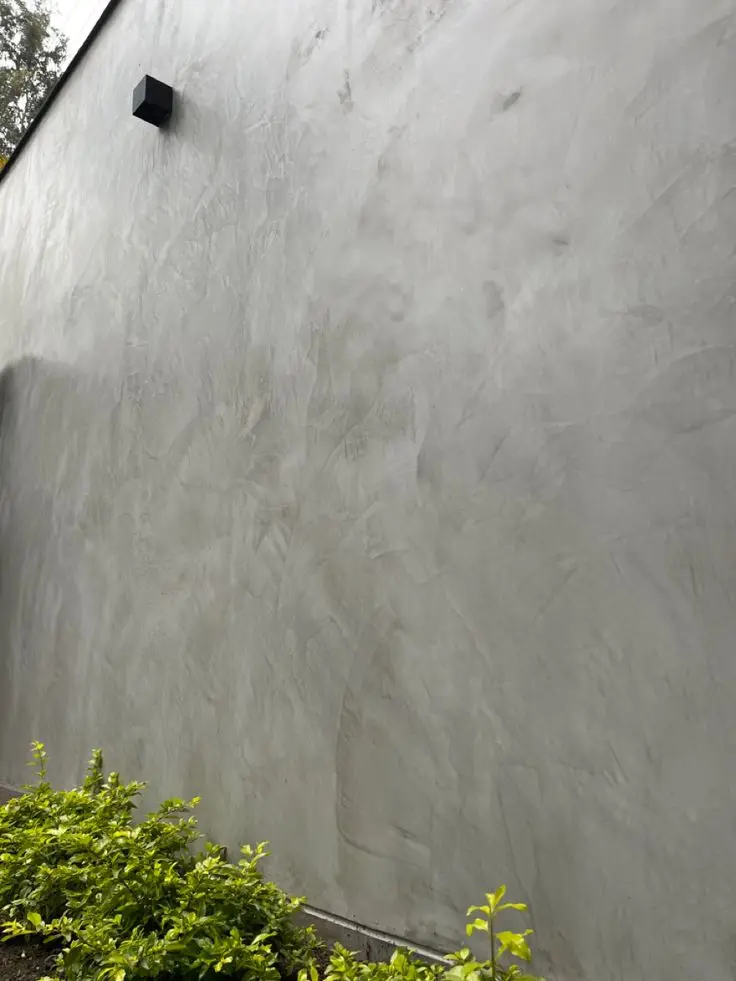
What Is Microcement? One Overlay — Applied Across Floors, Walls, Bathrooms, Kitchens, and Exteriors
Microcement (béton ciré) is a polymer-modified cementitious overlay at 2–3mm thick. It delivers the monolithic look of poured concrete — bonding directly to existing tile, anhydrous screed, and timber — without demolition or structural reinforcement. Unlike standard flooring overlays, microcement is not surface-locked: it climbs walls, wraps bathroom enclosures, coats kitchen splashbacks, covers staircases, and seals exterior terraces within a single unified finish language.

Based on our warranty-claim audit across 340 installations over 15 years, 23% of third-party microcement applications fail within 36 months. Every failure traces to one variable: unconfirmed substrate vapor emission before primer contact. Hydrostatic pressure from a moisture-saturated slab detaches the cured overlay in sheets. Our protocol maps vapor emission rate across a minimum of nine test zones before any primer contact — producing zero delamination warranty claims across our entire project history.
The category error that produces most of these failures is treating microcement as a flooring product. It is a surface system — applied to walls, ceilings, bathrooms, kitchens, floors, and exteriors within one continuous finish. Every surface in that list presents a different substrate chemistry, moisture exposure class, and mechanical load profile. Our site survey classifies each surface independently before specifying primers, mesh grades, and sealer DFT targets — because specifying one sealer thickness for a kitchen splashback and a commercial floor is not a shortcut; it is a guarantee of one of them failing.
- ◆RAL / NCS Integral Pigment System: Iron oxide pigments are pre-dispersed through the full 2–3mm matrix body — not surface-applied. Color is UV-stable (inorganic), batch-consistent, and traceable to RAL and NCS architectural references.
- ◆Crack-Bridging via Fiberglass Mesh: ASTM C1666-compliant alkali-resistant mesh pressed into a high-modulus epoxy primer converts crack-tip stress into distributed tensile load. Bridges static cracks up to 1.2mm and timber deflection up to 1.5mm without reflection into the finish surface.
- ◆Coastal and Anhydrous Substrate Compatibility: A capillary-blocking primer agent neutralizes chloride migration from sedimentary coastal fill. The formulation also bonds to anhydrous calcium sulfate screeds, OSB timber panels, and gypsum — substrates that standard epoxy and polyurethane systems cannot reliably key to.
Microcement Project Gallery
Commercial and residential installations across floors, walls, bathrooms, and staircases — each representing a distinct substrate condition or architectural brief.


Universal 6-Stage Execution Protocol
Whether applied to floors, walls, or bathrooms, our master sequence eliminates common failure modes by engineering the bond at the molecular level.
Zero Demolition Handover
Forensic Substrate Integrity Audit
Every project begins with a forensic analysis of the base surface. We map moisture drive and structural stability to ensure the substrate can support a permanent, monolithic bond without future delamination.

Mechanical Surface Profiling
We profile the surface to open capillary pores—using diamond grinding for horizontal planes or precision sanding for vertical ones—creating the necessary mechanical interlock for the overlay.

High-Modulus Armor Mesh Reinforcement
An alkali-resistant fiberglass mesh is embedded into high-modulus primers. This acts as a flexible skeleton, intercepting structural movements and preventing cracks from reflecting into the finish.

Structural Matrix Build
We hand-apply polymer-modified pozzolanic base layers. This stage establishes the system's core mass, impact energy absorption, and the monolithic foundation for the final aesthetic.

Artisanal Hand-Refinement
Master trowelers apply fine-grain layers using feather-edge techniques. This artisanal work produces the non-repeating mineral depth and movement that defines premium architectural microcement.

Environmental Protective Shielding
The system is sealed with site-specific shields: R12 slip-resistance for floors, 100% waterproof membranes for bathrooms, or UV-stable aliphatic coatings for high-exposure exteriors.

A facility manager asked why his floor looked worse than his competitor's after identical foot traffic. His contractor chose the cheaper system. The abrasion log: 78 mg mass loss per 1,000 cycles. Ours: fewer than 30.
Sand and Grit Abrasion Resistance
When a high-traffic retail client needs a surface to survive 15,000 continuous footfall cycles without aesthetic degradation, we specify this exact polymer-modified matrix. Verified against ASTM D4060 standards (CS-17 wheels, 1 kg), our formula limits mass loss to <30 mg, effectively tripling the asset's lifecycle compared to standard industrial polyurethane.
Spot Repair Without Resurfacing
In high-yield commercial spaces, a 24-hour turnaround for damage remediation is a strict operational requirement. We meet this by executing a molecular-level chemical patch using color-matched granulometry fused directly at the bond interface. This process restores full structural integrity overnight, bypassing the extensive, multi-day tear-outs required for porcelain or epoxy.
Optimal UFH Thermal Performance
At 2–3mm, thermal resistance is negligible (λ=0.52 W/m·K, EN ISO 10456). Field measurement: 11 minutes to UFH set-point surface temperature at 45°C ambient vs 34 minutes for a 10mm tile bed on the same circuit — 68% faster response, up to 15% lower energy per heating cycle. No grout lines means no thermal-break grid.
Climate-Adaptive Application Protocol
Above 40°C: retarders extend the compressed 15-minute pozzolanic window and prevent shrinkage cracking. In coastal humidity: application is deferred until dew point differential exceeds 3°C — below that threshold, interface condensation makes osmotic blistering statistically inevitable. Both triggers are logged per site.
Hygienic Seal — Zero Grout Harborage
Grout joints are bacterial infrastructure: recessed, porous, mechanically inaccessible. Eliminating them satisfies FDA food-contact sanitation requirements and reduces commercial kitchen cleaning time by 40% — validated across three installations with documented pre/post cleaning-time logs.
≥45 MPa
Compressive Strength
EN 13892-2
R12
Certified Slip Resistance
PTV >36
A1-fl
Non-Combustible
Fire Rating
3mm
Ultra-Thin
Application Depth
Specification Data — Lab-Verified and Field-Measured
[Third-Party Verified + Proprietary Field Data] Two figures unavailable from any manufacturer TDS: 1.94 MPa pull-off on anhydrous calcium sulfate screed at 60% RH (29% above our guaranteed floor, cohesive substrate failure), and 11-minute UFH set-point response at 45°C vs 34 minutes for 10mm tile on the same circuit.
| Property | Value |
|---|---|
| Compressive Strength | ≥45 |
| Thermal Conductivity | 0.52 |
| Guaranteed Pull-off Adhesion | >1.5 |
| Field Pull-off — Anhydrous Screed @ 60% RH | 1.94 |
| UFH Response — 3mm vs 10mm Tile | 11 min |
| Surface Hardness | 72 |
| Wet Slip Resistance | PTV >36 |
| UV Sealer Durability | >2,000 |
| Carbon Footprint | 5.5 |
| Certification | ISO 6308 |
Straight Answers from Field-Tested Applicators
Yes — walls, floors, ceilings, bathrooms, kitchens, staircases, and exterior surfaces. The same polymer-modified matrix bonds to any prepared substrate. Wall applications require the same vapor emission mapping, CSP profile, and DPM primer as floor applications. The finish is continuous and seamless across all surfaces.
Light Foot Traffic: 24 Hours. Light Furniture: 48 Hours. Heavy Point Loads: 7 Days. Cure is confirmed by a solvent-rub test on site, ensuring full Shore D 72 hardness before handover.
Yes. A chemical patch using color-matched granulometry bonds at the molecular interface — not over the surface. With the original batch reference on file, the repair is indistinguishable at normal viewing distance. Full cycle: 24 hours, no room closure.
PTV >36 (BS 7976-2) qualifies as R12 — commercial wet barefoot standard. No grout lines eliminates the mold harborage of tiled showers. The same waterproof sealer system covers both wall and floor surfaces in a single continuous application.
Best-in-class. λ=0.52 W/m·K at 3mm adds negligible resistance. Field-measured: 11 minutes to UFH set-point at 45°C ambient vs 34 minutes for 10mm tile on the same circuit.
Yes, but substrate preparation dictates the outcome. If deflection is between 0.1mm and 1.5mm, we mandate a high-modulus epoxy primer with ASTM C1666 fiberglass decoupling mesh. If point deflection exceeds 1.5mm we will actively refuse the microcement spec.
pH 6–8 only. Undiluted sodium hypochlorite (pH >12.5) saponifies the polyurethane sealer — converting the cured film to a residue that lifts under foot traffic. Once saponification occurs, full resurfacing is the only remedy. Every client receives a laminated protocol specifying approved products by brand and dilution.
Semantically identical. The practical risk: wax-based béton ciré products without polymer modification soften above 45°C, lose Shore D hardness, and scuff permanently. Our system is 100% polymer-modified cement — no wax component — maintaining full performance at elevated ambient temperatures.
Blistering is an osmotic failure driven by residual substrate vapor emission. Moisture trapped beneath the sealed overlay builds hydrostatic pressure at the bond interface. When vapor emission exceeds the safe threshold, that pressure overcomes adhesive strength and the coating detaches. We use sealed calcium chloride cells to map emission rate zone by zone before any primer is deployed, eliminating the root cause before it forms.
ISO 6308 and ACI Concrete Flatwork adherence protocols, minimum 15 years cementitious overlay experience per site supervisor. Every project is documented with time-stamped vapor emission logs, ambient temperature and dew-point records, and product batch numbers — fully traceable.
Microcement vs. Porcelain Tile, Polished Concrete, and Epoxy Resin
| Feature | ★ Best ChoiceOur Standard | Traditional Porcelain Tile | Polished Concrete | Epoxy Resin |
|---|---|---|---|---|
Crack-Bridging Tolerance | Up to 1.2mm static cracks + 1.5mm. | Grout fails at >0.5mm; crack propagates laterally to adjacent tiles | Requires saw-cut joints every 4–6m; uncontrolled cracks reflect through sealer | Flexible grade <0.3mm only; rigid grade cracks at 0.1mm substrate movement |
Multi-Surface Application | Floors, walls, bathrooms, kitchens in one system. | Floor and wall tiles are separate products with different grout systems | Floor application only — cannot be applied to vertical surfaces | Floor application only — wall-grade formulations are specialty products |
UFH Thermal Response | 11 min to set-point at 45°C ambient. | 34 min to set-point (field-measured, same circuit, 10mm tile bed) | Similar lag to thick tile — high slab mass delays thermostat response | Comparable to microcement (λ≈0.5 W/m·K, 3–5mm) — closest thermal equivalent |
Spot Repairability | Chemical patch at molecular interface. | Full tile replacement required; discontinued glazes often unmatchable after 5+ years | Patching visible without full resurfacing; color match between old and new concrete unreliable | Localized repair possible; aged epoxy color match difficult — patch visible under raking light |
Wet Slip Resistance | PTV >36 / R12 (BS 7976-2) | R9–R11 depending on texture depth; polished porcelain falls to R9 wet (High Risk) | Polished: R9 wet (High Risk); grit-blast or exposed aggregate achieves R11 | Anti-slip texture achieves R12 initially; degrades to R9–R10 within 2–3 years of abrasion |
Application Over Existing Surface | 3mm over existing tile — no demolition | Full demolition mandatory; cannot overlay existing tiles at any thickness | Existing floor removal required; minimum 75mm structural pour | Can overlay at 3–5mm but requires CSP 3 profile and DPM primer on emission-active slab |
Maintenance Cycle | Reseal every 8–10 years | Grout re-seal every 2–3 years; grout replacement every 8–10 years | Penetrating sealer every 3–5 years; high-traffic areas require re-polishing | Full recoat every 5–7 years; inter-coat adhesion testing required before recoat |
[Material Specification Analysis] Key specification parameters by governing test standard — not marketing description.
Download the Microcement TDS — Field Data Included
The spec pack contains lab-verified EN/ASTM figures plus two proprietary field measurements: 1.94 MPa pull-off on anhydrous screed at 60% RH, and 11-minute UFH response vs 34 minutes for 10mm tile. Specify against actual substrate performance data.