Epoxy Resin vs. Alternative Industrial Systems
| Feature | ★ Best ChoiceOur Standard | Polished Concrete | Polyurethane (PU) | Methyl Methacrylate (MMA) | Vinyl / VCT Tile |
|---|---|---|---|---|---|
Chemical Resilience | pH 1-14 continuous immersion (Novolac grade) (ours) | pH <5 etches unprotected matrix (ASTM C642 absorption 4–8%) | pH 2–11 continuous resistance; Skydrol contact causes topcoat swelling within 72 hrs | pH 3-11; highly vulnerable to pure solvents and ketones | Adhesive liquefies under aggressive solvents; tiles warp |
Impact Hardness | Shore D 85 (ASTM D2240) (ours) | Mohs 6-8 (Requires periodic silicate densification) | Shore D 60-75 (Yields under sustained heavy point loads) | Shore D 70-80 (Prone to gouging from dropped tools) | Indents permanently at 150 psi static load |
Seamless Hygiene | Monolithic pour; zero joints (ours) | Saw cuts harbor biosludge every 4–6m | Seamless but prone to outgassing pinholes if unprimed | Seamless, but distinct odor limits operational retrofits | Heat-welded seams trap bacterial colonies |
Light Reflectance (LRV) | LRV 85% (per ASTM E1477) (ours) | LRV 30-40% depending on aggregate exposure | LRV 60-70% with standard matte topcoats | LRV 50-65% (tends to amber, reducing reflectance) | LRV 10-50% (rapid dulling without daily burnishing) |
An empirical evaluation benchmarking chemical resistance, physical hardness, and long-term facility maintenance metrics using standardized test protocols.
≥60 MPa
Compressive Strength
ASTM D695
≥40 MPa
Flexural Strength
ASTM C580
0.1%
Max Water Absorption
ASTM D570
pH 1-14
Chemical Resistance
Novolac
Shore D 85
Impact Hardness
Quantitative Laboratory & Field Benchmarks
[0.4% Verified Warranty Activation Rate] Standardized ASTM and CEN performance benchmarks combined with proprietary, site-logged field data governed via strict NACE CIP Level 3 inspection protocols. This dual-verification approach provides absolute proof of performance in active industrial environments.
| Property | Value |
|---|---|
| Compressive Strength | ≥60 MPa |
| Flexural Strength | ≥40 MPa |
| Tensile Bond Strength | >2.5 |
| CTE (Filled Mortar Grade) | 11-13 |
| Impact Resistance | 160 in-lbs Pass |
| Proprietary Data: MVER Suppression | 14.2 to 0.4 |
| Proprietary Data: ATP Swab 90-Day Avg | <8 RLU |
| Static Crack Bridging | Up to 1.5mm |
Industrial Failure Diagnostics & Engineered Resolutions
Diagnostic Profile 01: Thermodynamic Shear (CIP Washdowns)
The Failure Mode: Raw epoxy expands violently under heat (CTE ≈ 50 µm/m·°C). During boiling Clean-In-Place (CIP) washdowns, this thermal expansion mismatch causes massive shear stress against the rigid concrete, popping the coating off in sheets.
The Engineered Resolution: We actively suppress the CTE to 11–13 µm/m·°C by densely loading the Novolac matrix with calcined crystalline aggregate. This engineered thermal mass perfectly mirrors the host slab's dimensional stability, permanently eliminating thermal shear delamination.
Diagnostic Profile 02: Molecular Chain Scission & Yellowing
The Failure Mode: Standard Bisphenol-A (BPA) resins rely on sacrificial topcoats. Under hard-wheeled traffic and intense UV exposure, these topcoats wear away, exposing the aromatic rings in the BPA backbone to photo-oxidative yellowing and severe caustic etching.
The Engineered Resolution: We substitute the backbone entirely with highly cross-linked Bisphenol-F Novolac. By integrating hindered amine light stabilizers (HALS) directly into the core resin structure, the system maintains absolute pH 1-14 immersion survival without requiring a separate, vulnerable wear layer.
Diagnostic Profile 03: Subterranean Biosludge Harborage
The Failure Mode: Operating as a subterranean sponge, unprotected concrete absorbs organic matter and moisture, fostering immense microbial colonies that standard facility sanitation cannot reach, directly violating ISO 22000 mandates.
The Engineered Resolution: Our monolithic pour drives water absorption down to <0.1% (ASTM D570), completely severing biological access to the slab interior. Continuous ATP swab testing demonstrates a plunge from 300+ RLU on raw concrete to a verified <8 RLU post-cure, effortlessly clearing FDA and GMP cleanroom thresholds.
Diagnostic Profile 04: OPEX Hemorrhage via Sacrificial Cycles
The Failure Mode: Facilities evaluating capital expenditure frequently ignore the OPEX tail. Commercial VCT and lower-tier urethanes mandate a rigorous 7-year strip, wax, and replacement cycle, inflating the annualized maintenance burden to $4.70/m².
The Engineered Resolution: Our high-crosslink resin systems require zero waxing or chemical stripping, tracking an annualized maintenance cost of just $1.95/m². This difference compounds across large facilities — a 5,000m² plant floor saves $13,750 per year in avoided maintenance labor, reaching full capital cost recovery within the third operational year.
Conditional Logic Application Protocols
Field Scenario: A 5,000m² manufacturing slab presents mixed Moisture Vapor Emission Rates and active control joints. Governed by strict NACE CIP Level 3 inspection protocols, our deployment teams execute a dynamic conditional logic matrix — adjusting chemistry and mechanical preparation based on real-time diagnostic telemetry.
Multi-Staged Epoxy Installation
Phase 1: Core Diagnostic Decision Tree
We measure the slab's internal physics before specifying the chemistry.
IF Calcium Chloride testing (ASTM F1869) reads >3 lbs MVER ➔ THEN* deploy a 15-lb capacity MVT suppression primer.
IF carbonation depth exceeds 15mm ➔ THEN* mandate mechanical densification before coating.
IF core tensile strength is <1.5 MPa ➔ THEN* reject standard build; inject low-viscosity consolidation resins.

Phase 2: Planetary Profiling Matrix
Mechanical preparation adapts directly to the host slab's current porosity and damage profile.
IF surface is power-troweled (CSP 1) ➔ THEN* utilize planetary diamond grinders to acquire an ICRI CSP 3-4 mechanical key.
IF dynamic control joints are present ➔ THEN* route out, install polyurea elastomeric filler, and integrate diamond dowel load plates to prevent future edge spalling.

Phase 3: Thermodynamic Climate Gates
Installation proceeds exclusively when continuous micro-climate sensors output passing metrics.
IF ambient RH exceeds 85% ➔ THEN* immediately halt application to prevent amine blush.
IF substrate temperature drops below 3°C above the ambient dew point ➔ THEN* deploy industrial dehumidification and indirect fired heaters until the thermodynamic delta is secured.

Phase 4: Stoichiometric Polymerization
Technical build layers and Novolac topcoats are metered strictly via automated systems.
IF the mixed batch exceeds 100 liters ➔ THEN* monitor exothermic mass closely to prevent flash curing in the bucket.
IF ambient temperature > 35°C ➔ THEN* alter hardener kinetics to extend the functional pot life, ensuring a flawless self-leveling finish without roller marks.

Phase 5: Performance Verification
Facility handover is contingent on passing final localized destructive and non-destructive testing.
IF cross-hatch adhesion (ASTM D3359) fails to achieve a 5A rating ➔ THEN* isolate and mechanically extract the compromised grid.
IF static dissipation is specified ➔ THEN* probe the matrix with megohmmeters to verify the strict 10⁶–10⁹ Ω range per ANSI/ESD S20.20.

Engineering Tolerances & Chemical Boundaries
Standard epoxy is a powerful insulator, generating massive triboelectric charges when forklifts drive over it. To achieve ANSI/ESD S20.20 compliance, we suspend conductive carbon nanoparticles or tin-antimony oxides within the primer and topcoat. We then ground the entire floor system directly to the facility's electrical earth busbar using embedded copper tape grids, ensuring charges drain at a controlled 10⁶–10⁹ Ω rate.
Rapidly fluctuating from ambient 20°C to an 85°C high-pressure steam wash causes immense thermal shock. Standard 2K epoxy will physically tear away from the concrete. We solve this by deploying urethane cement core builds or heavily aggregate-loaded Novolac systems that flex synchronously with the concrete slab, surviving continuous ΔT shifts without delamination.
We never 'feather-edge' a transition; it will inevitably chip under forklift tires. Instead, we perform a 'keyway cut' — sawing a 6mm x 6mm trench into the concrete exactly at the transition line. The liquid resin flows into this trench, creating an anchored, flush mechanical lock that transfers heavy wheel loads seamlessly.
Our 100% solid, zero-VOC formulations cure through pure chemical cross-linking rather than solvent evaporation. Laboratory testing per ISO 11890-2 confirms outgassing levels are mathematically negligible (<10 g/L), guaranteeing zero interference with sensitive semiconductor lithography or pharmaceutical compounding.
Yes. Skydrol notoriously strips standard polyurethanes and BPA epoxies to the bare concrete within days. Bisphenol-F Novolac resins possess a tightly knit molecular cross-link density that entirely repels phosphate esters, making them the default specification for aerospace hangars.
Epoxy is highly rigid (Shore D 85). If the host slab violently cracks due to seismic shifting or severe settlement, the resin will crack with it. To mitigate this in highly active facilities, we can insert an elastomeric polyurea membrane layer between the primer and the hard topcoat, allowing up to 1.5mm of lateral concrete movement without surface transmission.
We do not rely on estimated hours. Cure kinetics are verified on-site using a solvent-rub test (MEK) to check for cross-link integrity, followed by a Barcol or Shore D durometer reading. The facility is not cleared for heavy machinery until the durometer registers a consistent, mathematically verified 85 rating across the entire square footage.
Epoxy System Deployments: Industrial & Commercial Evidence
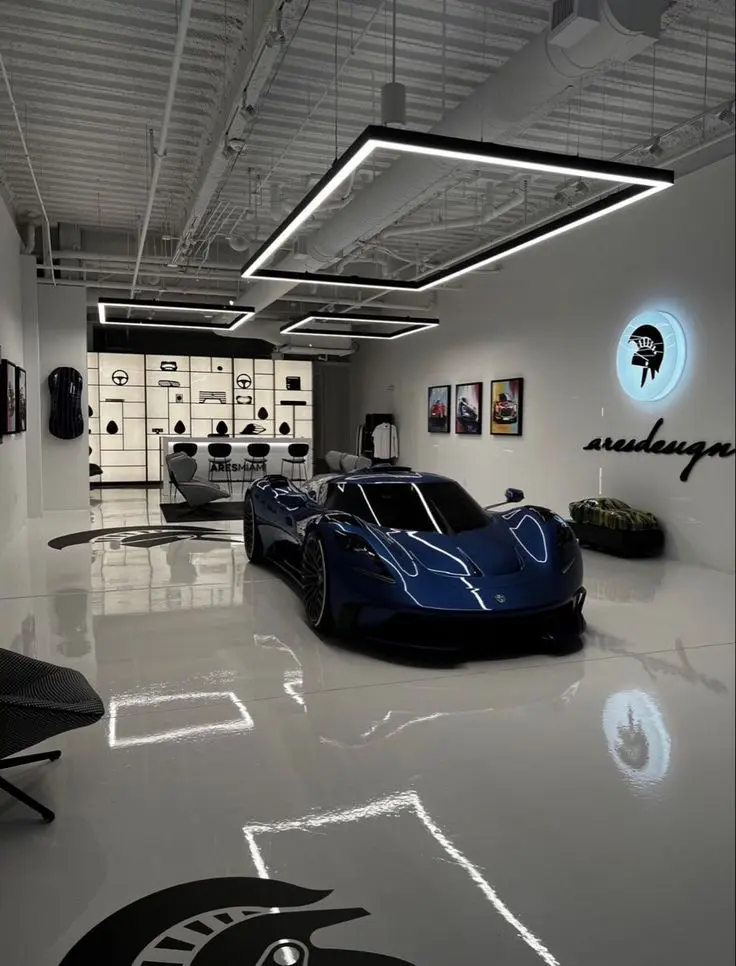
[Field Deployments] Documented site installations across demanding industrial, cleanroom, and commercial environments. Note the surface reflectivity and seamless integration around heavy machinery footings.


Load Transfer and Thermodynamic Stability in Polymer Matrixes
The primary failure mode of warehouse resins is rarely chemical breakdown; it is mechanical shear failure at the bond line. This occurs due to unmatched Coefficients of Thermal Expansion (CTE) and inadequate dynamic load transfer across control joints. By treating the resin overlay as a structural extension of the concrete rather than a surface aesthetic, our NACE-compliant engineering teams fundamentally re-engineer the slab's load-bearing capacity.

This engineering process involves calculating dynamic forklift shear, isolating subterranean hydrostatic pressure, and chemically welding a Bisphenol-F matrix deep into the open capillaries of the host concrete. The result is a monolithic armor capable of sustaining continuous heavy industrial operations, thermal shocks, and chemical immersion without delamination.
- ◆Capillary Covalent Welding: Deep-penetrating, low-viscosity primers do not just sit on top of the concrete; they wick deep into the substrate's interstitial voids, curing to form physical roots that lock the entire system to the host slab.
- ◆Dynamic Shear Dispersion: Point loads from 5-ton forklifts transfer massive shear stress directly to the floor. The Shore D 85 hardness of the resin spreads this localized force over a wider geometric area, preventing the underlying concrete from crushing.
- ◆Exothermic Curing Kinetics: The 100% solid matrix cures via an exothermic chemical reaction. Because no water or solvent leaves the system during this process, the wet-film thickness exactly matches the dry-film thickness, avoiding the microscopic shrinkage inherent in lower-grade paints.
- ◆Stoichiometric Mix Precision: We ensure precise molecular balance between Part A (resin) and Part B (hardener) to achieve absolute 100% polymer curing, leaving zero unreacted material that could soften the final finish.
- ◆Advanced Moisture Mitigation: Utilizing dense MVT primers, we isolate the upper resin from alkaline moisture drives up to 15 lbs/1000 sq ft, entirely arresting capillary-rise chloride attacks in challenging geographical zones.
- ◆End-of-Life Circularity & LEED v4.1: Our resin systems feature documented end-of-life protocols. Upon future facility decommissioning, the inert epoxy matrix can be mechanically granulated and repurposed as structural filler for aggregate sub-bases.
Access the Engineering Data & Lifecycle Models
Bypass generic estimates. Download our verified specification sheets and request a Lifecycle Cost Analysis (LCCA) comparing the 20-year financial impact of our Novolac resin systems directly against your current flooring OPEX liabilities.
