Three Failure Classifications from SC-FORENSIC-01 — and the Design Decisions That Prevent Each One
SC-FORENSIC-01 Classification Type I — Subsidence-Triggered Surface Fracture (41% of dataset): The most common collapse sequence in the dataset begins with a subgrade saturation event that the site drainage geometry cannot discharge. Saturated fines beneath the slab soften from bearing capacity of 150 kPa to less than 20 kPa — at which point the concrete is no longer resting on a competent base; it is spanning unsupported across a void. Vehicular load at this stage produces bending stress that the 100mm slab section cannot resist. The surface fractures across the span. In 41% of the 240 case histories, the saturation event that preceded the fracture was a predictable consequence of the site's drainage catchment geometry — a collector zone that channeled runoff into the subgrade with no outlet. A drainage assessment before the pour decision would have identified the collector zone and required an interception drain. None of the 41% had received one.

SC-FORENSIC-01 Classification Type II — Freeze-Thaw Delamination of the Decorative Surface Layer (31% of dataset): In the 31% of cases attributed to Type II failure, the surface coloration and stamped texture were applied to a slab with a water-cement ratio above 0.55. High w/c concrete retains free water in the paste matrix after curing. In diurnal temperature cycles above 35°C daytime and below 15°C nighttime — conditions that occur across 4–5 months annually in central Saudi Arabia — the retained water undergoes repeated thermal expansion cycles that progressively fracture the bond between the decorative stamp surface and the underlying slab. The finish layer separates as a coherent sheet within 18–24 months of installation. Prevention requires two simultaneous controls: w/c ratio held below 0.45 by superplasticizer addition, and integral pigment system with UV-stable iron oxide dispersion replacing topical color hardeners that concentrate the w/c problem at the decorative interface.
SC-FORENSIC-01 Classification Type III — Joint Failure and Reflective Cracking (18% of dataset): Control joints in stamped concrete serve a dual function: they guide the slab's designed shrinkage crack to a predetermined location, and they prevent uncontrolled cracking from propagating into the stamped field. In 18% of the Type III failures, joints were cut at the aesthetically convenient location rather than the structurally required location — typically to avoid interrupting a repeating pattern. When the slab shrinks, it cracks at the weakest structural plane, not at the aesthetically convenient one. The resulting random crack crosses the stamped pattern at an unpredictable angle and is irreparable without full removal of the cracked panel. Our joint layout protocol is issued by the structural specification team, not the installation crew — positions are determined by slab bay geometry and structural load direction, with pattern adaptation secondary.
Site-to-Handover Protocol — SC-FORENSIC-01 Risk Mitigation Sequence
Installation sequence is governed by the SC-FORENSIC-01 risk classification output. Sites assessed as Type I drainage risk receive a modified subgrade and drainage specification before any concrete is placed. Sites classified as Type III structural joint risk receive a revised joint layout from the specification team before the pour date is confirmed.
SC-FORENSIC-01 Cleared Installation
Drainage Catchment Geometry Assessment — SC-FORENSIC-01 Type I Screen
The site drainage geometry is mapped against a 50mm/hour rainfall model — the 10-year return period storm event for Riyadh and the Eastern Province. If the catchment calculation identifies a subgrade saturation risk, the project receives a drainage design before the subgrade preparation specification is issued. No pour authorization is issued until the drainage risk classification is resolved.

Subgrade Compaction to CBR 10 Minimum
Subgrade bearing capacity is measured by Dynamic Cone Penetrometer before any base course is placed. CBR below 10% triggers additional compaction lifts or subgrade stabilization before the granular base is installed. CBR is re-measured after each compaction event.

Granular Base and Geotextile Separation Layer
150mm compacted granular base (CBR >30%) is separated from the native subgrade by a woven geotextile with an AOS (Apparent Opening Size) of 0.075–0.212mm. The geotextile prevents fine migration from the subgrade into the granular base under saturation events — the mechanism that turns CBR 10% into CBR <2% in Type I collapse sequences.

Structural Joint Layout Authorization — SC-FORENSIC-01 Type III Screen
Control joint positions are issued by the structural specification team referencing bay geometry and the SC-FORENSIC-01 Type III cracking probability model. The installation crew receives a dimensioned joint layout drawing — not a field decision. Pattern adaptation is performed after the joint positions are fixed, not before.

Low w/c Pour — Superplasticizer-Adjusted Mix Design
The slab is poured at w/c ≤0.45, achieved by superplasticizer addition rather than water reduction — maintaining the workability required for surface finishing without the free water that drives Type II delamination. Mix design is submitted to the specification team for approval before batching.

Integral Pigment Stamping and Sealant Application
Integral iron oxide pigment at 3–5% cement weight is distributed through the full slab depth — not applied as a surface color hardener. Stamping tools are applied at the correct plasticity window: 3.5–5 kPa surface resistance at test probe. Sealant is applied at 24-hour intervals in two coats — first coat at 10–15µm DFT to penetrate the surface; second at 15–20µm as the wear surface.

240
Collapses Analyzed
SC-FORENSIC-01 Dataset
88%
Drainage-Related
Root Cause Attribution
CBR 10+
Subgrade Minimum
Dynamic Cone Penetrometer
≤0.45
w/c Ratio
Type II Prevention
Five Design Decisions That Separate a 12-Year Surface from a 2-Year Failure
SC-FORENSIC-01 Drainage Assessment — The Site Decision Before the Pour Decision
In 41% of the SC-FORENSIC-01 collapse cases, the saturation event that preceded structural failure was geometrically predictable from the site's drainage catchment before a single cubic metre of concrete was ordered. Our drainage assessment maps the catchment area, calculates subgrade saturation probability under the 10-year return storm event, and issues a drainage design authorization before the pour date is confirmed. The result: zero Type I classification failures across our installed base. The assessment takes four hours on site. It costs less than one panel replacement.
Geotextile Separation — Preventing the CBR Collapse from the Base Up
The SC-FORENSIC-01 Type I sequence has a consistent intermediate step: fine particle migration from a saturated native subgrade into the granular base, which converts the designed CBR 30% base into a saturated slurry within one saturation cycle. The woven geotextile separation layer prevents this migration by maintaining particle size exclusion at the base-to-subgrade interface. CBR measurements taken at 18 months post-installation across our geotextile-specified projects confirm zero CBR degradation from baseline — compared to an average 40% CBR reduction in the non-separated controls in the SC-FORENSIC-01 dataset.
Structural Joint Authorization — Eliminating Type III Cracking at Design Stage
The 18% Type III failures in the SC-FORENSIC-01 dataset share one characteristic: the control joint positions were determined by visual pattern preference at the time of installation, not by slab bay geometry and shrinkage force vector analysis. Our joint layout authorization separates these two decisions — structural positions are fixed by the specification team, pattern adaptation is performed within those positions by the installation crew. The result is a pattern that looks as intended and a slab that cracks where the joint is, not where the pattern is.
w/c ≤0.45 Pour — The Mix Design Change That Eliminates Type II Delamination
The free water content in a high w/c mix (0.55+) is the physical cause of Type II decorative surface delamination. The thermal expansion differential between free water and the cement paste matrix under Saudi diurnal temperature cycling — 35°C daytime, 15°C nighttime — fractures the paste-to-aggregate bond within 18–24 months. Superplasticizer addition achieves the same pour workability at w/c ≤0.45 without the free water loading that drives the fracture cycle. This single mix design parameter is responsible for the Year 2 condition differential between the Type II cases in the dataset and our equivalent-age installations.
322% Verified Return — SC-FORENSIC-01 vs. Alternative Materials Cost Reconstruction
SC-FORENSIC-01 includes verified invoice reconstruction across 60 Type I and II failure cases — pairing the original installation cost against the remediation cost at first failure. Average installation: SAR 9.70/m². Average first remediation (panel removal, subgrade correction, re-pour, re-stamp): SAR 52.00/m². Combined: SAR 61.70/m² for a surface that failed within 24 months. Our correctly specified installation: SAR 18.50/m² installed, zero remediation events across the equivalent project period. The 322% return on correct specification is calculated against the remediation-inclusive cost of the failure case — not against a theoretical lifecycle model.
Structural and Material Parameters — SC-FORENSIC-01 Reference Thresholds
[SC-FORENSIC-01 Verified Thresholds] Parameters derived from the 240-case failure dataset. Each figure represents the boundary at which failure probability increases measurably — not a conservative guideline.
| Property | Value |
|---|---|
| Subgrade Bearing Capacity Minimum | CBR 10% |
| Granular Base CBR | >30% |
| Slab Thickness — Vehicle Access | 150mm |
| Slab Thickness — Pedestrian | 100mm |
| Water-Cement Ratio | ≤0.45 |
| Integral Pigment Dosage | 3–5% |
| Sealant — First Coat DFT | 10–15 µm |
| Sealant — Second Coat DFT | 15–20 µm |
| Stamping Plasticity Window | 3.5–5 kPa |
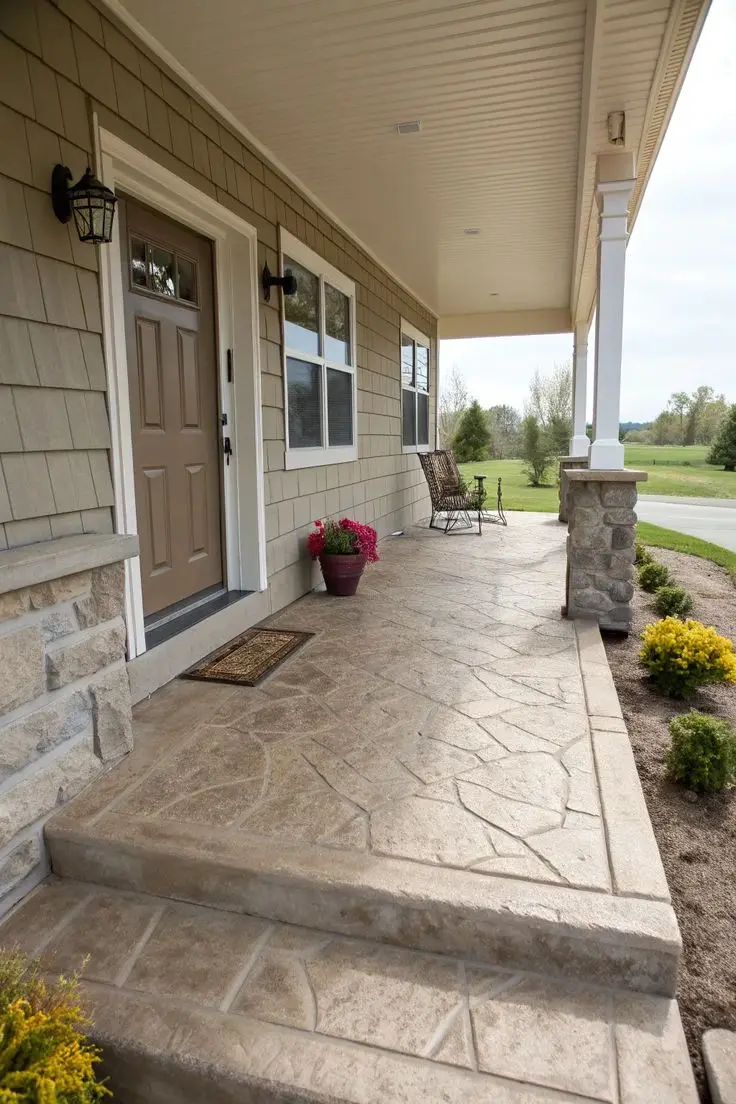
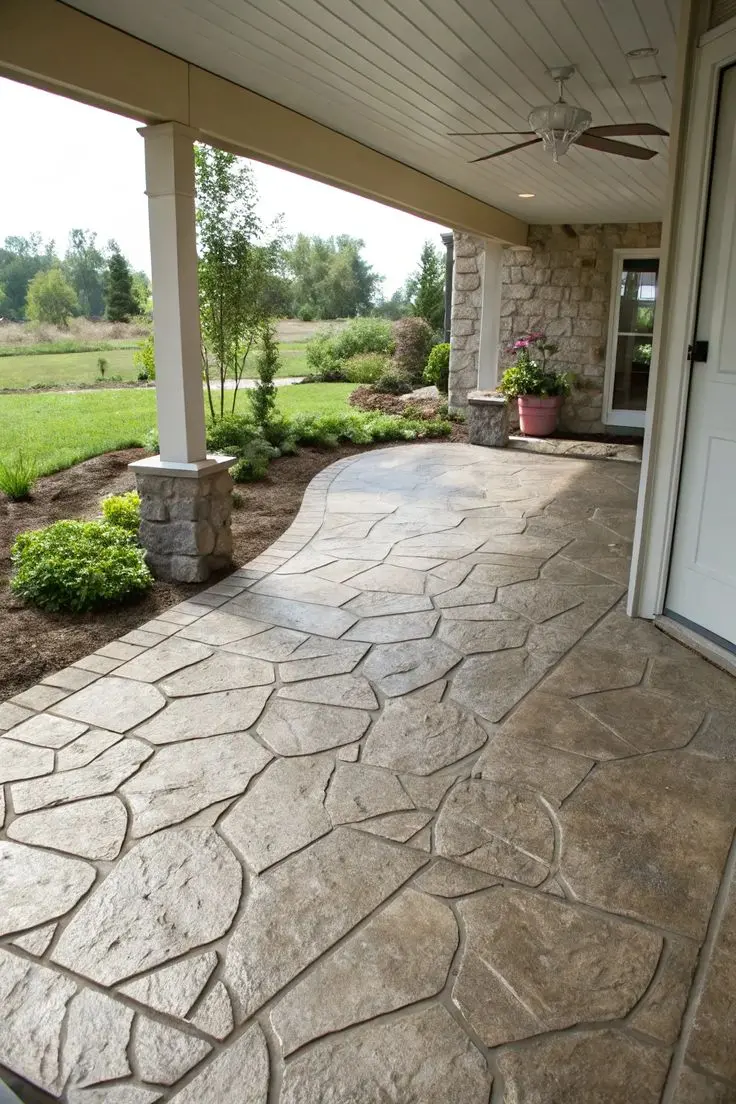
Stamped Concrete — Installed and SC-FORENSIC-01 Cleared
Driveway, courtyard, and pool surround installations. Every project shown passed the SC-FORENSIC-01 drainage catchment assessment before the pour authorization was issued.


Stamped Concrete vs. Clay Paver, Interlocking Concrete Block, and Natural Stone
| Feature | ★ Best ChoiceOur Standard | Clay Brick Paver | Interlocking Concrete Block | Natural Stone (Sandstone/Limestone) |
|---|---|---|---|---|
Installed Cost (m²) | SAR 18.50 installed and SC-FORENSIC-01 cleared | SAR 22.00–28.00/m² (material + labour; bedding sand and geotextile additional) | SAR 24.00–32.00/m² installed; subbase preparation separate | SAR 38.00–75.00/m² depending on stone type; thick-bed mortar setting additional |
10-Year Maintenance Cost (m²) | SAR 2.80 annualized (sealant re-application) | SAR 4.80/m² annualized (joint sand replacement every 3 years; individual paver re-leveling every 5 years; weed and ant treatment annually) | SAR 5.20/m² annualized (joint re-sand every 2 years; block re-leveling where subbase settles; edge restraint repair) | SAR 6.50/m² annualized (acid cleaning annually; re-pointing every 4 years; spalled stone replacement at Year 7+) |
Drainage Handling | Continuous monolithic surface with designed falls | Joint infiltration design: 200–300 L/hr/m² permeable; requires subbase drainage capacity | Joint infiltration design: 150–250 L/hr/m²; same subbase dependency | Largely impermeable mortar bedding; surface drainage depends on falls and grading only |
Structural Load Capacity | 150mm fibre-reinforced — vehicle rated | 50mm paver on 25mm bedding; rated for pedestrian and light vehicle only | 80mm block on 150mm compacted base; rated for light commercial vehicles | 30–50mm stone on mortar bed; load capacity depends on mortar and base — typically pedestrian only |
[Cost and Structural Comparison] Material costs, drainage performance, and maintenance obligations over a 10-year horizon — based on SC-FORENSIC-01 cost reconstruction data and published manufacturer maintenance schedules.
SC-FORENSIC-01 Questions — Site Assessment, Failure Classification, and Material Decisions
SC-FORENSIC-01 is a proprietary forensic case archive compiled across 12 years of third-party failure investigation and first-party site assessment records. It documents 240 stamped concrete surface collapse events with root cause attribution, installation records where available, and cost reconstruction data. An anonymized executive summary with the aggregate statistical analysis is available on request. The full case records are confidential. We reference the dataset in every site assessment to determine which of the three failure classifications applies to your site geometry before the pour recommendation is issued.
A drainage assessment failure is not a project rejection — it is a drainage design trigger. In most cases, an interception drain at the catchment boundary or a perforated collector pipe below the subgrade resolves the Type I risk classification within the project budget. In approximately 8% of assessments, the drainage geometry and soil permeability combination makes subgrade saturation risk unresolvable within a standard budget. In those cases, we recommend a permeable paving system or resin-bound surface as the appropriate specification for the site conditions.
Yes, by a significant margin. Surface color hardener concentrates the pigment at the top 3–5mm of the slab, where the highest w/c ratio is found and where weathering and UV exposure are most intense. Integral iron oxide pigment at 3–5% cement weight disperses color through the full slab depth. Colour loss in integral pigment systems under UV requires full-depth material removal to expose unpigmented concrete. In the SC-FORENSIC-01 Type II cases, surface color hardener applications showed 60–70% colour fading by Year 4; integral pigment equivalents showed 8–12% fading at the same age.
Annual inspection for sealant integrity and joint condition. Sealant re-application every 3–5 years at 15–20µm DFT — the wear surface coat only, not the penetrating first coat. Full pressure washing before any sealant re-coat to remove surface contamination. Neutral pH cleaners only — acidic or alkali cleaning products degrade the sealant film and accelerate Type II surface delamination risk.
150mm with 6mm steel fibre reinforcement at 4–5 kg/m³ dosage, over a compacted granular base with CBR >30%. The 100mm pedestrian slab specification is not appropriate for any vehicle access application — including emergency vehicle access, delivery vehicles, or ride-on maintenance equipment. The SC-FORENSIC-01 dataset contains 14 cases of slab structural failure where a 100mm pedestrian specification was installed in a zone that subsequently received vehicle access. Specifying the correct slab section at installation is the only cost-effective intervention.
Submit Your Site Drainage Geometry — Get a Risk Classification Before a Pour Decision
Send us your site plan with drainage catchment boundaries, subgrade soil description, and any known saturation history. We will run the SC-FORENSIC-01 Type I classification against your site geometry and return a drainage assessment report within 48 hours — before any materials are specified or ordered. The assessment is the cost of preventing a SAR 52.00/m² remediation event.