SUDS Compliance Is a Drainage Calculation, Not a Material Claim
Sustainable Urban Drainage Systems (SUDS) planning requirements in the GCC construction framework — informed by BS EN 752 and the SuDS Manual (CIRIA C753) — do not accept a manufacturer's stated permeability figure as planning evidence. They require site-specific discharge records: a permeameter test on the installed surface demonstrating that the system's actual permeability matches or exceeds the design model. This distinction matters because permeability is not a fixed material property — it is a function of aggregate grading, void content, binder film thickness, and installation technique. The same aggregate type installed by two contractors at different binder-to-aggregate ratios can produce permeability values that differ by a factor of three. The SUDS compliance document we issue at handover contains the permeameter discharge records from the installed surface — not the manufacturer's TDS — because those are the values a planning authority can verify.

The aggregate specification governs both the drainage performance and the structural longevity of a resin-bound surface. BS EN 12620:2002+A1:2008 (Aggregates for Concrete) is the reference standard for aggregate quality in structural resin systems. It defines the Los Angeles abrasion value (≤25%), the Micro-Deval coefficient (≤15%), and the flakiness index (≤35) that separate an aggregate that bonds durably to an aliphatic epoxy matrix from one that fractures and debonds under traffic. Our aggregate selection is sourced from suppliers whose grading certificates confirm compliance with these parameters per consignment — not as a one-time qualification test. Eng. Faris Al-Sulaimi (BSc Civil & Environmental Engineering) reviews the aggregate certificate against the BS EN 12620 parameters for each project specification before the material order is placed.
The binder is the variable that the aggregate specification depends on. Polyurethane binders are the standard in the UK market and perform adequately in temperate climates. In the Saudi climate — ambient temperatures reaching 50°C in summer, with diurnal cycling of 20–25°C between day and night — a polyurethane binder at 45°C softens sufficiently under dark-coloured aggregate surface temperatures (which can reach 65°C in direct solar exposure) to allow aggregate displacement under vehicle tyres. The DCOF reading that measures 0.45+ at installation measures 0.30–0.35 at peak summer pavement temperature on a polyurethane binder — below the ANSI A326.3 commercial threshold of 0.42. Our 100% solid aliphatic binder maintains Shore D hardness above 75 throughout the Saudi temperature range — confirmed by a heat-cycle test protocol at 70°C sustained surface temperature, the standard we use to qualify binder suppliers for Saudi Arabian projects.
Verified Performance Parameters — Permeameter and Third-Party Records
[Third-Party Verified: Eng. Faris Al-Sulaimi, BSc Civil & Environmental Engineering] Drainage performance figures are permeameter measurements from installed surfaces — not manufacturer TDS values. DCOF and hardness figures are from third-party testing under Saudi temperature protocol.
| Property | Value |
|---|---|
| Permeability — Installed Surface (Permeameter) | 850 L/min/m² |
| System Void Ratio | 20% |
| DCOF — At Installation | 0.45+ |
| DCOF — At 70°C Surface Temperature (Saudi Protocol) | 0.43+ |
| Binder Shore D — At 70°C Sustained | >75 |
| Aggregate Abrasion — Los Angeles Value | ≤25% |
| Aggregate Micro-Deval Coefficient | ≤15% |
| Aggregate Flakiness Index | ≤35 |
| Binder Content by Weight | 7–9% |
| UV Stability — Aliphatic Binder | >2,500 hrs QUV-A |
Installation Protocol — Permeability-First Sequence
Installation sequence is organized around the permeability verification requirement. The final permeameter test is not the last step — it is the authorization gate before the client receives the SUDS compliance documentation.
SUDS Compliance Document Issued at Handover
Drainage Attenuation Calculation — Design Discharge vs. Rainfall Event
The SUDS drainage model for the site is completed before the specification is finalized. The design storm event (10-year return period, 50mm/hr) is modeled against the surface's designed permeability, the subbase void storage volume, and the discharge rate to the soakaway or outfall. If the calculation identifies an attenuation deficit, the subbase design is modified before installation proceeds.

Aggregate Certificate Review — BS EN 12620 Compliance Per Consignment
Each aggregate consignment is checked against its BS EN 12620 grading certificate before it is accepted on site. If the Los Angeles abrasion value exceeds 25%, the Micro-Deval coefficient exceeds 15%, or the flakiness index exceeds 35, the consignment is rejected. Certificate review is logged per project and forms part of the handover documentation.

Permeable Macadam Subbase Installation — 150mm Compacted
The permeable macadam subbase is installed at 150mm compacted depth, providing the void storage capacity that the attenuation model requires. Subbase void ratio is measured on a sample before compaction — typically 25–30% for properly graded open-graded macadam.

Binder Temperature Preparation — 20–25°C Working Range
The aliphatic resin is conditioned to 20–25°C before mixing. At Saudi ambient temperatures above 35°C, the binder is stored in shaded, air-conditioned conditions until immediately before application. Pot life at 20°C is 25 minutes; at 35°C ambient (shade) it compresses to 12 minutes. Application is organized in bays sized for completion within one pot life cycle.

Force-Action Mixing and Screed Application
Aggregate and binder are combined in a force-action mixer at the specified binder-to-aggregate ratio (7–9% by weight). The mix is screeded to 16–18mm compacted depth using a gauge bar on a smooth screed board — roller application is not used, as roller pressure compresses the void structure below the 20% design ratio.

Permeameter Verification — SUDS Compliance Discharge Record
After 24-hour cure, a falling head permeameter test (ASTM C1701) is conducted across a minimum of five test locations on the installed surface. Each test records the discharge rate in L/min/m². All five locations must meet or exceed 700 L/min/m² before the SUDS compliance document is issued. The test records are attached to the handover documentation as the planning authority evidence file.

850
L/min/m² Permeability
ASTM C1701
20%
System Void Ratio
Measured
0.45+
DCOF at Installation
ANSI A326.3
0.43+
DCOF at 70°C
Saudi Protocol
Permeable surfacing is specified in L/min/m², not in aggregate colour. Here are the four measured parameters that determine whether a resin-bound surface delivers SUDS compliance at Year 1 and at Year 10.
Parameter 01: 850 L/min/m² — Permeameter Discharge Rate at Handover
Verified by: ASTM C1701 falling head permeameter, 5 test locations per project. The 850 L/min/m² figure is the minimum discharge rate recorded across our installed project base — not the theoretical maximum for the aggregate type. It is produced by the combination of the 20% void ratio, the 7–9% binder content calibrated to coat each aggregate particle without filling the interparticle void space, and the screed-not-roller application technique. A roller-applied resin-bound surface at the same binder content can produce void ratios of 12–14% and discharge rates of 300–450 L/min/m² — below the threshold that a SUDS drainage model requires for a 50mm/hr design storm event.
Parameter 02: Shore D 75+ at 70°C — Binder Hardness Under Saudi Pavement Temperature
Verified by: ASTM D2240 heat-cycle test at 70°C sustained, 48 hours. Dark aggregate surfaces in direct Saudi solar exposure reach 60–70°C pavement temperature in July and August. A polyurethane binder at Shore D 60 (ambient) softens to Shore D 35–40 at 70°C — a state in which vehicle tyres can displace aggregate from the binder film, reducing DCOF and creating surface irregularity. Our aliphatic binder is qualified by a 48-hour 70°C heat-cycle test; the Shore D reading at end-of-cycle must exceed 75 before the binder is authorized for Saudi projects. This is a supplier qualification standard, not a product claim.
Parameter 03: DCOF 0.43+ at 70°C — Wet Slip Performance at Peak Summer Temperature
Verified by: ANSI A326.3 tribometer test under heat-cycle protocol. The DCOF 0.42 commercial threshold (ANSI A326.3) is measured at ambient temperature — typically 20–23°C. A polyurethane-binder resin system that measures DCOF 0.47 at ambient drops to 0.30–0.35 at 70°C surface temperature as the binder softens and the surface friction coefficient falls. Our Saudi heat-cycle protocol tests DCOF at 70°C surface temperature — because that is the operational condition, not a laboratory reference condition. The 0.43+ result confirms that the system remains above the commercial safety threshold through the full Saudi temperature range.
Parameter 04: BS EN 12620 Per-Consignment Certificate — Aggregate Quality Assurance
Verified by: Los Angeles abrasion value ≤25%, Micro-Deval ≤15%, Flakiness index ≤35 per BS EN 12620. The aggregate is 85–90% of the system by weight and 80% of its contact surface area. An aggregate that fractures under vehicle tyre abrasion (Los Angeles >25%) produces angular fines that migrate into the void structure and progressively reduce permeability over 18–24 months. An aggregate with high flakiness index (>35) has preferential fracture planes that produce the same outcome under compaction. Per-consignment certificate review — not a one-time qualification test — is the only way to maintain these parameters across a full project delivery where aggregate may come from multiple batches.
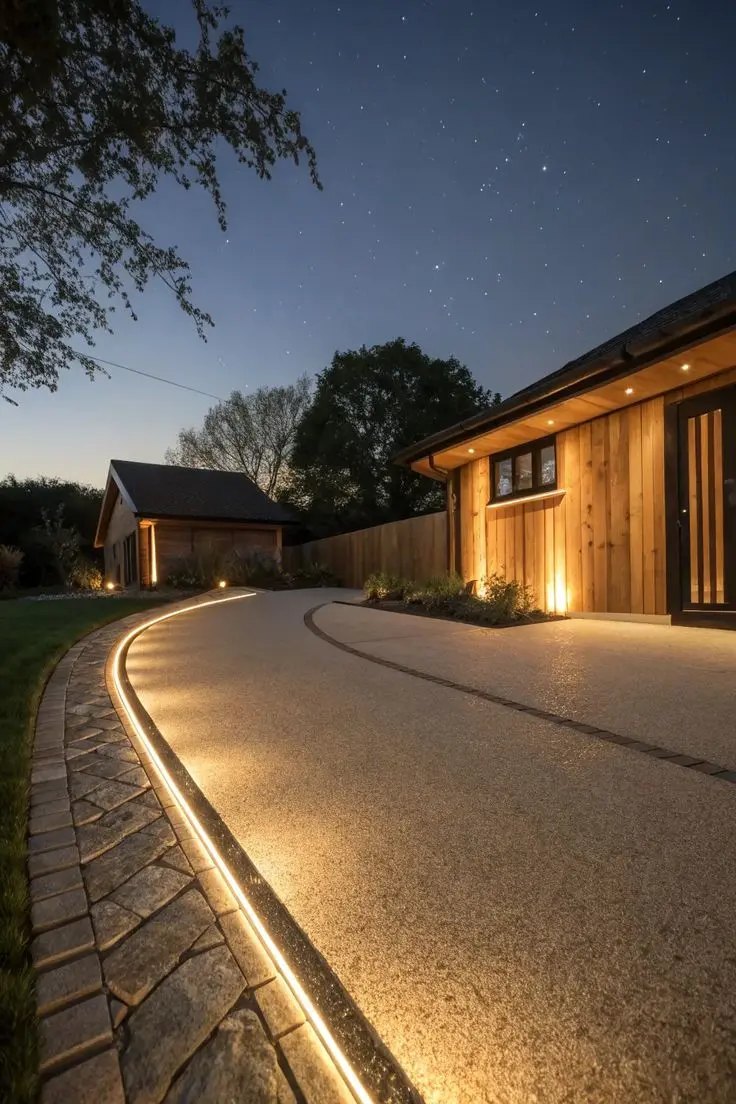
Resin-Bound Installations — SUDS Compliance Documented
Driveway, car park, and pathway installations with permeameter discharge records. Aggregate grading certificates and attenuation reports available on request for each project shown.


Resin Bound vs. Tarmac, Block Paving, and Gravel — Drainage and Maintenance
| Feature | ★ Best ChoiceOur Standard | Tarmac (Asphalt) | Interlocking Block Paving | Loose Gravel / Shingle |
|---|---|---|---|---|
Permeability | 850 L/min/m² (Ours — measured, ASTM C1701) | 0–5 L/min/m² (impermeable — surface runoff to kerb drain only) | 150–250 L/min/m² joint infiltration design (subbase dependent) | Not measurable — no coherent matrix; surface displacement under first vehicle pass |
SUDS Planning Compliance | Compliant — discharge records issued at handover | Non-compliant — impermeable surface requires attenuation tank for planning | Potentially compliant depending on installation quality and joint maintenance | Conditionally compliant — planning accepts loose gravel but no performance data available |
10-Year Maintenance Cost (60m²) | SAR 1,400 total (pressure wash + sealant re-coat, Year 7) | SAR 3,200 (crack seal every 3 years; surface patch at Year 6–8; no weed control needed) | SAR 4,800 (re-sand every 2 years; individual block re-leveling; weed and ant treatment annually) | SAR 5,600 (annual top-up for displacement; edging board replacement; weed control every 6 months) |
Aggregate Displacement Under Traffic | Zero (binder-locked matrix) | No aggregate displacement — monolithic surface | No displacement from paver units; joint sand can migrate under traffic | Continuous displacement — tracked into property, onto roads, into drains |
Surface Temperature at Peak Solar Exposure | Dark aggregate 60–65°C; DCOF maintained | 65–75°C surface temperature; thermal expansion causes edge cracking at restraint points | 55–65°C; individual block expansion within joint space; edge creep at perimeter restraint | 55–70°C depending on colour; no structural impact; no slip rating applicable |
[Drainage and Lifecycle Comparison] Permeability figures are measured values (resin bound) or published design values (alternatives). Maintenance costs are based on a 10-year service period on a standard residential driveway (60m²).
Technical Questions — Permeability, SUDS Compliance, and Climate Performance
Three documents: (1) ASTM C1701 falling head permeameter discharge records for a minimum of five test locations on the installed surface, confirming discharge rate in L/min/m²; (2) BS EN 12620 aggregate grading certificates for the consignment used on the project, confirming Los Angeles abrasion, Micro-Deval, and flakiness index; (3) a drainage attenuation report from Eng. Faris Al-Sulaimi (BSc Civil & Environmental Engineering) confirming that the installed system's discharge rate meets or exceeds the design model requirements for the 10-year return period storm event. These three documents form the planning authority evidence file.
Yes, up to a maximum gradient of 1:10 (10%). Above this gradient, the installation requires a course aggregate blend (6–10mm) rather than the standard 2–6mm blend to maintain sufficient void structure and binder film stability. Gradients steeper than 1:6 are not suitable for resin-bound surfacing under vehicle traffic — at this slope angle, vehicle braking applies shear stress that exceeds the binder-to-aggregate bond strength under loaded vehicle conditions.
Resin bound: aggregate is fully coated in binder and laid as a matrix — every stone is locked in position, permeability is maintained at 850 L/min/m², and the surface is smooth and uniform. Resin bonded: binder is applied to a carrier surface and aggregate is scattered onto the wet binder — loose stones are left on the surface, permeability is unreliable, and the surface is not suitable for SUDS planning compliance. Resin bonded is cheaper to install; it produces a visually similar initial result but loses aggregate within 6–18 months and cannot be presented as a SUDS-compliant drainage solution.
24 hours at 20–25°C ambient. At Saudi ambient temperatures above 35°C, the aliphatic binder cures faster — we confirm cure by Shore D reading at the 18-hour mark. If Shore D exceeds 75 at 18 hours, vehicle access is authorized. This is typically achieved 18–20 hours post-installation in summer conditions. The permeameter test is conducted before vehicle access is authorized — not after.
Section repair is possible using the same aggregate consignment (batch-stored from the original installation) and freshly prepared aliphatic binder. The repair boundary is saw-cut to a clean edge and the section is replaced. With the original aggregate batch reference stored, the repair colour match is within the natural variation of the aggregate — indistinguishable from the surrounding surface within 4–6 weeks as the binder UV-stabilizes to the same tone.
Request a SUDS Compliance Report for Your Site — Permeameter Data and Attenuation Modeling Included
Submit your site plan with drainage catchment area, soil permeability description, and outfall or soakaway details. Eng. Faris Al-Sulaimi will return a drainage attenuation model confirming whether the resin-bound specification meets your planning authority's discharge requirements — before you specify materials or issue an order.