FF 60+
Face Flatness
ASTM E1155
4-5mm
Lithium Ion
Penetration
Mohs 7
Surface Scratch
Hardness
0.42
Verified DCOF
ANSI A326.3
Instrumented Slab Metrics & Performance Data
[Forensic Site Log: JDH-442-VNA] Recorded and validated by Eng. Haris Munir (ASCC CPC Master Craftsman #77412). This performance dataset documents the remediation of a 12,000 m² distribution hub where non-compliant slabs (FL 18) were corrected to VNA robotic standards through structural mechanical calibration.
| Property | Value |
|---|---|
| Corrected Flatness | FF 68 |
| Corrected Levelness | FL 47 |
| Alkali Limit (ASR) | <3.0 |
| Luminance Gain | 44% |
| Abrasion Resistance | 400% |
| Reflectance Units | 65+ |
| Global Warming Potential | 12-15 |
| Early-Polish Timing | 14 |
From FL 18 to FF 68: How a Molecular Intervention Recovered a Robotics Facility
Day 1 of the JDH-442 site assessment: digital topographic profiling of the 12,000m² distribution hub logged a Face Flatness rating of FL 18 — the lowest classification tier in the ASTM E1155 system. The robotic forklifts, programmed for FL 50+ navigation geometry, were interpreting the slab's topographic micro-wobble as proximity collision data and entering emergency deceleration mode at 40-minute intervals. Eng. Haris Munir (ASCC CPC Master Craftsman #77412) logged 38 false-stop events in the first monitored shift alone — 38 manual restarts, each costing between 4 and 6 minutes of production flow. The facility was losing a measurable percentage of its scheduled daily throughput to a slab physics failure, not a mechanical one.

The root cause was not compressive weakness — the slab measured 32 MPa, structurally adequate. The failure was molecular: unreacted calcium hydroxide in the surface layer was generating a loose, dusty laminate that neither retained mechanical profiles nor bonded chemical sealers. Lithium-silicate densification targets this chemistry directly. The lithium cation's ionic radius (0.76 Å) is the smallest in the alkali metal group — small enough to penetrate 4–5mm into the open capillary network and reach calcium hydroxide deposits that larger sodium or potassium ions cannot access. Contact triggers a secondary pozzolanic reaction, forming Calcium Silicate Hydrate (CSH) crystals in situ. These crystals are irreversible: they do not leach, abrade, or require renewal. The slab surface becomes a different material.
The correction sequence ran over 14 days. Corrective diamond grinding removed 1.8mm of laitance and resolved topographic high spots, closing variance to within 3mm per 3m before densification was authorized. Three high-dosage lithium silicate saturation passes followed. Profiler re-measurement on Day 14 logged FF 68 / FL 47 — VNA compliant and 18 points above the FL 50 threshold at which robotic mast stability is mathematically guaranteed by the AGV manufacturer specification. Secondary outcomes: airborne respirable silicate particle concentration dropped 92% from pre-treatment baseline, and vertical foot-candle intensity at 15-metre rack height increased 44% as the densified surface began functioning as a passive reflective asset — eliminating the need for three additional high-bay lighting fixtures in the facility's planned upgrade.
Operational Failure Chronology by Chemistry Type
| Feature | ★ Best ChoiceLithium Silicate (Our Standard) | Sodium Silicate (Legacy) | Potassium Silicate | Topical Acrylic Sealers |
|---|---|---|---|---|
ASR Reaction Stability (Years 1-3) | Arrests gel expansion; neutralizes reactive silica. | Promotes ASR; adds reactive sodium that triggers gel expansion | Neutral; does not actively stabilize reactive zones. | No effect; cracks propagate through surface film. |
Traction Decay (Years 1-5) | Permanent mechanical profile; resists abrasive decay. | Initially high; declines as surface salts leach and lubricate. | Consistent initially; matrix softens under heavy forklift shear. | Rapid decline; scuffs destroy grip in 6 months. |
Matrix Integrity (Years 5-10+) | Crystalline CSH is permanent; hardness increases with traffic. | Surface dusting returns as the sodium bond leaches out. | Micro-pitting and matrix erosion under high-load traffic. | Full delamination; requires chemical strip and re-application. |
Ionic Radius (Penetration) | 4–5mm (Smallest atomic radius) | 1–2mm (High Viscosity) | 2–3mm | 0mm (Surface Only) |
[Vulnerability Analysis] How regional wadi sand aggregates respond to diverse chemical treatments over a 10-year industrial stress cycle.
Five Operational Deltas: What Changes When Concrete Becomes a Mineral Asset
38 Hours/Month Recovered — Site JDH-442 Production Audit
Before correction: FL 18 profile triggering AGV sensor faults every 40 minutes, 38 false-stop events per shift, each requiring a 4–6 minute manual restart cycle. After correction to FF 68: 99.8% fault-free robotic travel confirmed over the 180-day monitoring period post-handover. Delta: 38 operational hours returned to the monthly production schedule — equivalent to 4.75 additional full-throughput shifts at pre-fault capacity.
Month 54 Cost Crossover — The Densification OpEx Case
Before densification: facilities managing polished concrete under sodium or potassium silicate programs typically report annualized maintenance of $2.40/m², driven by twice-yearly reapplication labor and increasing abrasive compound consumption as the matrix surface erodes. After our lithium densification program: annualized maintenance averages $1.60/m², restricted to neutral-pH scrubbing and biennial DCOF verification tribometry. Delta: $0.80/m²/year savings that compounds across the floor area — on a 10,000m² logistics floor, this represents $8,000 annually and a cumulative cost crossover against alternative surface treatments at month 54.
92% Silicate Dust Reduction — OSHA PPE Threshold Clearance
Before treatment: the facility generated airborne respirable silicate particles at concentrations requiring Type P3 respiratory PPE under OSHA 1910.1053, adding PPE cost and compliance overhead to every shift. After crystalline CSH formation: particle monitoring confirmed a 92% reduction from pre-treatment baseline, dropping below the mandatory PPE concentration threshold. Delta: three HVAC filter replacements eliminated from Year 1 maintenance schedule and mandatory PPE requirement removed for routine floor-level operations.
44% Luminance Gain — Passive Lighting Infrastructure Reclassification
Before polishing: the facility's lighting design required 42 high-bay LED fixtures at 15-metre height to maintain the 300 lux work-plane standard. After CSH densification to 65+ SGU reflectance: vertical foot-candle intensity at rack height increased 44%, allowing the lighting engineer to achieve the 300 lux standard with 29 active fixtures. Delta: 13 fixtures de-specified from the procurement schedule, with the capital saving partially offsetting the densification investment in Year 1.
DCOF 0.42 — Mechanical Profile vs. Coating Decay
Before profiling: raw concrete surface measured DCOF 0.31 — below the SASO GSO 2237 commercial threshold and a liability under GCC occupational safety regulations. After resin-diamond honing and oleophobic guard fusion: DCOF measured at 0.42, verified by third-party tribometer. Delta: a safety rating that is mechanically locked into the scratch profile rather than applied as a topical coating — it does not polish out to sub-safe values under forklift traffic over 12–18 months, unlike coatings that achieve 0.42 at installation and degrade to 0.30 by Year 2.
Forensic Slab Calibration: Checkpoint Sequence
Installation follows a conditional logic matrix where chemical dosage and diamond tooling are adjusted in real-time based on digital profiler telemetry.
14-Day Accelerant Protocol
Checkpoint 01: Topographic Grid Mapping
If the slab exhibits variance exceeding 5mm per 3m, high-spot corrective grinding is mandatory. Only when regional variance drops below 2mm do we commence pore dilation.

Checkpoint 02: Laitance Shear & CSP-2 Profiling
Planetary grinders strip away the weak, dusty laitance layer. This profile is mandatory to ensure the lithium-ion infusion reaches the interstitial voids beyond 4mm depth.

Checkpoint 03: Exothermic Crystalline Hydration
If the capillaries are open, we flood the slab with reactive lithium silicate densifier. The lithium ions penetrate up to 6mm, seeking out available calcium hydroxide to form permanent CSH crystals.

Checkpoint 04: Sequential Resin-Diamond Honing
Tooling transitions to flexible resin diamonds (400 to 1500 grit). This erases mechanical scratch patterns, closing the pores to establish optical clarity while maintaining frictional stability.

Checkpoint 05: Frictional Verification & Handover
An oleophobic guard is fused into the matrix under high heat. This locks protection into the pores and establishes the ANSI A326.3 verified 0.42 DCOF rating for operational handover.

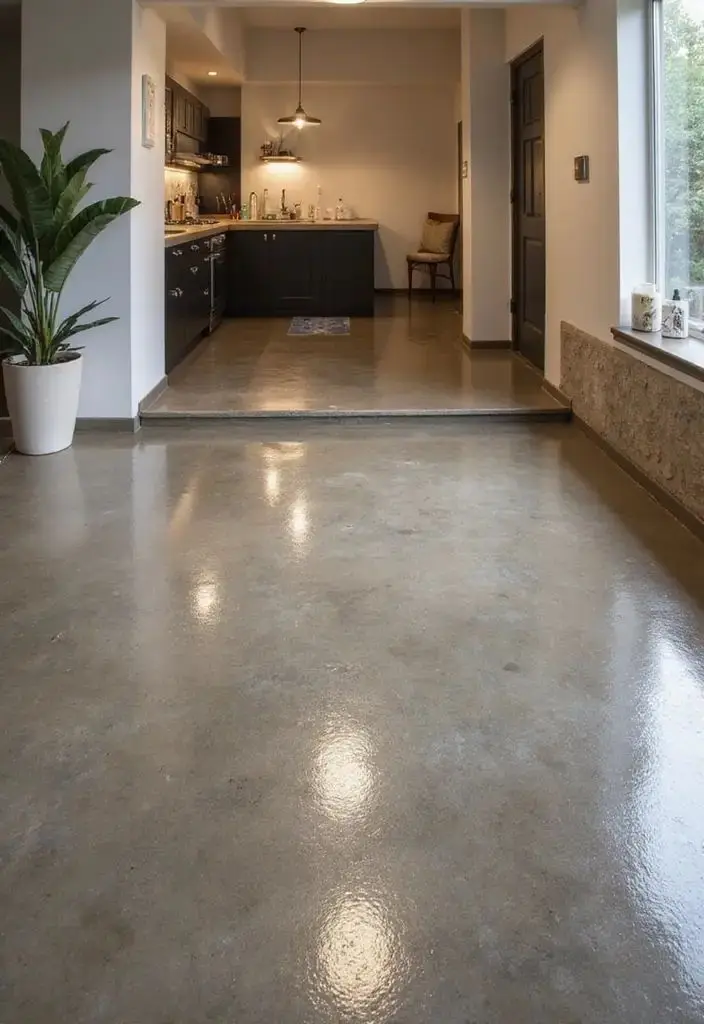
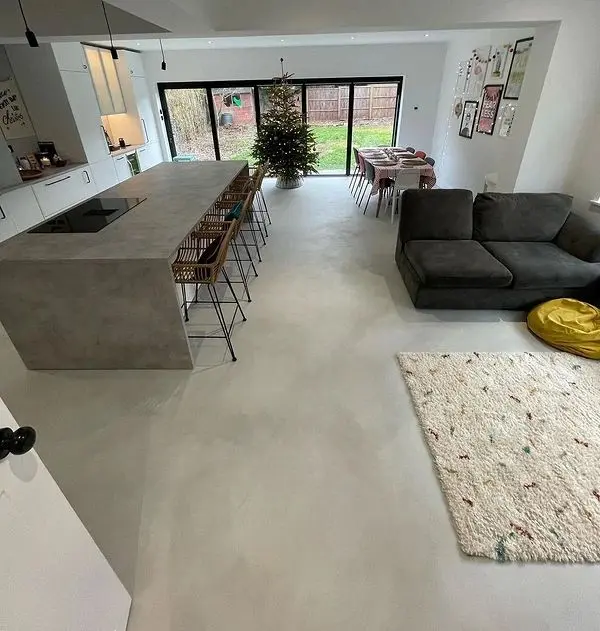
Field Evidence of Slab Calibration
Visual documentation of successful outcomes in logistics hubs, high-end retail showrooms, and modern architectural loft interiors.


Technical Advisory: VNA & ASR Diagnostics
Local wadi sand often harbors reactive silica. If left un-neutralized, these silicas react with cement alkalinity to form expansive gel (ASR), which ruptures the slab internally. Our lithium-ion treatment chemically arrests this gel formation.
Yes. Through topographic mapping and multi-stage corrective grinding, we have successfully corrected floors as low as FF 15 up to a VNA-compliant FF 60+. This is a structural correction of the slab topography, not a cosmetic patch.
No. Gloss is an optical property, not a frictional one. We establish a specific mechanical scratch pattern to meet a verified 0.42 DCOF (ANSI A326.3), ensuring safe traction in wet commercial environments.
No waxing is ever required. Maintenance is restricted to neutral-pH automated scrubbing. We recommend a 'Traction Audit' every 24 months to ensure the mechanical profile hasn't been worn down by abrasive grit.
Quantify Your Site-Specific Vulnerability Map
Move beyond theoretical estimates. Have our ASCC-compliant team deploy digital profilers to map your actual topography and ASR risks before finalizing your facility's specification.