Why This System Exists — and What Each Part of It Does
The Structural Problem — Post-Tensioned Slabs and Dead Load Limits
Post-tensioned slab construction dominates Saudi residential buildings built since the 1990s. These slabs have precise dead load budgets, and 200mm dense block at 480 kg/m² frequently exceeds the available capacity on renovation projects. A dual-layer 13mm gypsum assembly on a 92mm stud frame weighs 94 kg/m². That difference — 386 kg/m² less — is what allows the same layout to be structurally viable. On a 6m × 4m partition alone, it is 9,264 kg of dead load that either stays within the available budget or forces structural remediation. We calculate this check and include it in every renovation quote.
The Acoustic Problem — Why Walls Test Better on Paper Than on Site
Adding more board layers to a standard partition increases the STC rating on paper. It does not always translate to the same performance on site. Structure-borne sound travels laterally through the steel stud frame, floor track, and ceiling junction — bypassing the board entirely. The result is a wall that specifies STC 55 and measures STC 42–46 when someone brings a sound level meter. The correct fix is resilient channel mounts that decouple the board from the frame, plus acoustic sealant at every perimeter junction. That assembly delivers the specified rating on site, not just on the specification document.
The Fire Compliance Problem — Not All Gypsum Assemblies Are Fire-Rated
Standard 12.5mm gypsum board achieves approximately 30 minutes of fire resistance. A 30-minute rating does not meet legal fire compartment requirements for buildings over 28 metres, protected egress routes, or apartment boundaries. Those require a 2-hour rating using a certified assembly — dual 15.9mm Type X boards on each side of a 92mm stud cavity, with every MEP cable and pipe penetration sealed with UL-classified putty pads. We map all penetrations before boarding begins and photograph each sealed penetration — because a single unsealed cable sleeve reduces a 2-hour wall to whatever the hole provides.
The Coastal Humidity Problem — Standard Board Degrades Without Water Contact
Standard gypsum board absorbs up to 5% of its weight in moisture under sustained high ambient humidity. In Jeddah, the Eastern Province, and coastal Red Sea cities, ambient relative humidity exceeds 80% for six or more continuous months every year. At 5% moisture absorption, the paper face begins to delaminate from the core and fastener pull-through resistance falls below structural thresholds — without any direct water contact. MR-grade glass-mat board caps absorption at 0.5% and maintains structural integrity through the full humidity cycle. For any property within 50km of the Saudi coast, MR board is the correct specification throughout — not only in bathrooms.
What Gypsum Board Work Covers — Floors, Ceilings, and Every Wall Type
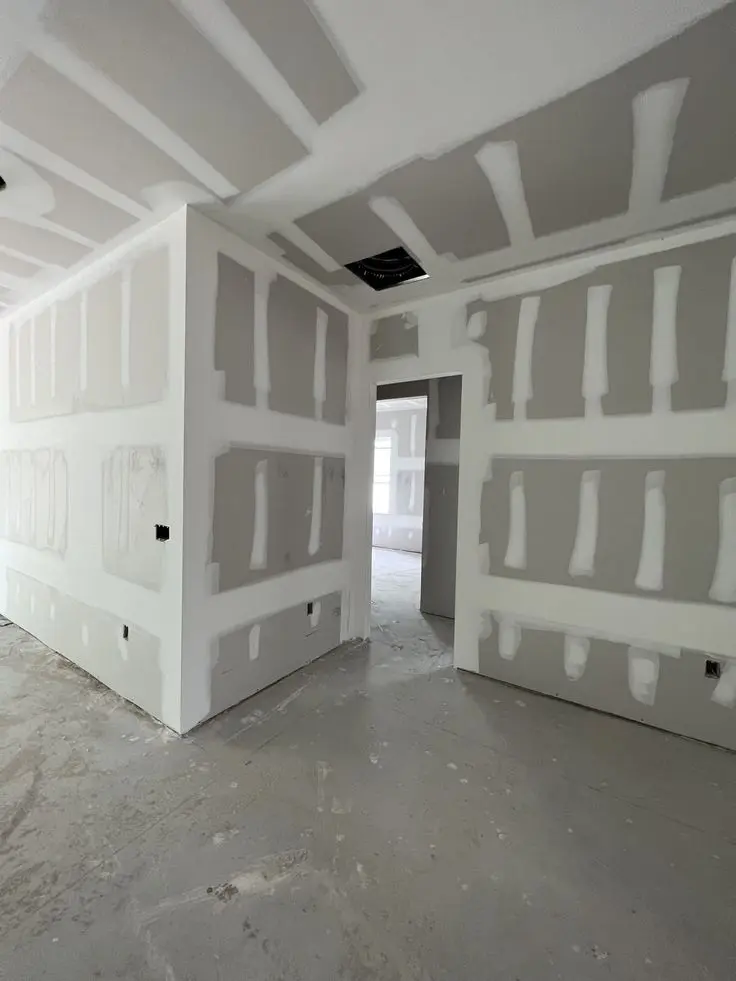
Gypsum board framing covers both walls and ceilings. Partition walls are built on steel stud frames and boarded on both sides — board type, layer count, cavity fill, and penetration sealing all determined by what the wall needs to do (standard, acoustic, fire-rated, or moisture-resistant). Suspended ceilings use the same board and framing logic — flat ceilings, coffered ceilings, curved soffits, cove detail — installed without wet trades and without disruption to the floors below.
Because the system uses dry installation throughout — no mortar, no wet renders, no cure wait — gypsum board work is significantly faster and cleaner than masonry alternatives. A full partition wall from stud installation to ready-for-paint can be completed in one or two days. An equivalent masonry wall requires mortar, a cure period, render, and more cure. In occupied residential or commercial spaces, the difference in disruption is substantial.
SAR 35–40/m² covers a standard partition or ceiling: stud framing, board, cavity fill, tape, joint compound, and finish skim ready for paint. Acoustic upgrades with resilient channel decoupling add approximately SAR 8–12/m². Fire-rated assemblies using dual 15.9mm Type X board add approximately SAR 10–15/m². The site visit quote specifies which assembly is appropriate and gives the complete all-in price.
Gypsum Board Cost — Saudi Arabia Price Guide
SAR 35–40/m² covers a complete standard installation. Here is what sits at each level and what drives the price above the base range.
SAR 35–40/m²
per m²
Standard Partitions and Ceilings
Steel stud framing, standard 13mm gypsum board, mineral wool cavity fill, tape and compound, finish skim coat ready for paint. Structural load check included free.
- ✓92mm steel stud frame and track
- ✓13mm single or dual-layer gypsum board
- ✓Mineral wool cavity fill
- ✓Tape, jointing compound, finish skim
- ✓Structural load check included
SAR 45–55/m²
per m²
Acoustic Partition — STC 55 Assembly
Resilient channel mounts decouple board from the steel frame. Acoustic-isolated studs. Perimeter isolation tape at all junctions. Cavity filled with 75mm 45 kg/m³ mineral wool batt. On-site acoustic verification included.
- ✓Resilient channel clips at 400mm centres
- ✓Acoustic-isolated steel studs
- ✓75mm 45 kg/m³ mineral wool batt
- ✓Acoustic sealant at all perimeter junctions
- ✓Calibrated on-site NIC measurement at completion
SAR 48–58/m²
per m²
2-Hour Fire-Rated Assembly
UL Design U419 certified assembly: dual 15.9mm Type X boards each side, 92mm stud cavity. All MEP penetrations mapped before boarding and sealed with UL-classified putty pads. Photographic record of every sealed penetration provided at handover.
- ✓Dual 15.9mm Type X gypsum boards each face
- ✓92mm metal stud cavity
- ✓All penetrations fire-stopped with UL putty pads
- ✓Photographic fire-stop record for permit file
- ✓Certification available for building permit submission
Every quote includes the structural load check. The price is fixed after the site visit — no additions once work starts.
Get a Free Structural Load CheckWhat Clients Ask Before Starting
Very common — and the engineer is correct. Saudi residential buildings built since the mid-1990s predominantly use post-tensioned slab construction. Those slabs were designed to a specific total dead load, and adding dense concrete block partitions at 480 kg/m² in a renovation frequently exceeds what the slab was designed to carry. The engineer is not being overly cautious — they are doing a load calculation. A gypsum board assembly at 94 kg/m² resolves the calculation in most cases with no layout change required. We include this load check with every renovation quote.
Everything needed to deliver a finished partition or ceiling ready for paint: steel stud framing, gypsum board in the correct type and layer count, mineral wool cavity fill, tape and jointing compound, finish skim coat, and the structural load check. Acoustic upgrades with resilient channel decoupling add approximately SAR 8–12/m². Fire-rated dual Type X assemblies add approximately SAR 10–15/m². Both are specified at the site visit if required — the total installed price is given before any work begins.
Flanking transmission. An STC 55 specification achieved by mass — adding more board layers — suppresses sound passing directly through the wall face. It does nothing to sound travelling laterally through the steel stud frame, floor track, and ceiling junction as structure-borne vibration. These rigid connections carry sound around the wall without ever passing through the board. The consistent result is STC 42–46 measured on site against a specification of STC 55. The correct assembly uses resilient channel mounts that decouple the board from the frame, plus acoustic sealant at every perimeter junction sealed to under 0.5mm. That assembly delivers the specified rating on site.
In coastal Saudi properties — Jeddah, Eastern Province, anywhere within 50km of the coast — yes. MR board is triggered by ambient humidity, not direct water contact. During the Jeddah summer, ambient relative humidity exceeds 80% continuously. Standard gypsum board at 5% moisture absorption capacity begins to delaminate from the inside under these conditions without a single drop of water touching it. MR glass-mat board caps absorption at 0.5% and maintains structural integrity throughout the coastal humidity cycle. We specify it throughout the property for coastal projects — not only in bathrooms.
Share Your Floor Plan. We Will Check the Slab Load for Free.
If your structural engineer has rejected blockwork, send us the partition plan and the slab type. We will return a load calculation showing whether the gypsum board assembly fits within the available slab capacity — and a fixed all-in price for the installation. No obligation.