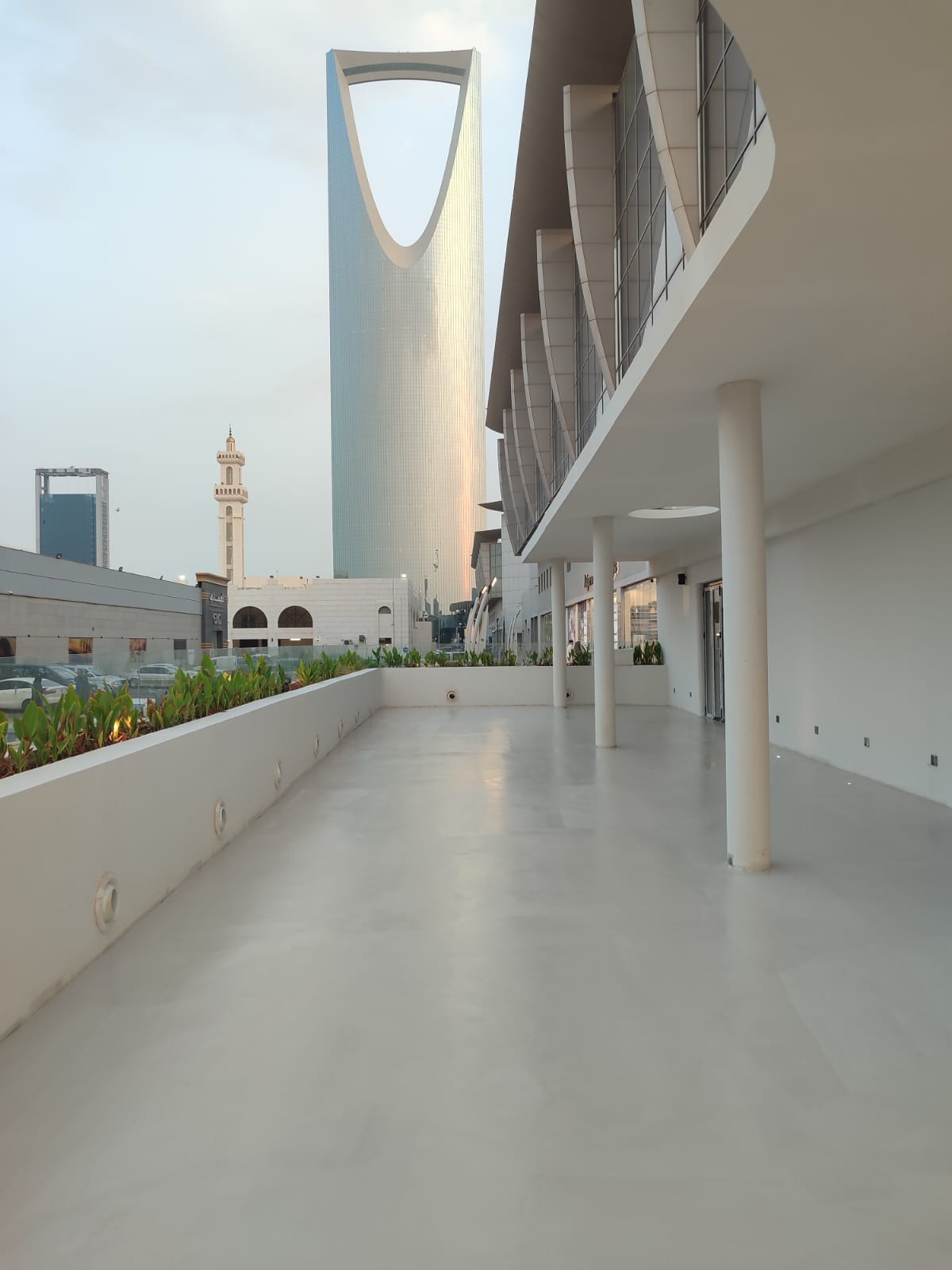
Why Most Outdoor Microcement Fails — and How to Make Sure Yours Doesn't
Most outdoor microcement failures have nothing to do with the coating itself. They come down to two things: the wrong sealer and application in the wrong conditions. Understanding both is the difference between an outdoor surface that lasts fifteen years and one that fails before the next summer.
The sealer is where most outdoor projects go wrong. Standard polyurethane sealers — even high-quality indoor grades — are formulated for temperate climates. Their softening point sits at around 50°C. Outdoor surfaces in extreme heat climates reach 65°C in direct summer sun. At that temperature, an indoor sealer does not gradually degrade — it softens rapidly, turns tacky underfoot, and begins to yellow within weeks. The correct specification for any outdoor microcement surface is an aliphatic polyurethane sealer: UV-stable, heat-rated, and non-yellowing at sustained temperatures above 65°C. This is not an upgrade. It is the minimum viable specification for outdoor use. Using anything less will fail.
Application timing is the second critical factor. Microcement must be applied to a substrate between 15°C and 25°C. Below that range, the polymer resin does not activate properly and the coating develops whitish patches and poor adhesion. Above that range — which in a hot climate means any time after mid-morning in summer — the material sets faster than it can be spread, levelled, and blended. The result is visible trowel marks, uneven colour, and a surface that cannot be corrected after curing. Every outdoor installation we carry out is scheduled for early morning. The day's scope is planned around what can realistically be completed before substrate temperatures rise. This is a technical requirement of the material, not a scheduling preference.
The third outdoor-specific factor is thermal cycling. Outdoor slabs go from 65°C in direct afternoon sun to 20°C at night — every day through summer. That daily expansion and contraction puts continuous stress on any rigid bonded surface. It is why outdoor tile grout cracks, crumbles, and needs constant repointing in hot climates. Outdoor microcement handles this differently. The polymer content in the coating gives it flexibility to move with the substrate rather than resist it. The fiberglass reinforcement mesh pressed into the primer layer absorbs building movement before it reaches the coating surface. Together, these two elements address thermal cycling at a material level — not just at an installation level.
What a correctly specified outdoor microcement project delivers: one continuous, seamless surface across your terrace, pool surround, patio, balcony, or exterior facade. No grout lines cracking under thermal pressure. No tile joints collecting sand and debris. No sealer yellowing or softening in summer heat. A surface specified for the environment it will live in — from day one.
What Outdoor Microcement Delivers — and What to Know Before You Commit
UV-Stable Sealer — Rated for 65°C+
Every outdoor surface gets an aliphatic polyurethane sealer rated for sustained UV exposure and temperatures above 65°C. This is the only correct specification for outdoor use in extreme heat climates. Standard indoor sealers soften and yellow under sustained direct sun — the outdoor-rated sealer does not.
Applied Over Existing Surfaces
Your existing outdoor tiles or concrete stay in place. We grind for mechanical grip, repair active thermal cracks with flexible epoxy, fill grout joints flush, and apply the system on top. No demolition. No rubble. No weeks of construction disruption.
Anti-Slip — R12 Rated for Wet Zones
Anti-slip aggregate is worked into the finish coat wherever the surface will be wet: pool surrounds, outdoor shower areas, sloped terraces, and garden paths. R12 slip resistance — the standard for wet outdoor surfaces — without the look or feel of a utility floor.
Completely Seamless
No grout lines cracking under thermal cycling. No tile joints collecting sand and biological growth. One continuous surface from the interior threshold across the terrace to the garden boundary — no transitions, no strips, no breaks.
Moves With the Substrate — Doesn't Fight It
The elevated polymer content in outdoor microcement grades gives the coating flexibility to move with daily thermal expansion and contraction rather than resist it. The fiberglass mesh underneath absorbs building movement before it transfers to the surface. This is the structural reason outdoor microcement outlasts grouted tile in hot climates over time.
Every Outdoor Surface in One System
Terraces, patios, balconies, pool surrounds, garden paths, and exterior facades — all in the same seamless system, with sealer and finish specifications adapted to each surface's exposure and use.
Light Colours Are the Correct Choice for High-Sun Surfaces
This is a technical point, not a style preference. Light tones reflect heat, stay cooler underfoot, and hold their colour under sustained UV significantly longer than dark shades. Dark colours absorb more heat — surface temperatures on dark outdoor microcement in direct summer sun can exceed 75°C — and show tonal shift over years of UV exposure. For open and south-facing surfaces, lighter palettes are the correct specification.
Outdoor Sealer Needs More Frequent Refreshing Than Indoor
The protective coat on outdoor surfaces takes far more punishment than indoor: direct UV, thermal cycling, sand abrasion, and rain. High-exposure surfaces like open pool surrounds and south-facing terraces need the sealer refreshed annually. Covered outdoor areas every 2–3 years. A sealer refresh is a half-day professional job — not a full reinstallation.
Pool Interiors Require a Completely Different Product
The surface inside a swimming pool — permanently submerged in chlorinated water — is a different specification from outdoor microcement. Pool interiors require a dedicated pool microcement system formulated for continuous chemical submersion. Pool surrounds use the standard outdoor system. These are two separate products and must be treated as such.
Outdoor Microcement Projects
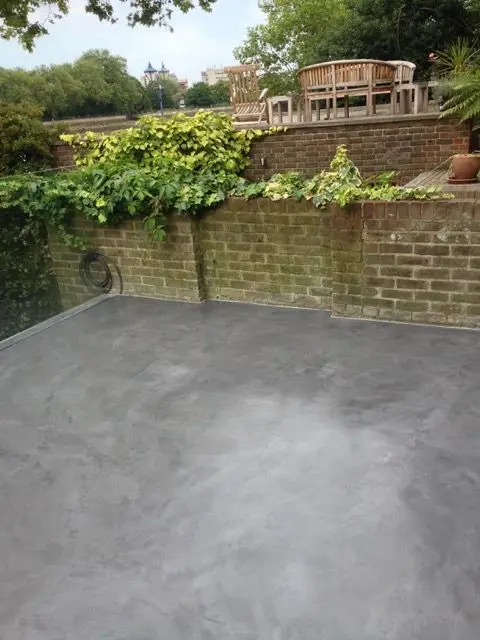
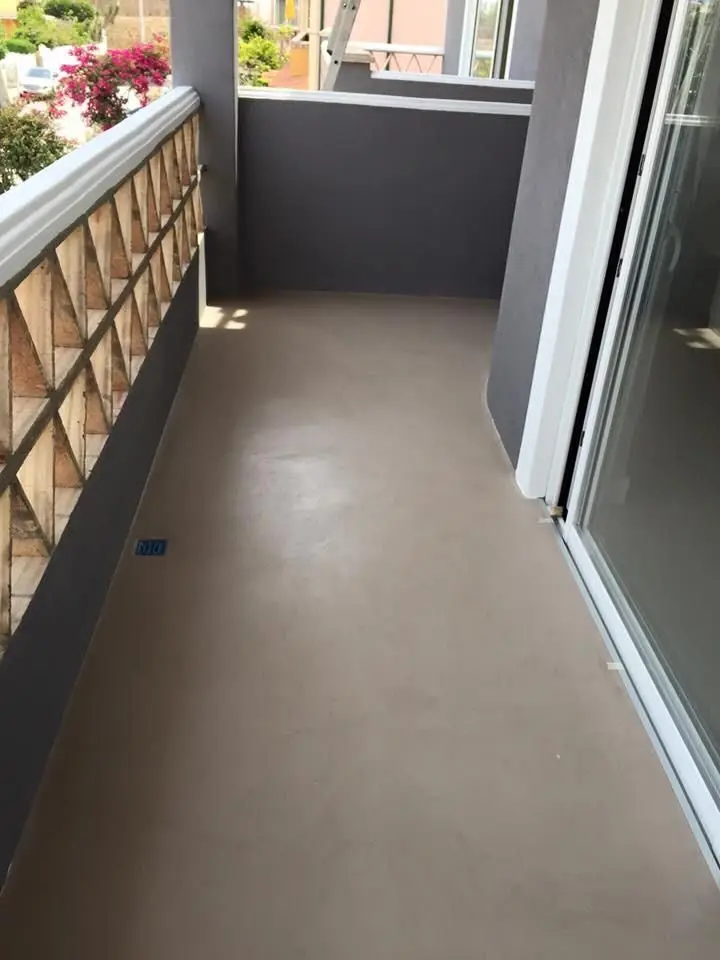
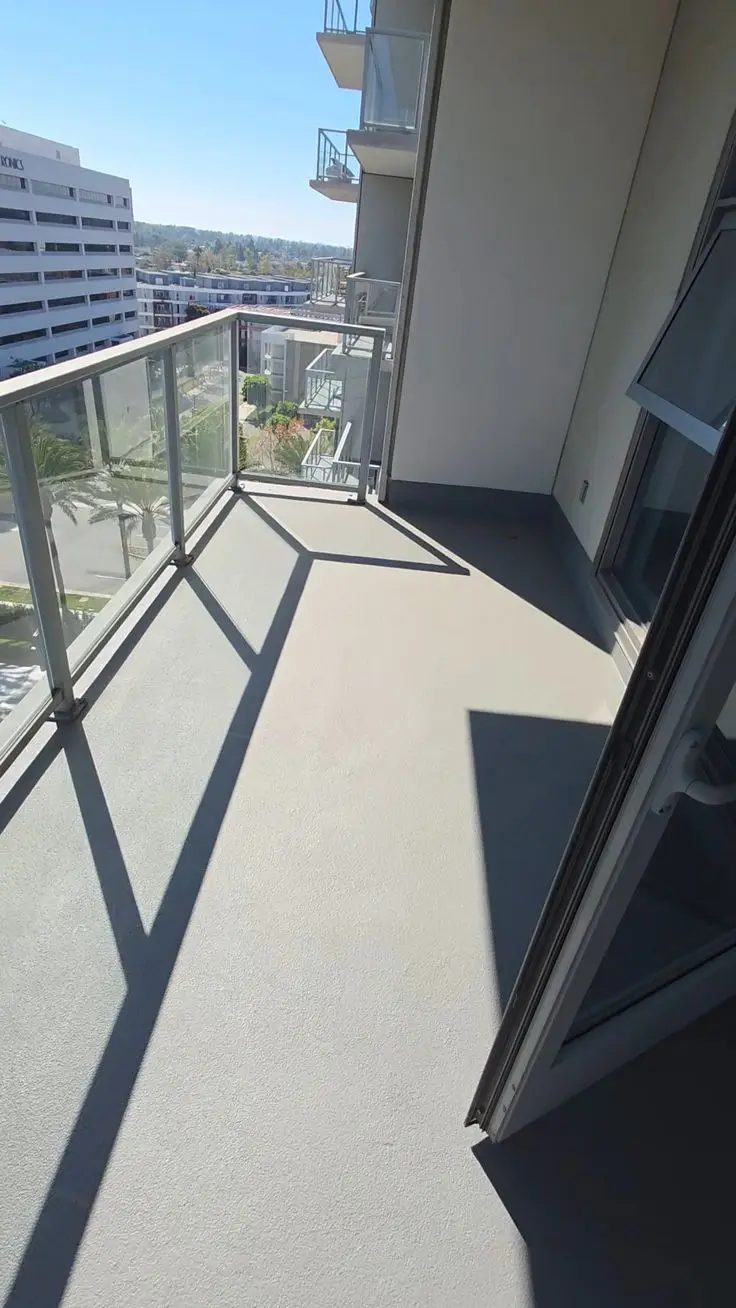
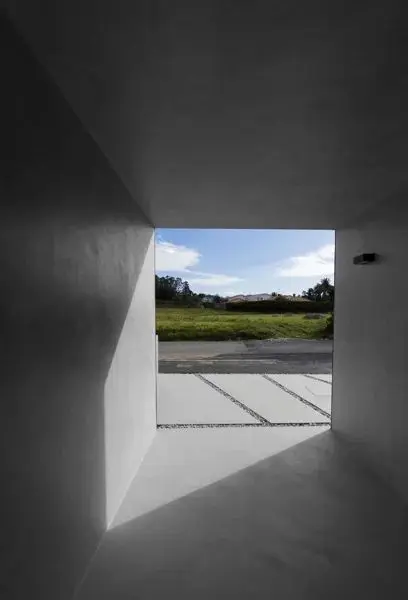
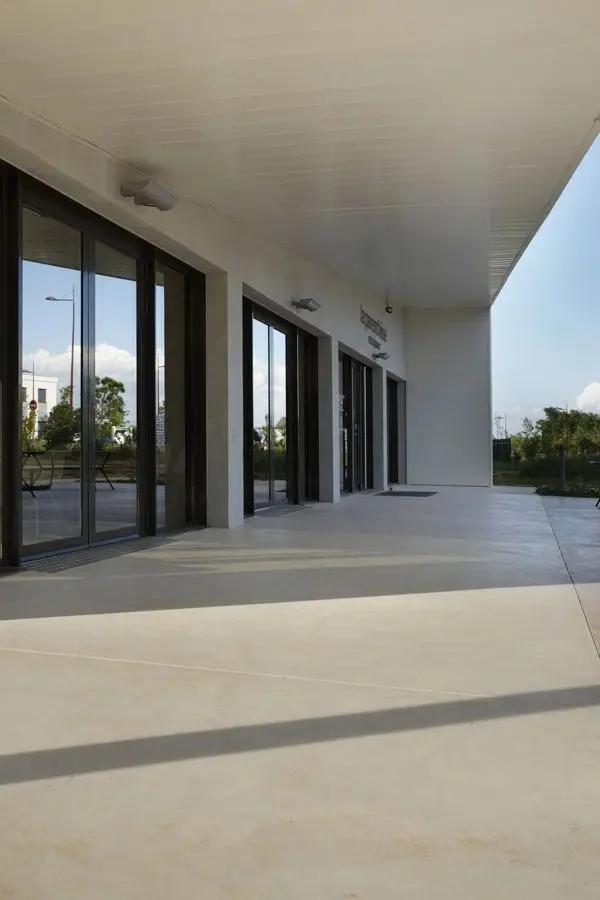
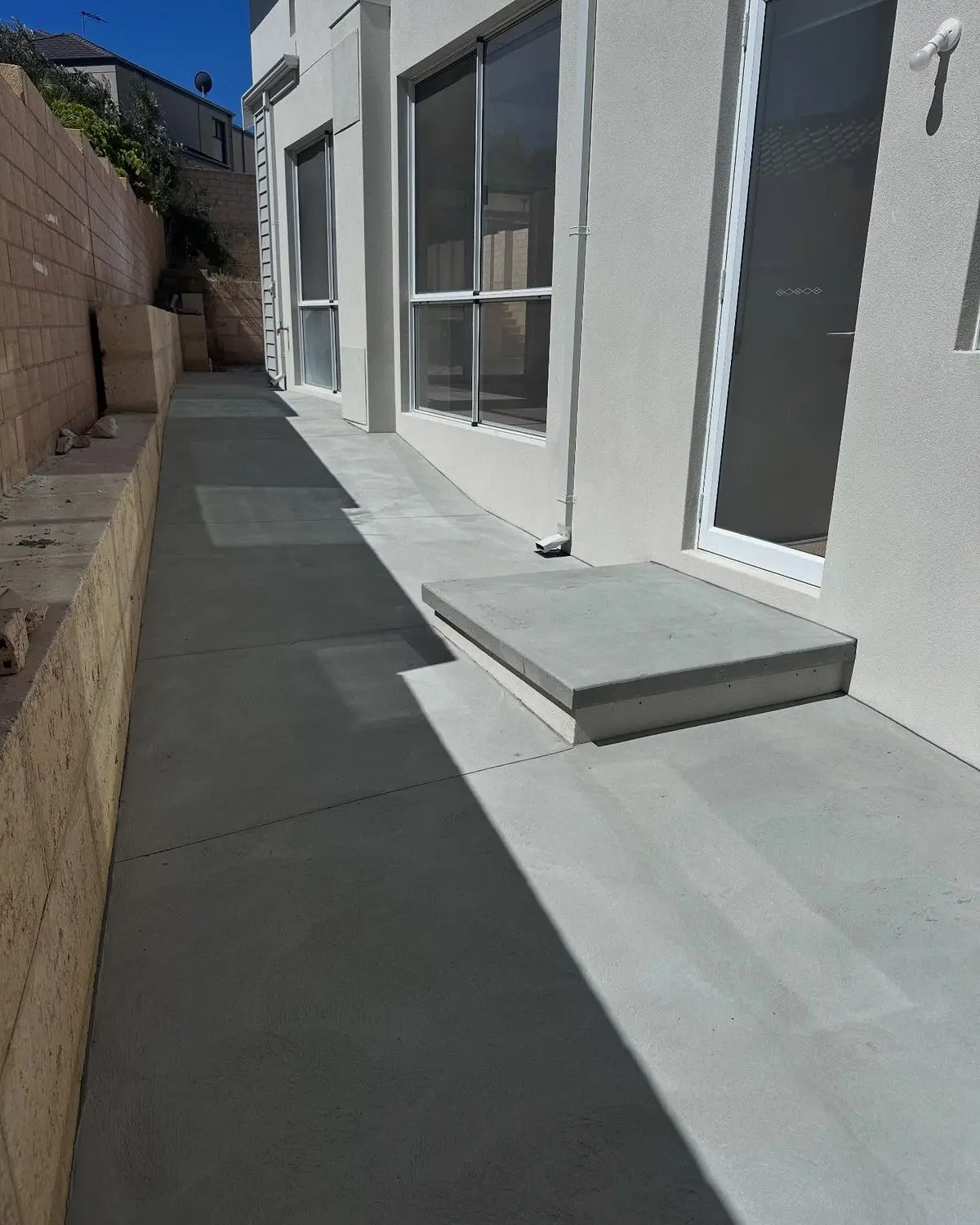
Terraces, pool surrounds, exterior facades, and balconies — each one started with an existing outdoor surface and finished with the same seamless, UV-stable result.
Outdoor Finish Options
Every outdoor finish is sealed with an aliphatic polyurethane system rated for extreme heat and UV. Colour selection matters more outdoors than indoors — lighter tones perform better, last longer, and stay cooler underfoot on high-exposure surfaces.
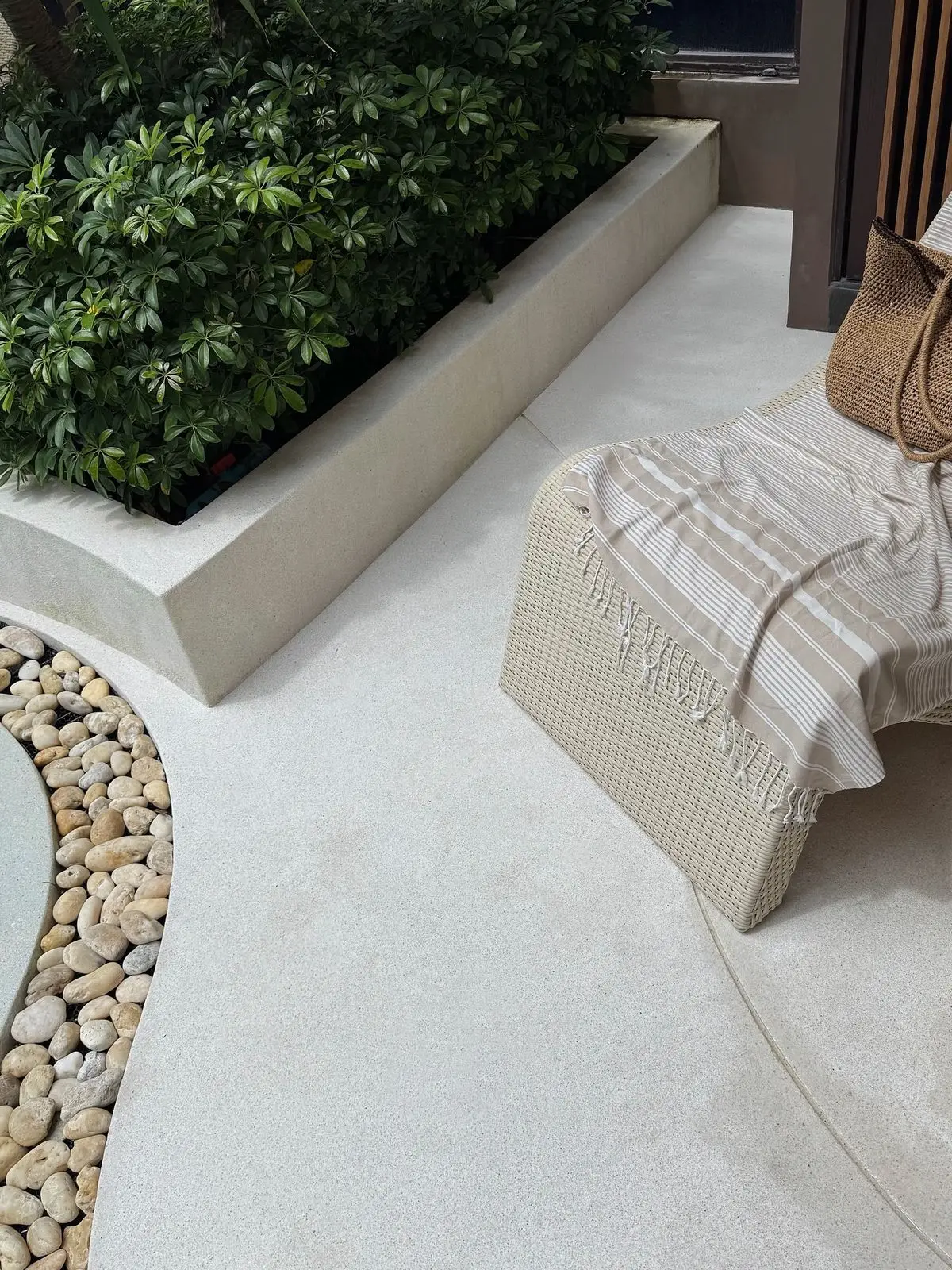
Light Mineral — Open Terraces & High-Sun Surfaces
Cream, warm white, and soft sand tones. Reflects heat rather than absorbing it, stays cooler underfoot in direct sun, and holds colour under intense UV the longest of any palette. The technically correct choice for fully exposed outdoor surfaces in extreme heat climates.
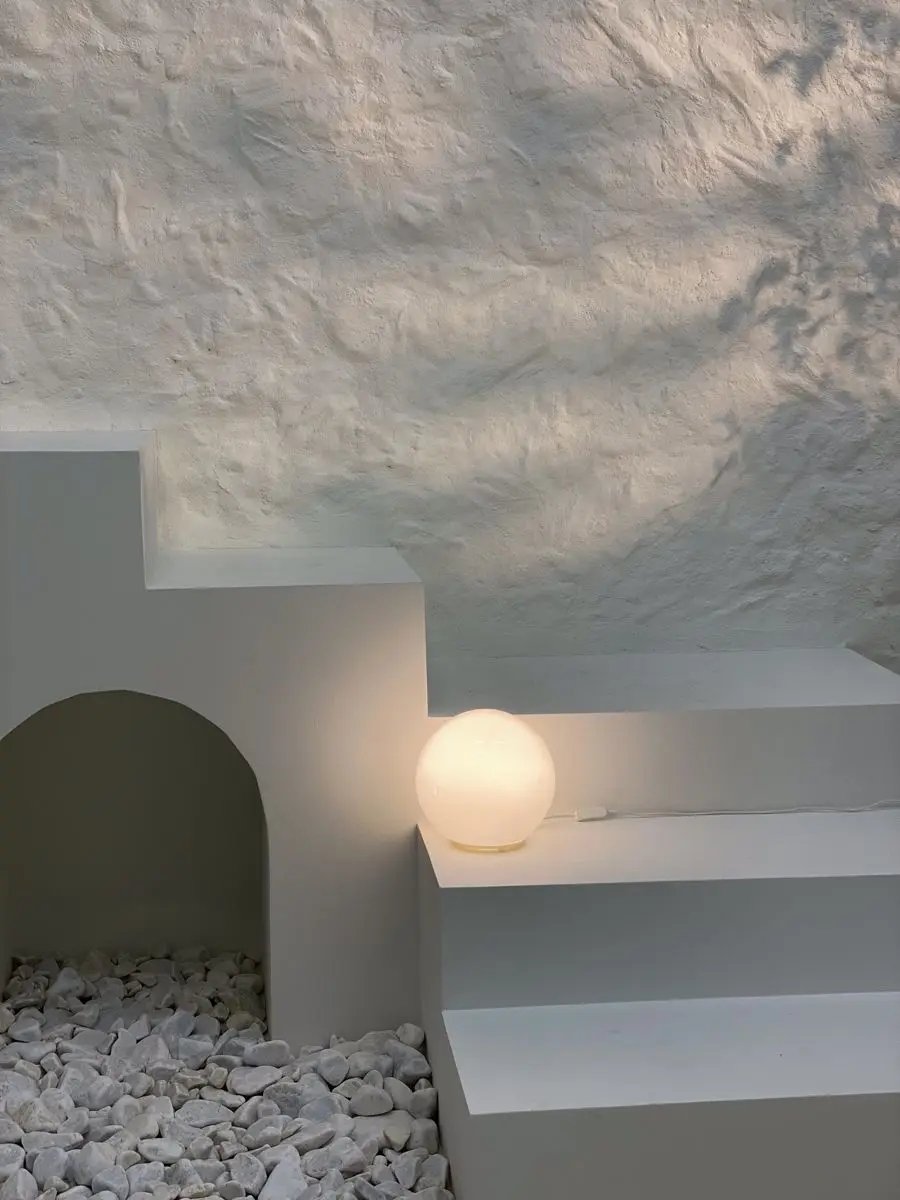
White Textured — Exterior Walls & Ceilings
A textured white mineral finish applied continuously from outdoor walls to exterior ceilings. Creates a unified architectural envelope and reflects indirect light across shaded patio areas — a finish that performs as well as it looks.
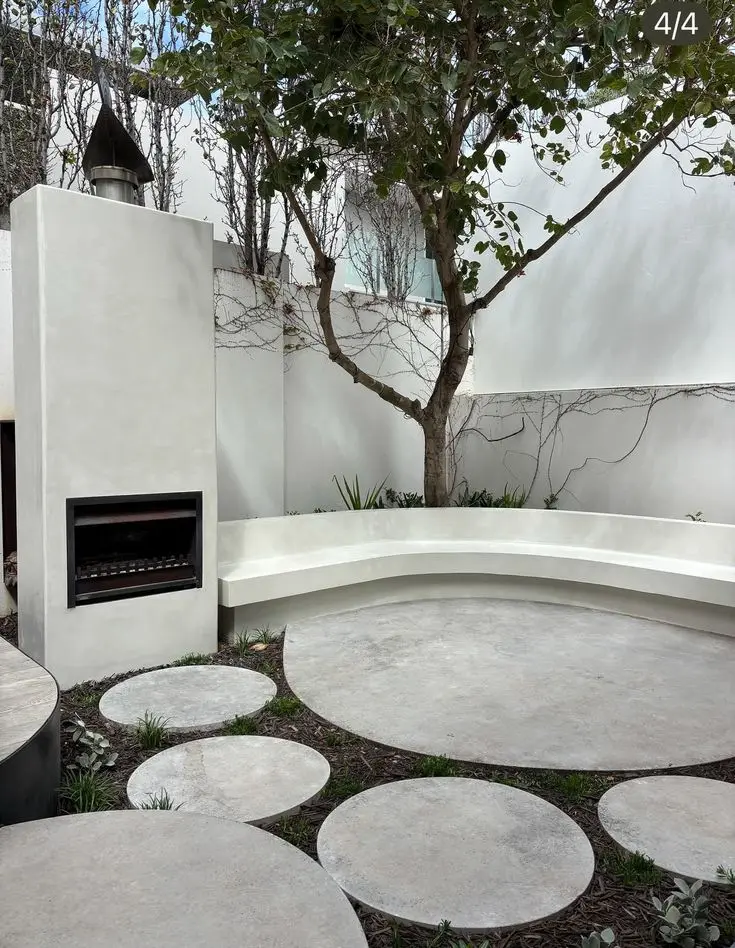
White Seamless — Patios, Benches & Feature Elements
White microcement applied continuously across patio floors, integrated benches, fireplace surrounds, and circular stepping elements. Eliminates the joints and cutting required with tile on complex outdoor geometries — one material, one seamless finish.
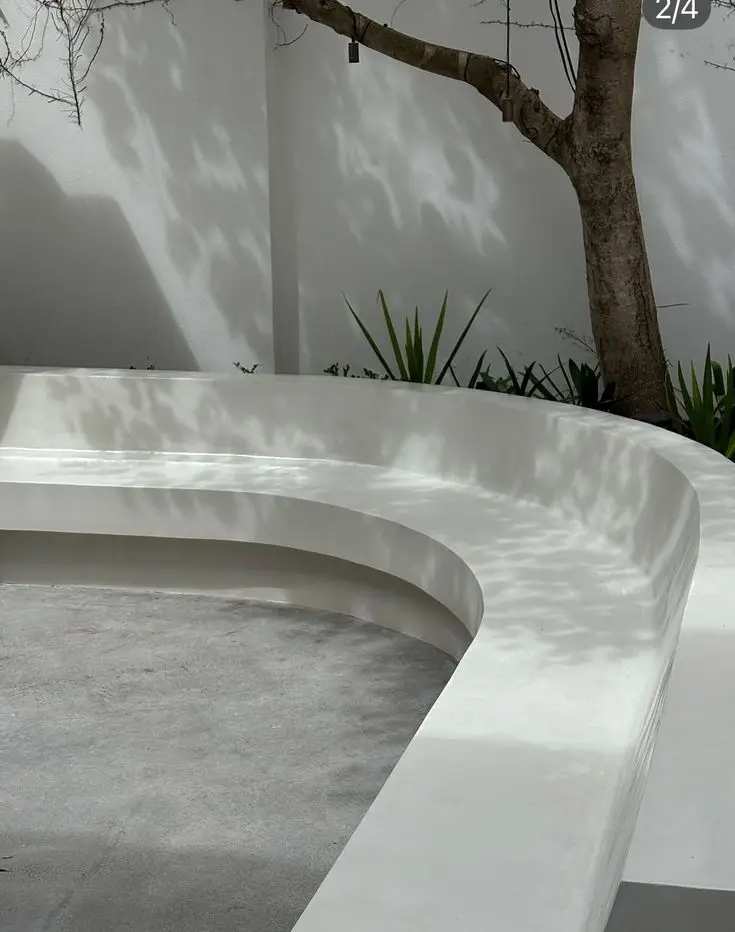
Architectural Curved Elements — Built-in Seating
Continuous microcement application over curved outdoor seating and structural benches. The coating flexes with thermal movement without cracking at curves — a result impossible to achieve with tile or stone on complex organic forms.
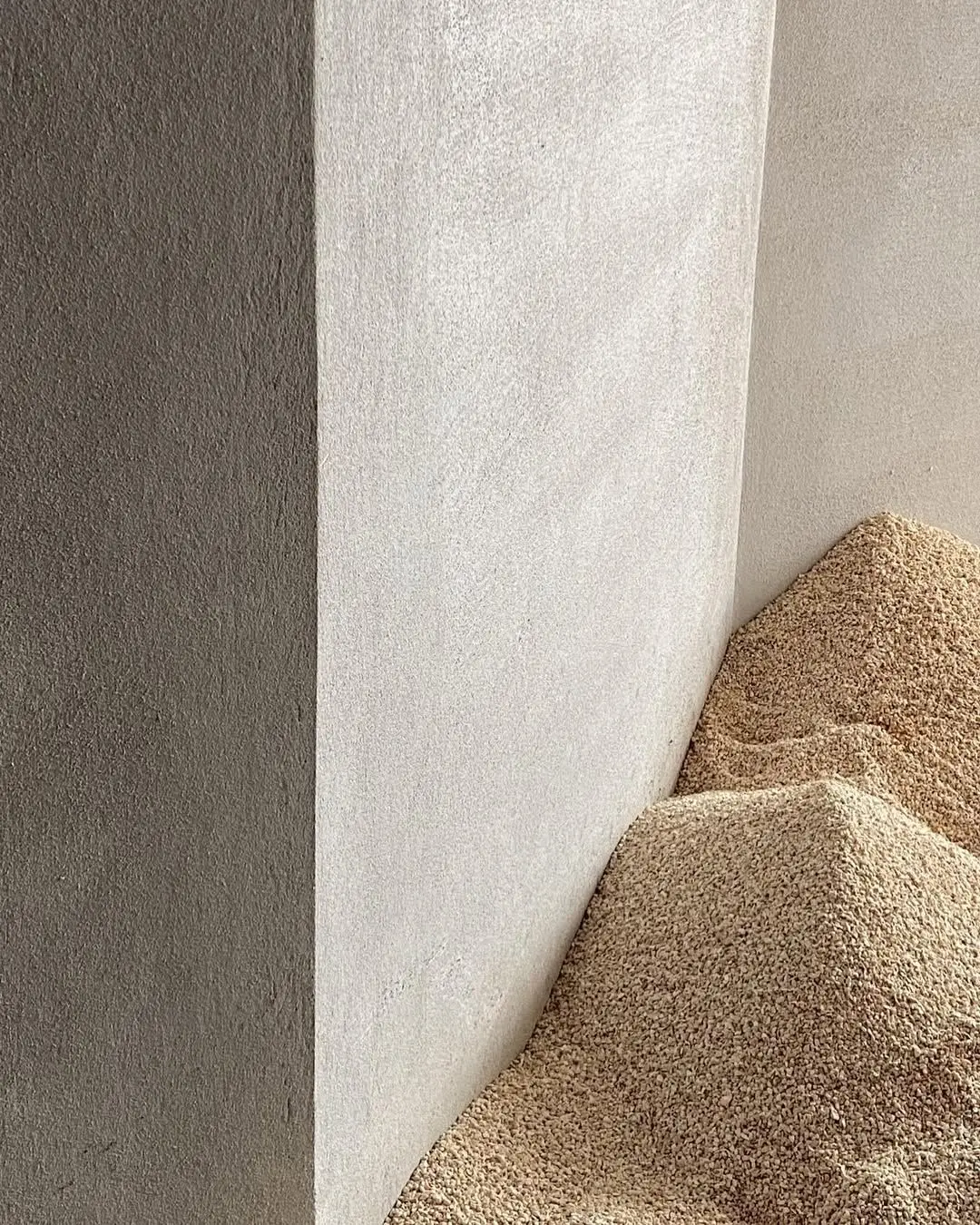
Light Grey Texture — Exterior Facades & Boundary Walls
A mineral-textured grey finish for exterior walls, boundary walls, and full-facade applications. Sealed with UV-stable aliphatic polyurethane — the same sealer used on outdoor floors — to prevent the yellowing and degradation seen with standard exterior renders.
How Outdoor Microcement Gets Installed
Outdoor installation is more demanding than indoor because the substrate carries risks interior surfaces do not — thermal cracking, ground moisture, UV-degraded adhesives, and failed existing sealers. Every step below is non-negotiable. Shortcutting any one of them produces a failure that cannot be corrected without removing and restarting the entire surface.
Scheduling — Morning Windows Only
Before any site work begins, the installation is scheduled around substrate temperature. Outdoor microcement must be applied to a surface between 15°C and 25°C. In hot climates, outdoor concrete and tile surfaces exceed 25°C by mid-morning in summer and often do not cool below that threshold until after sunset. All coating application — primer, base coats, and finish coat — is planned for early morning work windows. The day's scope is set around what can realistically be completed before temperatures rise, not around what would be most convenient. Applying microcement to a substrate above 25°C causes the material to set before it can be spread and blended — producing a surface that cannot be corrected after curing.
Substrate Assessment
The outdoor substrate is assessed across three dimensions before preparation begins. Moisture: readings are taken at multiple points across the surface, including ground contact zones where rising damp is most likely. Any reading above the product threshold requires a vapor barrier before proceeding. Stability: every tile or paver is tap-tested individually to identify hollow spots, loose adhesion, and delaminated sections — any unstable tile is a crack initiation point for the microcement above and must be fixed or replaced. Crack mapping: every crack in the existing surface is documented and classified. Active cracks still moving from thermal cycling are treated differently from settled historic cracks. A substrate that looks flat and intact to the eye often reveals significant instability under proper assessment.
Surface Preparation — Grinding, Crack Repair & Joint Treatment
Diamond grinding removes surface glaze from existing tiles, strips old sealers and coatings, and creates the mechanical surface profile that the bonding primer and microcement need for proper adhesion. The grinding specification for outdoor surfaces is typically more aggressive than for indoor — UV-degraded tile glazes and weathered sealers create a surface that appears clean but provides minimal bond strength. After grinding, all active thermal cracks are filled with a flexible epoxy filler that remains elastic after curing — not rigid cement filler, which will crack again along the same line as the substrate continues to cycle. Grout joints on tiled surfaces are filled flush with the surrounding tile face, allowed to cure fully, and sanded smooth. Any hollow tiles identified in the assessment are regrouted or replaced. The result is a structurally stable, mechanically profiled, and uniformly porous surface across the entire area.
Exterior-Grade Bonding Primer
An exterior-grade bonding primer is applied by roller across the full prepared surface. The exterior formulation differs from indoor primers in its tolerance for higher ambient moisture variability and its extended open time — important for outdoor surfaces that can absorb environmental humidity between early morning application and the rising temperatures of mid-morning. On non-absorbent surfaces such as polished porcelain or glazed tile, a specialist adhesion promoter is used in addition to or instead of the standard primer. The primer must reach the correct tack level before the next stage proceeds — applying the reinforcement mesh over uncured primer is one of the most common causes of adhesion failure in the base layer.
Fiberglass Reinforcement Mesh
Fiberglass reinforcement mesh is pressed into the wet primer across the entire surface area before the primer skins over. This layer absorbs the building movement and thermal cycling forces that would otherwise transfer directly to the microcement above. The mesh must be fully embedded in the primer with no bridged sections, no air pockets, and no overlap gaps. On outdoor surfaces exposed to high thermal movement, the mesh specification is heavier than for indoor applications. This step is frequently omitted or compromised by contractors reducing cost and time. Outdoor microcement installed without properly embedded mesh on a thermally active substrate will crack — not immediately, but within the first summer cycle.
Structural Base Coats
Two structural base coats of microcement are applied by hand trowel. The first coat is worked into the primed surface with firm pressure to ensure full contact and eliminate air pockets. It dries for the full required period — between 12 and 24 hours depending on ambient temperature and humidity on that day. Outdoor drying times shift significantly with even small temperature changes and require closer monitoring than indoor work. Once fully dry, the first base coat is sanded to remove trowel lines, high spots, and texture inconsistencies before the second coat goes on. The second base coat follows the same process: applied, dried fully, and sanded again. These two layers form the structural foundation of the system — providing compressive strength, establishing colour depth, and bridging any remaining minor surface imperfections.
Finish Coat
The finish coat is the thinnest layer and the most technically demanding to apply. It must be completed in a single continuous pass across the entire surface without stopping — any section that begins to dry while adjacent wet material is still being applied will show a visible join line that cannot be removed after curing. For large outdoor areas, this requires multiple applicators working in coordinated sections. The finish coat sets the final colour, texture, and visual character of the surface. Anti-slip aggregate is worked in at this stage for any zones requiring R12 slip resistance — pool surrounds, outdoor shower areas, sloped paths, and wet terraces. The finish coat is applied in the early morning window and shaded from direct sun during curing to prevent uneven drying.
Pre-Sealer
Before the main protective sealer is applied, a pre-sealer or pore-filler is applied to consolidate the finish coat and create a uniform absorption profile across the surface. Outdoor microcement grades, using a coarser aggregate specification than indoor, have a slightly more open pore structure that benefits particularly from this step. The pre-sealer penetrates the surface pores, reduces differential absorption between lighter and darker areas, and prevents the main sealer from soaking unevenly — which would cause patchy sheen levels and visible colour variation in the final result. It cures fully before the main sealer is applied.
UV-Stable Aliphatic Polyurethane Sealer
The outdoor protective sealer is applied in multiple coats by short-nap roller. The specific product, number of coats, and interval between coats is determined by the manufacturer's technical datasheet for the conditions on installation day — ambient temperature and humidity both affect drying time between coats, and outdoor application requires more careful monitoring than indoor work. The product specification does not vary: aliphatic polyurethane, UV-stable, rated for sustained heat above 65°C, non-yellowing. For pool surrounds and other high-exposure surfaces, a higher-solids sealer formulation with greater abrasion resistance is specified. Light foot traffic is possible 24–48 hours after the final coat. Full outdoor use after 7 days.
Outdoor Microcement — Questions Answered
Yes — but only with the correct sealer and the correct application conditions. Outdoor surfaces require an aliphatic polyurethane sealer rated for sustained UV exposure and temperatures above 65°C. All coating work must be done at substrate temperatures between 15–25°C, which in summer means early morning installation windows only. With the correct specification and conditions, outdoor microcement performs well and outperforms grouted tile over time.
Terraces, patios, balconies, pool surrounds, garden paths, exterior walls, exterior facades, and covered outdoor areas — provided the substrate is stable, solid, and can be properly prepared. Pool interiors in permanent contact with chlorinated water require a dedicated pool microcement system — an entirely different product. Every outdoor substrate is assessed on-site before any specification is confirmed.
Not when correctly specified. Anti-slip aggregate is worked into the finish coat for every surface that will be wet — pool surrounds, outdoor shower areas, sloped terraces, and garden paths. This achieves an R12 slip resistance rating. The texture is subtle and controlled — proper grip in wet conditions without the rough appearance of a utility floor.
Microcement must be applied to a substrate between 15°C and 25°C. Above 25°C the material sets before it can be spread and levelled properly — producing visible trowel marks, uneven colour, and poor surface blending that cannot be corrected after curing. In summer, outdoor concrete and tile surfaces exceed 25°C by mid-morning. All coating work is therefore scheduled for early morning windows. This is a technical requirement of the material, not a scheduling preference.
Outdoor slabs in hot climates go from 65°C in direct afternoon sun to 20°C at night, every day through summer. That is why outdoor tile grout cracks and crumbles — the rigid joint cannot accommodate the substrate's daily expansion and contraction. Outdoor microcement handles it differently: the elevated polymer content gives the coating flexibility to move with the substrate, and the fiberglass mesh underneath absorbs movement before it reaches the surface.
With a UV-stable aliphatic sealer, no significant colour change occurs within the first several years under normal outdoor conditions. Lighter colours are more durable: they reflect heat and hold their tone under sustained UV significantly better than dark shades. Dark colours absorb more heat — surface temperatures on dark outdoor microcement in direct summer sun can reach 75°C+ — and show tonal shift over years of exposure. For fully exposed, south-facing, and high-sun surfaces, lighter palettes are the technically correct specification.
Yes — provided every tile is stable, solid, and properly bonded. The surface is diamond-ground for mechanical grip, grout joints are filled flush, an exterior-grade primer is applied, and the microcement system is installed on top. Every tile is tap-tested before preparation begins. Any hollow, cracked, or lifting tile must be fixed or replaced before the microcement goes on — these are crack initiation points that transfer directly through to the new surface.
The microcement coating is cement-based and does not degrade. With correct sealer maintenance, the installed system performs well for 15–20 years. The sealer needs refreshing more frequently outdoors than indoors: annually for high-exposure surfaces like open pool surrounds and south-facing terraces, every 2–3 years for covered outdoor areas. Every installation is covered by a 3-year written warranty against peeling, blistering, and sealer failure.
Pool surrounds — the area around the pool that gets wet from splashing and foot traffic — use standard outdoor microcement with anti-slip finish and UV-stable aliphatic sealer. Pool interiors — permanently submerged in chlorinated water — require a dedicated pool microcement system formulated for continuous chemical submersion. These are completely different products with different chemistry, different application processes, and different performance requirements. We specify the right system for each zone and will not apply the wrong product to either surface.
Yes. Outdoor microcement works on exterior walls and facades using the same UV-stable aliphatic sealer as outdoor floors. Vertical surfaces use the same primer, mesh, and base coat sequence — base coats are applied in thinner passes to prevent sagging before curing. The finished result is the same seamless, architectural surface as the floor, which makes indoor-to-outdoor-to-facade applications particularly effective visually.
Sweep or rinse regularly, then clean with a mild pH-neutral cleaner and water. Avoid acidic cleaners — vinegar, limescale removers, citrus-based products, and anything with a pH below 6 will etch the cement surface permanently. Do not use high-pressure washing at close range directly on the surface. For pool surrounds, rinse off chlorinated water after use. The sealer needs professional refreshing annually for high-exposure surfaces and every 2–3 years for covered areas — a half-day job that restores full protection.
SAR 80–130 per square meter for the complete installed system — substrate assessment, surface preparation, exterior primer, fiberglass mesh, base coats, finish coat, pre-sealer, and UV-stable aliphatic sealer. Pool surrounds with anti-slip specification and facade work sit toward the upper end. Large open terrace areas on stable substrates sit toward the lower end. Every quote is itemised line by line — you see the cost of testing, preparation, materials, labour, and sealer before any work begins.
5 to 7 working days for a typical terrace or pool surround — covering the full assessment and preparation sequence, base coat drying and sanding, finish coat, and sealer. Because all coating work is done in early morning windows, larger areas or complex surfaces may need additional days. Light foot traffic is possible 24–48 hours after the final sealer coat. Full outdoor use after 7 days.
Send Us a Photo of Your Outdoor Space. We'll Give You a Straight Answer.
WhatsApp us a photo of your terrace, pool surround, patio, balcony, or exterior facade and tell us what you are thinking. You will get an honest assessment: whether outdoor microcement is the right choice for that surface, what preparation it would need, and what it would cost. If it is not the right material for your situation, you will hear that too.
