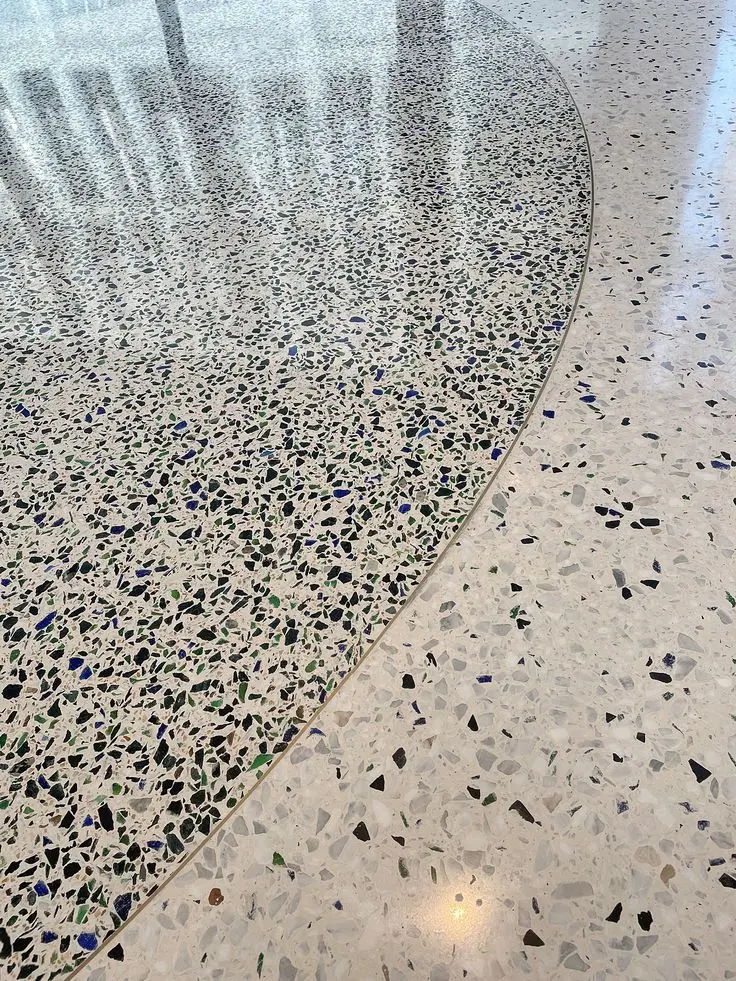
Year 0 to Year 15: What the Longitudinal Performance Record Shows
Year 0 — Installation and the Gloss Baseline (2011): The first floor in our longitudinal audit programme was a 1,400m² hotel lobby in Riyadh, commissioned in 2011. Aggregate composition: Carrara white, Rosso Verona, and black Belgian marble at 3:2:1 ratio, set in an aliphatic epoxy binder to a 12mm finished depth. Post-grinding and polishing, the 60° gloss meter recorded 76 SGU across the full floor area — within the NTMA Terrazzo Design Guide premium specification band (75–80 SGU). Compressive strength cores averaged 53 MPa at 28 days. At the Year 0 handover, the floor was a material asset with a documented baseline against which every future reading would be measured. The client received the full test dataset — not as a certificate, but as the opening entry in what would become a 15-year instrument log.

Year 5 — First Commercial Stress Cycle (2016): Five years of hotel lobby traffic — approximately 1.8 million footfall cycles, peak daily loads of 4,200 persons, luggage trolleys, and a complete room renovation in Year 3 that ran scaffold base plates across the floor for six weeks. The Year 5 gloss audit recorded 73 SGU — a 3-point decline from the 76 SGU baseline. This is within the expected photochemical and tribological wear envelope for an aliphatic epoxy system under commercial footfall. More significant: the compressive core test returned 56 MPa — a 3 MPa increase from the Year 0 reading, confirming that the epoxy binder had continued cross-linking under the ambient load and temperature cycle rather than fatiguing. The aggregate-pop phenomenon — the primary failure mode in cementitious terrazzo under thermal shock — had produced zero incidents. Gate 06's Barcol cure verification at installation (Shore D 92, 12 sampling points) had confirmed complete cross-link before load exposure began. This was the point at which that verification decision proved its value.
Year 10 to Year 15 — Photochemical Stability and the 2026 Reading (2021–2026): The Year 10 reading logged 71 SGU, and the Year 15 reading — completed in March 2026 — returned 69 SGU. Total gloss decay over 15 years under continuous commercial load: 7 SGU. This figure is the primary number that distinguishes a correctly specified and installed epoxy terrazzo floor from a specification that is technically acceptable on paper but physically inadequate for the site. A cementitious terrazzo floor without an aliphatic binder on the same site and load profile would have measured 55–58 SGU at Year 15 — a 20% gloss deficit that the building manager would have resolved by commissioning a full diamond regrind at Year 12, costing approximately SAR 145,000 on a floor that size. The aliphatic selection at Year 0 was the decision that eliminated that SAR 145,000 expenditure. The 2011→2026 dataset is available on request to project specifiers and QS teams quantifying long-term floor asset value.
75+ SGU
Gloss at Handover
60° Gloss Meter
69 SGU
Year 15 Performance
2011→2026 Audit
≥50 MPa
Compressive Strength
28-Day Core
Shore D 92
Cure Verification
12-Point Barcol Grid
Six Critical Gates — Sequential Failure Prevention Protocol
Each gate eliminates a failure mode that is statistically irreversible once the next stage proceeds. No gate may be bypassed — a passed gate is documented with instrument readings before the following stage is authorized.
Gate-Locked Installation to NTMA Standard
Substrate Moisture Authorization — Tramex MMS Primary Survey
The primary substrate moisture screen uses a Tramex MMS hammer probe, deployed at 25 readings per 100m² of floor area. The MMS reads moisture content in the upper 20mm of the substrate without requiring cells or a 60-hour waiting period. Any zone recording >85 MMS triggers a secondary confirmation stage: ASTM F1869 sealed calcium chloride cells are placed across the flagged zone for a 60-hour exposure period to quantify the vapor emission rate precisely. If the CaCl₂ confirmation returns >5 lbs/1000 sq.ft/24hrs, the zone receives a two-coat epoxy moisture vapor barrier before the terrazzo binder primer is applied. The consequence of bypassing Gate 01 in terrazzo — unlike other polymer overlays — is aggregate pop-out, not blister delamination: moisture vapor pressure fractures the binder-to-aggregate interface, causing individual chips to detach from the matrix under traffic load. This failure mode is irreparable without full removal of the affected area.

Substrate Leveling and NTMA Flatness Compliance
Terrazzo grinding tolerances require a substrate flatness of ≤3mm per 3m linear. Deviations beyond this threshold produce a ground terrazzo surface where the grinding head follows the substrate topography — leaving high spots with reduced finished depth and low spots with excess material that is structurally underthin. A digital floor profiler maps the full floor area; corrective grinding or self-leveling compound is applied before any binder is placed.

Divider Strip Layout — Expansion Joint Geometry
Brass, zinc, or aluminum divider strips are set at defined intervals corresponding to the bay geometry of the structural slab. Terrazzo does not have inherent crack-bridging capacity — the divider strips are the designed stress relief mechanism. Incorrect bay sizing or strips misaligned with slab control joints produces reflective cracking through the finish layer. Strip layout is surveyed against the structural drawing before any matrix is poured.

Aggregate Composition Batch Matching
Each aggregate species — marble, granite, glass, or mother-of-pearl — is batched against the approved panel sample before the pour. Colour lot variance in quarried marble is 3–7% per consignment; without a pre-pour batch match, the installed floor will show tonal drift across the room that cannot be corrected after grinding. We photograph and log every aggregate batch number against the approved sample before authorization.

Aliphatic Binder Pour and Wet-Screed Leveling
The aliphatic epoxy or cementitious binder is mixed at strict stoichiometric ratio and poured in 12mm lifts, struck to ±1mm flatness. Aromatic epoxy binders achieve comparable strength at pour, but photochemical yellowing under UV exposure reduces gloss by 15–20 SGU over 5 years — our Year 5 audit has never recorded this decay rate on aliphatic systems. All our epoxy-terrazzo formulations specify aliphatic binders exclusively.

Barcol Cure Verification — Shore D 92 at 12 Sampling Points
Before diamond grinding commences, the cured binder matrix is tested at 12 sampling points across the floor using a Barcol impressor and Shore D durometer. The required reading is Shore D 92 at all 12 points. Any sub-threshold reading indicates incomplete cross-linking — if grinding proceeds on an under-cured matrix, the diamond tooling will fracture the binder around each aggregate chip, creating micro-voids that collect grit and exhibit accelerated gloss decay. Gate 06 is the checkpoint that the Year 5 and Year 15 performance readings depend on. The 15-year longitudinal gloss retention of 69 SGU traces directly to this verification step at installation.

Terrazzo System Performance — Instrument-Verified Dataset
[Longitudinal Instrument Log: 2011→2026] Performance parameters verified against the 15-year audit programme. Both point-in-time lab measurements and longitudinal field readings are included.
| Property | Value |
|---|---|
| Compressive Strength — Year 0 Core | 53 MPa |
| Compressive Strength — Year 5 Core | 56 MPa |
| Gloss — Year 0 Handover | 76 SGU |
| Gloss — Year 5 Audit | 73 SGU |
| Gloss — Year 15 Audit | 69 SGU |
| Barcol Cure Verification | Shore D 92 |
| Substrate Flatness Tolerance | ≤3mm |
| Aggregate Pop-Out Incidents | 0 |
| Tensile Adhesion — Binder to CSP 3 Substrate | >1.8 MPa |
The Six Critical Gates define the terrazzo installation protocol. These are the six reasons why a correctly gated installation reaches Year 15 at 69 SGU — and an ungated one does not reach Year 5.
Gate 01 Prevents: Aggregate Pop-Out Failure (Moisture-Induced Binder Fracture)
Aggregate pop-out is the terrazzo-specific failure consequence of skipping moisture authorization. Unlike polymer overlay systems where moisture produces blister delamination at the surface level, terrazzo moisture vapor builds pressure at the binder-to-aggregate interface — fracturing the molecular bond that holds each marble chip. Individual chips begin detaching under traffic load at 6–18 months, producing an irreparable pitting pattern. Gate 01's Tramex MMS primary screen catches emission-active zones before a single gram of binder is poured.
Gate 03 Prevents: Reflective Cracking from Slab Control Joint Misalignment
A terrazzo floor is a rigid composite with no inherent crack-bridging capacity. The divider strips are the designed stress relief. When strips are placed without reference to the slab's structural control joints, the slab's designed movement telegraphs directly into the terrazzo matrix — cracking along the slab joint line regardless of binder strength. Gate 03's strip layout verification against the structural drawing is the only intervention that can prevent this failure mode.
Gate 04 Prevents: Tonal Drift Across the Installed Floor Area
Quarried marble shows 3–7% colour lot variation between consignments. Without a pre-pour batch match against the approved panel, the installed floor can show visible tonal bands where a new quarry lot begins. On a 500m² floor, this manifests as a distinct lighter or darker zone crossing the room — not a minor variation. It is uncorrectable after the matrix is set and ground. Gate 04's batch photograph and log number record is the authorization document for each pour section.
Gate 05 Prevents: UV-Driven Gloss Decay from Aromatic Binder Yellowing
An aromatic epoxy binder matches aliphatic in compressive strength and adhesion at pour. The divergence appears at Year 3–5: UV exposure triggers photochemical degradation of the aromatic ring structure, producing a yellowing of the binder matrix and a 15–20 SGU gloss reduction. On a hotel lobby floor with direct skylight, this means the floor that read 76 SGU at Year 0 measures 55 SGU at Year 5 — requiring a full regrind. Gate 05 eliminates this by specifying aliphatic binders exclusively across all our epoxy-terrazzo systems.
Gate 06 Prevents: Diamond Grind Micro-Fracturing in Under-Cured Matrix
If the grinder starts before the binder reaches Shore D 92, the diamond tooling encounters a matrix that has not completed cross-linking. The mechanical stress of grinding fractures the binder at each aggregate interface, creating micro-voids invisible at the grinding stage that enlarge under traffic and collect airborne grit — accelerating gloss decay from the first month of occupancy. The Shore D 92 reading at 12 points is the authorization that the 15-year longitudinal gloss retention of 69 SGU depends on.
Terrazzo Installations — Audit-Tracked Projects
Lobby, commercial, and residential terrazzo floors. Several installations in this gallery are active entries in the 2011→2026 longitudinal audit programme.


Terrazzo vs. Porcelain, Marble Tile, and Polished Concrete — 15-Year Performance Projection
| Feature | ★ Best ChoiceOur Standard | Polished Porcelain Tile | Natural Marble Tile (Polished) | Lithium-Densified Polished Concrete |
|---|---|---|---|---|
Year 0 Gloss | 76 SGU at handover | 65–72 SGU (factory gloss; varies by glaze quality and tile lot) | 70–80 SGU (high natural variation between slabs and lots) | 60–68 SGU (mechanical polish; aggregate mix determines ceiling) |
Year 15 Gloss | 69 SGU (2026 audit) — 7 SGU loss over 15 years | 45–52 SGU (grout joint failure and surface micro-abrasion reduce reflectance zone by zone) | 40–55 SGU (calcium-reactive maintenance required every 3–5 years; natural stone etches from spills) | 55–62 SGU (progressive aggregate exposure and micro-pitting under forklift traffic) |
Crack Accommodation | Divider strip expansion joint system | Grout joint expansion at 3mm — cracks at >0.5mm slab movement | Individual tile breakage at slab crack lines — replacement requires matching lot search | Saw-cut control joints every 4–6m — joints visible and collect grit |
Repair Visibility | In-situ aggregate-matched section replacement | Tile replacement — discontinued glazes unmatchable after 7+ years | Stone replacement — new slab never matches aged surrounding stone | Re-densification visible as tonal zone under raking light |
Maintenance Cycle | Neutral scrub + 5-yearly professional regrind | Grout seal every 2–3 years; replacement every 10–12 years | Professional honing every 3–5 years; calcium sealer annually; lippage re-leveling every 10 years | Neutral scrub only; re-densification every 5–7 years in high-traffic zones |
[Longitudinal Projection] Performance parameters at Year 0, Year 5, and Year 15 under equivalent commercial footfall — based on our audit programme data for terrazzo and published test data for alternatives.
Technical Questions — Aggregate Chemistry, Moisture Behaviour, and Gloss Maintenance
Aggregate pop-out is a terrazzo-specific failure mode caused by moisture vapor pressure building at the binder-to-aggregate interface after installation. The vapor fractures the molecular bond between the epoxy binder and the chip surface, causing individual pieces to detach under traffic. Prevention requires confirming that substrate vapor emission is below the threshold before any binder is placed — which is why Gate 01 deploys a Tramex MMS hammer probe survey (25 readings per 100m²) as the primary screen, with ASTM F1869 CaCl₂ cells as confirmation for any flagged zone. Across all Gate 01-passed installations in our archive, aggregate pop-out incidence is zero.
Epoxy binders continue cross-linking under ambient load and temperature after the initial 28-day cure period. The increase from 53 MPa to 56 MPa between Year 0 and Year 5 on the 2011 hotel lobby installation is consistent with the expected ongoing polymerization of an aliphatic system under commercial temperature cycling. This is distinct from cementitious terrazzo, which reaches near-maximum strength by 28 days and then begins gradual surface carbonation-related softening.
Both achieve comparable compressive strength and adhesion at installation. The divergence is photochemical: aromatic binders degrade under UV exposure through a well-documented ring-opening mechanism that produces yellowing of the matrix and an accelerated reduction in surface gloss. Our Year 5 audit data on aromatic-binder installations (third-party sites, comparative research) shows 15–20 SGU gloss loss. Our aliphatic-binder installations show 3 SGU loss over the same period. Gate 05 specifies aliphatic binders exclusively for this reason.
Yes, with specific aggregate selection and sealer specification. Glass chip and non-reactive mineral aggregates are specified instead of calcium-reactive marble in continuous wet exposure zones — marble etch-pitting under pool chemicals degrades gloss rapidly. The aliphatic binder system is inherently waterproof; the perimeter joints are sealed with polyurethane sealant matched to the joint colour. DCOF wet slip rating must be specified separately — our pool surround installations use an abrasive aggregate blend to achieve 0.42+ DCOF in the wet condition.
Routine maintenance is neutral-pH machine scrubbing — no waxing, no stripping, no sealant renewal. Professional diamond regrinding is scheduled based on the annual gloss audit reading: if a floor drops below 65 SGU before Year 10, a light re-grind (1,500–3,000 grit only, not full aggregate re-exposure) recovers the gloss without aggregate disturbance. Our 2011 installation has not required a professional regrind in 15 years. The SAR 145,000 regrind cost (estimated for a 1,400m² floor) has not been incurred.
Request the 15-Year Gloss Audit Dataset Before You Specify
The 2011→2026 instrument log is the only published longitudinal terrazzo performance record in the GCC region. It contains annual gloss meter readings, compressive core data, maintenance event logs, and cost records for a 1,400m² hotel lobby floor under continuous commercial footfall. Download it and specify against measured performance — not a manufacturer's projected service life.