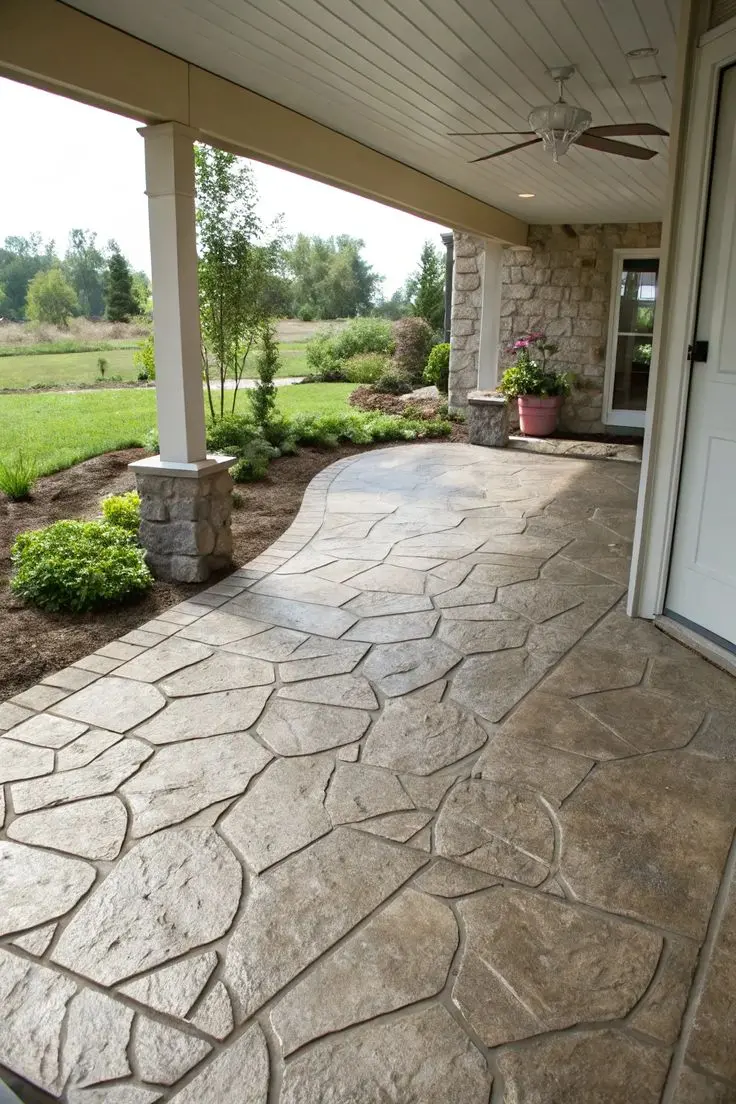
Why Walkways Need a Different Approach Than Flat Slabs
A walkway rarely runs in a straight line. It curves around landscape features, follows natural terrain contours, and changes width as it moves from a narrow garden path to a wider entry approach. This makes formwork the critical skill — bending forms to achieve smooth curves without kinks, holding consistent width through turns, and managing elevation changes where the path steps up or down with the terrain.
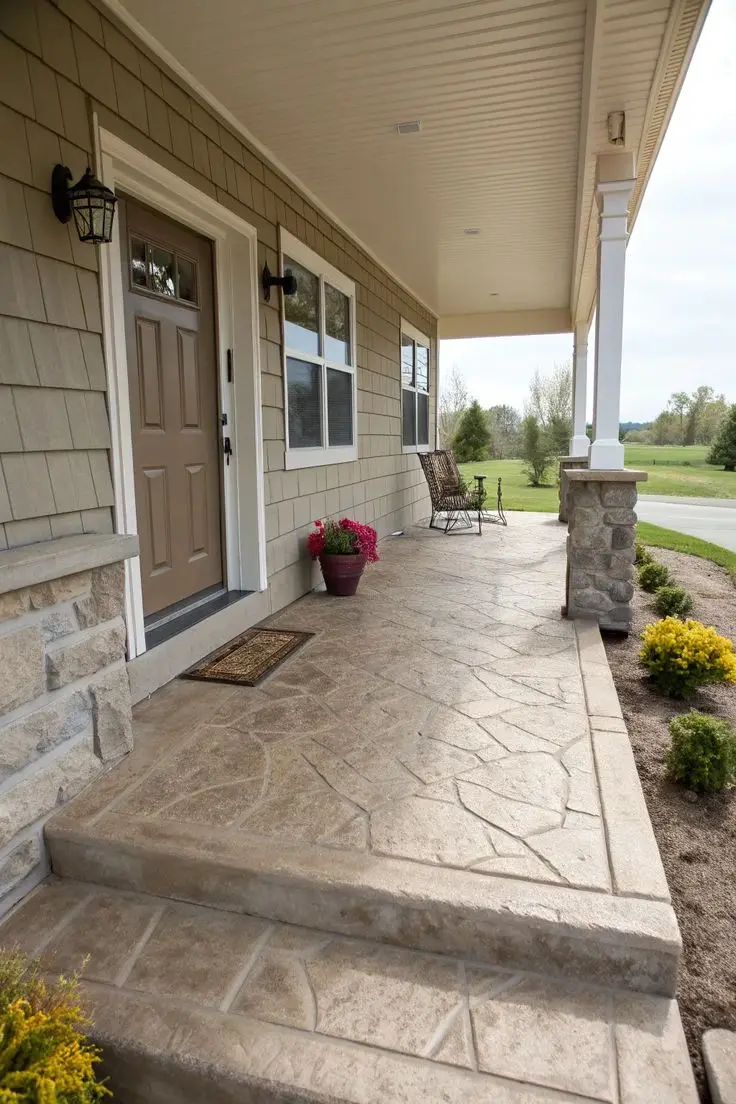
The structural requirements are lighter than a driveway or patio. Walkways carry foot traffic only, so the slab can be thinner and the reinforcement lighter. But the narrower width introduces its own challenge: control joints must be placed more carefully because a crack across a 900mm-wide path is far more visible and disruptive than one across a 6-meter patio. Joint placement follows the stamp pattern's natural lines so the path reads as continuous stone or brick.
Pattern selection matters differently here too. On a wide driveway or patio, large-format patterns like ashlar slate work well because the surface area lets the pattern repeat naturally. On a narrow walkway, smaller patterns like cobblestone, running bond brick, and irregular flagstone scale better. They fill the width without awkward cuts at the edges, and their detail holds visual interest even on a surface you might only be 600mm wide.
What Stamped Concrete Brings to Walkways
Follows Any Curve
Flexible formwork lets the path sweep around trees, garden beds, and water features in smooth arcs. No straight-line constraint, no angular corners forced by rigid paving units.
Stable Footing Year-Round
A continuous slab stays flat. Individual stepping stones shift in sand over time, and loose gravel scatters under foot traffic. A monolithic walkway eliminates trip hazards from displaced or settled units.
Works With the Landscape
The path pours directly up to planting beds, lawn edges, and garden borders without transition strips. Grade changes are built into the formwork, so the walkway rises and falls with the terrain naturally.
No Weeds Between Joints
Sand-jointed pavers and stepping stones create pathways for weed growth within months. A sealed, joint-free stamped surface eliminates the gaps where seeds germinate and roots establish.
Safe After Dark
A smooth, continuous surface without raised edges or displaced units is safer for evening use. Low-voltage path lighting illuminates a predictable surface rather than an uneven collection of individual pieces.
Patterns That Scale to Walkway Widths
Walkways are narrow. The pattern needs to fill the width without awkward edge cuts, hold visual detail at close viewing distance, and scale from a 600mm garden path to a 1200mm entry approach.
Random Flagstone
Irregular shapes fill any width naturally without visible edge cuts. The organic look blends with garden landscaping, and deep texture channels water off the walking surface effectively. The most requested walkway pattern.
European Cobblestone
Small, dense units that scale perfectly to narrow widths. The pronounced surface relief provides excellent grip in shaded garden areas where moisture lingers. Works equally well as a full walkway or as a decorative border along a larger path.
Running Bond Brick
Linear brick coursing that runs parallel to the path direction, drawing the eye forward and making walkways feel longer. The regular geometry stamps efficiently on narrow surfaces and absorbs control joints cleanly.
Wood Plank
Realistic timber grain cast from weathered wood. Creates a boardwalk aesthetic through garden areas without the rot, termite damage, and warping that make real wood paths impractical in Saudi Arabia's climate.
Garden Path Project: A Walkway That Defines the Landscape
The property had a large landscaped garden with mature trees, raised planting beds, and a 400mm elevation change between the rear patio and a lower garden seating area. The existing gravel paths washed out during rain, shifted under foot traffic, and required constant raking. The owner wanted permanent paths that followed the existing garden layout without removing any established plantings or altering the terrain.
Curved formwork was set around every tree and garden bed, following the natural walking lines the family had already established through the gravel. The elevation change was handled with three gradual steps integrated into the path, each formed and stamped as part of the continuous pour. Random flagstone pattern was chosen in a warm sandstone color to complement the garden's natural tones. The path width expanded from 900mm through garden sections to 1200mm at the approach to the lower seating area, creating a natural sense of arrival.
The walkway system replaced 85 linear meters of gravel with a permanent, joint-free surface that follows the original garden paths exactly. No plants were removed, no terrain was regraded beyond the path footprint. The integrated steps eliminated the previous trip hazard at the elevation change. Six months after installation, the paths show no movement, no weed growth, and the family reports using the lower garden area daily rather than avoiding it.
How a Walkway Gets Built
Walkway installation is defined by formwork precision. The path must follow curves smoothly, hold consistent width, and manage grade changes — all within a narrow working area between established landscape features.
Layout and String Line
The path route is marked on site following the designed alignment. String lines or flexible layout hoses define both edges through curves. Width consistency is checked at regular intervals. Any grade changes, steps, or transitions to other surfaces are marked and elevation is established with a transit level.
Half day
Excavation and Sub-Base
The path footprint is excavated to the required depth — typically 175–200mm total for the sub-base and slab combined. Excavation in established gardens requires care around root zones and irrigation lines. A compacted aggregate sub-base of 50–75mm is placed and leveled. Lighter than driveways because walkways carry only foot traffic.
1 day
Curved Formwork
Flexible form boards are bent to follow the layout curves and secured at close intervals to hold smooth arcs. This is the most skill-intensive step on a walkway project. Any kink or flat spot in the formwork shows permanently in the finished edge. Reinforcement mesh is positioned at mid-depth.
1 day
Pour, Stamp, and Finish
Concrete with integral pigment is placed continuously along the path length. On long walkways, the crew works in manageable sections to maintain the stamping window. Release agent and stamp mats are applied in sequence. The narrow width means mat alignment is critical — the pattern must center on the path without running off either edge.
1 day
Curing and Sealing
After curing, excess release agent is washed off. Control joints are saw-cut at calculated intervals, aligned with the pattern's natural grout lines. UV-stabilized sealer is applied to protect the color and surface. Foot traffic is safe after sealer cure, typically within a few days.
3–5 days cure
Walkway Pricing
Stamped concrete walkways in Saudi Arabia typically range from SAR 65–90 per square meter. The lower baseline compared to driveways and patios reflects the lighter structural requirements — thinner slab, lighter reinforcement, and a smaller sub-base. The cost variable on walkways is formwork complexity, not structural engineering.
SAR 65–75/m²
per m²
Straight and Simple
Straight or gently curved path, single pattern, one integral color, standard reinforcement, and acrylic sealer. For front entry approaches and utility connections between outdoor areas.
- ✓Straight or gentle curves
- ✓One stamp pattern
- ✓Single integral color
- ✓UV-stabilized acrylic sealer
SAR 75–90/m²
per m²
Garden Path
Complex curves around landscape features, width transitions, integrated steps or grade changes, two-tone color, and premium sealer. For garden paths, landscape walkways, and winding residential connections.
- ✓Complex curved formwork
- ✓Width transitions
- ✓Integrated steps or grade changes
- ✓Two-tone color and premium sealer
All Floroz walkway quotes are itemized. Every cost element is visible before work begins.
Request a Walkway AssessmentWalkway Questions
The practical minimum is about 600mm for a single-person garden path. Below that, the stamp pattern cannot reproduce properly and the path feels cramped to walk. For main entry approaches and paths where two people walk side by side, 1200mm or wider is standard. Width can vary along the path's length, narrowing through garden sections and widening at entry points or seating areas.
Yes. Flexible formwork bends to follow any curve radius. The path can sweep around tree trunks, wrap along garden bed edges, and follow natural terrain contours. The key is maintaining smooth curves without kinks — this is a formwork skill, not a material limitation. Root protection measures are taken around mature trees to avoid damage during excavation.
Steps are formed and poured as part of the continuous walkway. They receive the same stamp pattern and color as the flat sections, so the transition is visually seamless. For gradual slopes, the path can ramp smoothly. For steeper changes, formed steps with a consistent rise height provide safe, predictable footing. Non-slip texture on step treads is standard.
Tree roots grow toward moisture and can exert significant force on lightweight surfaces. A properly placed walkway accounts for this: the path alignment keeps adequate distance from major root zones, the sub-base provides a buffer layer, and control joints are positioned to allow minor movement without visible cracking. For paths near large established trees, the route is planned to avoid the primary root zone entirely.
The stamp texture itself provides meaningful grip. In permanently shaded garden areas where moisture lingers, deeper-texture patterns like cobblestone and flagstone perform better than shallow seamless textures. Anti-slip aggregate can be mixed into the sealer for additional wet traction in areas where the path passes through irrigated planting zones or stays shaded most of the day.
Every Property Needs Paths That Actually Work
We walk your property, assess the terrain, plan the route around your landscape, and specify the right path width, pattern, and finish for each section. Every Floroz walkway quote is itemized.