Why Driveways Need a Different Specification
A stamped concrete driveway deals with conditions no other residential surface faces. It supports the concentrated point loads of vehicle tires, not just parked weight but the dynamic forces of turning, braking, and acceleration. In Saudi Arabia, it absorbs daily temperature swings that can exceed 60°C between midday sun and nighttime cooling. And it is constantly exposed to engine oil, transmission fluid, and brake dust that attack sealers and stain unprotected concrete.
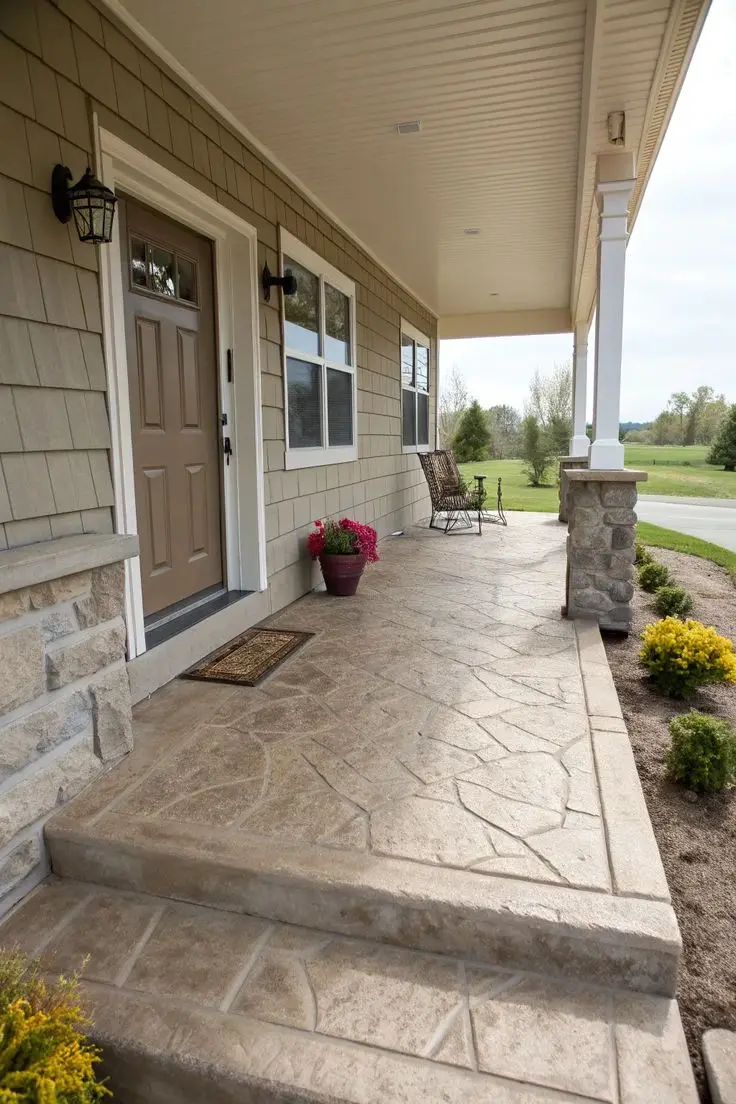
This is why driveway specs cannot match a patio or walkway. The slab needs to be thicker, the reinforcement heavier, the sub-base engineered for load distribution rather than just drainage. The concrete mix targets higher compressive strength. The surface gets a hardener for tire abrasion resistance. The sealer blocks hydrocarbon penetration while maintaining UV stability. Every layer from the compacted sub-grade to the final seal coat is specified for the forces this specific surface will encounter.
Patterns that perform well on driveways share three characteristics: defined joint lines that absorb control joints invisibly, sufficient texture depth for tire traction without catching debris, and a visual scale that reads clearly across a wide, flat expanse. Not every pattern in the library works here.
What Changes When You Switch to a Stamped Driveway
No Settling Under Tire Loads
A monolithic slab distributes vehicle weight across its full area. Pavers concentrate load on single units and their sand bedding, leading to localized sinking and trip hazards over time.
Oil and Fluid Resistance
Sealed stamped concrete blocks engine oil, transmission fluid, and brake dust from penetrating the surface. Spills wash off instead of leaving permanent marks.
Clean Entry from Year One
The driveway is the most visible surface on any property. A continuous slab means no sand-filled joints where weeds establish and spread across your entrance.
Handles Saudi Arabia's Thermal Cycling
The slab expands and contracts as one unit through pre-planned control joints. Segmented paving pushes individual pieces apart in extreme heat, opening joints and creating uneven surfaces.
Curb Appeal That Lasts
A well-executed stamped finish turns the driveway from a plain utility slab into an architectural feature. Integral color means the appearance does not depend on a surface coating that wears away.
Simpler Long-Term Care
Paver driveways need periodic re-sanding, releveling, and weed treatment. Stamped concrete needs resealing every few years. That is the entire maintenance cycle.
Patterns That Work Under Tire Traffic
Not every stamp pattern suits a driveway. These are selected for vehicle-load performance: enough texture for traction, defined joints that hide control cuts, and a scale that reads well across a wide surface.
Ashlar Slate
The most specified driveway pattern. Rectangular geometry aligns naturally with control joints, moderate texture provides traction without catching debris, and it works with both modern and traditional facades.
European Cobblestone
Dense, small-unit pattern with excellent grip. Works well for driveway aprons, turning areas, and accent bands bordering a larger field pattern.
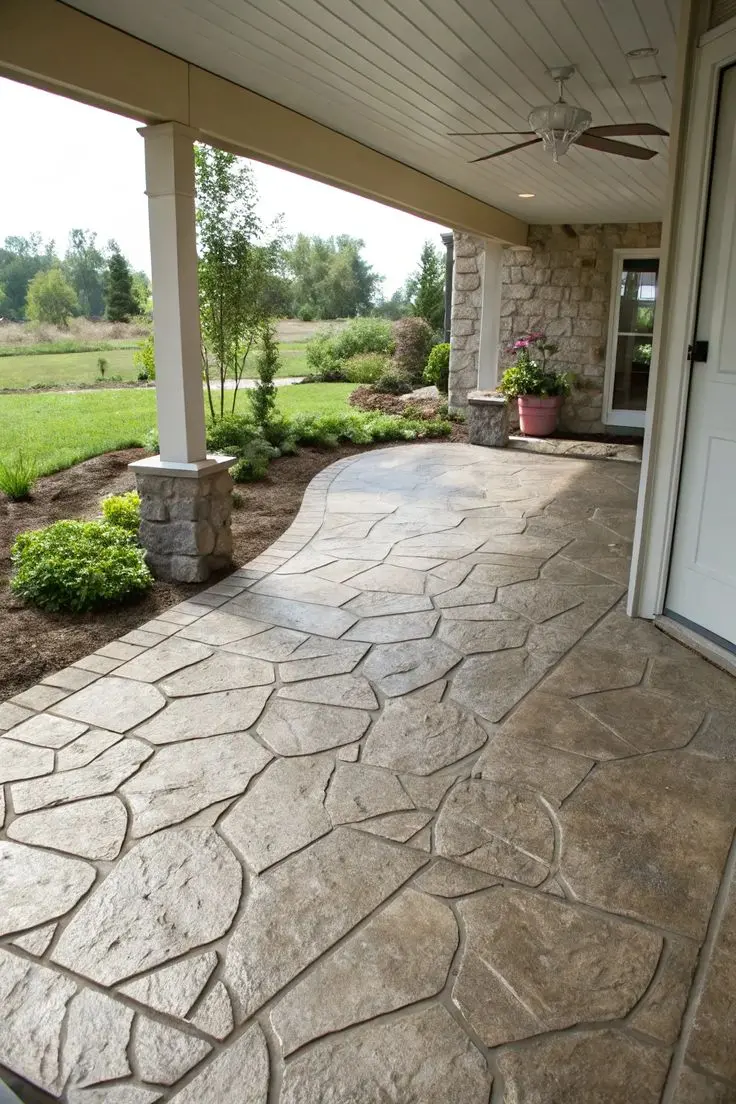
Random Flagstone
Irregular stone shapes that absorb control joints into the natural randomness of the design. The organic look complements landscaped entries and formal approaches alike.
Herringbone Brick
Interlocking diagonal coursing that draws the eye along the driveway's length. A classic choice for traditional architecture and properties with brick facades.
Running Bond Brick
Simple, linear brick coursing for a clean, orderly surface. Regular geometry makes it efficient to stamp, and the defined lines absorb control joints with minimal visual interruption.
How a Driveway Gets Built
A driveway pour follows a stricter sequence than lighter-use surfaces. Every step here is specific to vehicle-load requirements.
Sub-Grade Assessment and Base Preparation
The existing soil is evaluated for bearing capacity and drainage. The sub-grade gets excavated to the engineered depth, and a compacted aggregate base is laid in lifts, typically 100–150mm of graded crushed stone mechanically compacted to form a stable platform. Poor soil or high water tables mean additional base depth or drainage provisions.
1–2 days
Formwork and Steel Placement
Perimeter forms define the driveway outline, elevation, and drainage pitch. Steel reinforcement is positioned at mid-depth. Control joint locations are pre-planned to align with the stamp pattern. Edges get thickened where the driveway meets the street or transitions to other surfaces.
1 day
Concrete Pour and Color Integration
The mix, specified for the required compressive strength with integral pigment, is placed continuously to avoid cold joints. The surface is screeded and floated. For driveways, dry-shake color hardener is typically broadcast and worked into the surface to increase density and abrasion resistance under tires.
Same day
Stamping
Release agent goes down, then stamp mats are laid in sequence starting from the most visible edge. Timing is everything: the slab must be firm enough to hold the impression but plastic enough to accept the full texture depth. The crew works continuously across the entire area within the stamping window.
Same day
Curing, Joint Cutting, and Sealing
After curing, excess release is washed off revealing the final color contrast. Control joints are saw-cut along pre-planned pattern lines. The sealer, selected for UV stability and hydrocarbon resistance, goes on in controlled coats. Pedestrian use is safe after sealer cure. Vehicles wait until the concrete reaches adequate strength.
5–10 days total
Engineering Specifications for Driveways
These apply to residential driveways carrying standard passenger vehicles. Heavier vehicles require additional engineering.
| Property | Value |
|---|---|
| Slab Thickness | 150mm minimum |
| Compressive Strength | 4,000+ PSI (28 MPa min.) |
| Reinforcement | Steel rebar or welded wire mesh |
| Sub-Base Depth | 100–150mm compacted aggregate |
| Control Joints | 3m maximum spacing |
| Surface Treatment | Integral color + dry-shake hardener |
| Sealer | UV-stabilized acrylic, hydrocarbon-resistant |
Stamped vs. Pavers vs. Plain Concrete for Driveways
Driveways face vehicle loads, tire wear, fluid exposure, and high visibility. These factors affect material choice differently than lighter-use surfaces.
| Feature | ★ Our StandardStamped Concrete | Interlocking Pavers | Plain Concrete |
|---|---|---|---|
Load Handling | Monolithic slab distributes weight across the full area. Nothing shifts or rocks under concentrated tire loads. | Individual units on sand bedding. Turning and braking forces displace units over time, creating uneven patches that need periodic releveling. | Same monolithic performance as stamped concrete. Equal structural capability without any decorative finish. |
Appearance | Full stone or brick texture with integral color. The driveway becomes a design feature rather than a utility surface. | Factory-formed units with consistent shapes. Visual variety through unit color and laying pattern, but limited texture depth. | Plain gray surface. Functional but adds nothing to property aesthetics. |
Stain Resistance | Sealed surface blocks oil and fluid penetration. Spills wash off. Sealer is renewed periodically. | Fluids soak into sand joints and porous paver surfaces. Staining is often permanent. | Unsealed concrete absorbs fluids readily. Oil stains are permanent without a sealer. |
Ongoing Maintenance | Resealing every few years. No other recurring work. | Joint re-sanding, unit releveling, weed management, and ant treatment throughout the driveway's life. | Minimal maintenance but no aesthetic value. Stains and cracks are visually prominent. |
Stamped concrete delivers the structural performance of plain concrete with the visual impact of premium paving, at a lower long-term maintenance cost than pavers.
What Determines the Price
Stamped concrete driveways in Saudi Arabia typically run SAR 80–120 per square meter, covering materials, sub-base, reinforcement, stamping, and sealing.
SAR 80–95/m²
per m²
Standard
Single pattern, one integral color, standard reinforcement, and acrylic sealer. Suits straightforward driveway areas with good site access.
- ✓One stamp pattern
- ✓Single integral color
- ✓Standard rebar grid
- ✓UV-stabilized acrylic sealer
SAR 95–110/m²
per m²
Enhanced
Field pattern with contrasting border, two-tone color, surface hardener for extra tire abrasion resistance, and premium sealer.
- ✓Field + border combination
- ✓Two-tone color
- ✓Dry-shake hardener
- ✓Premium sealer with hydrocarbon resistance
SAR 110–120/m²
per m²
Premium
Custom multi-pattern layout, hand-applied accent work, heavy reinforcement for larger vehicles, and penetrating sealer.
- ✓Custom multi-pattern design
- ✓Hand-applied accents
- ✓Heavy reinforcement
- ✓Penetrating sealer
All Floroz driveway quotes are itemized. Every cost element is visible before work begins.
Request a Driveway AssessmentDriveway Questions
A properly built stamped driveway is designed for vehicle loads. The 150mm slab, steel reinforcement, and compacted sub-base provide the structural capacity for passenger vehicles. The stamping textures only the surface layer and does not reduce load-bearing capacity. Cracking under vehicles almost always traces back to sub-base preparation or slab thickness, not the stamping.
Concrete gains strength progressively during curing. Walking is typically safe after sealer cure. Vehicle traffic should wait until the slab reaches adequate compressive strength, which depends on the mix, temperature, and humidity. Your installer will specify the wait period. Loading the slab too early risks surface damage.
A sealed stamped driveway resists hydrocarbon penetration. Oil and fuel sit on the surface rather than soaking in, and prompt cleanup prevents residual marks. The sealer is the barrier, though. If the sealer deteriorates without renewal, the concrete underneath becomes vulnerable to absorption. Keeping the sealer on schedule prevents this.
Localized damage can be repaired with a stampable patching compound that accepts color and texture matching. Achieving an invisible repair requires skilled work since the patch must match surrounding color, texture, and sealer sheen. The trade-off: damage needing repair is far less common on a monolithic slab than on segmented paving, where individual unit displacement is routine.
In direct midday sun during summer, any hard surface in Saudi Arabia gets hot. Lighter integral colors like sandstone tones, light gray, and desert beige absorb less radiation and stay cooler than dark surfaces. Heat-reflective sealers reduce surface temperature further. For barefoot areas, lighter colors and partial shade are the most effective solutions.
Your Driveway Sees More Traffic Than Any Other Surface on Your Property
We assess site conditions, soil, vehicle loads, and design preferences before specifying anything. Every Floroz driveway quote is itemized so you see what each component costs before work begins.