What Makes a Courtyard Different From Every Other Outdoor Surface
A courtyard sits inside the architecture rather than beside it. Walls on three or four sides mean the surface is viewed from windows, doorways, and balconies at close range and from every direction. There is no distant viewing angle to smooth out imperfections. The stamp pattern, color consistency, and edge finishing are inspected at the standard people apply to interior floors, not exterior hardscape.
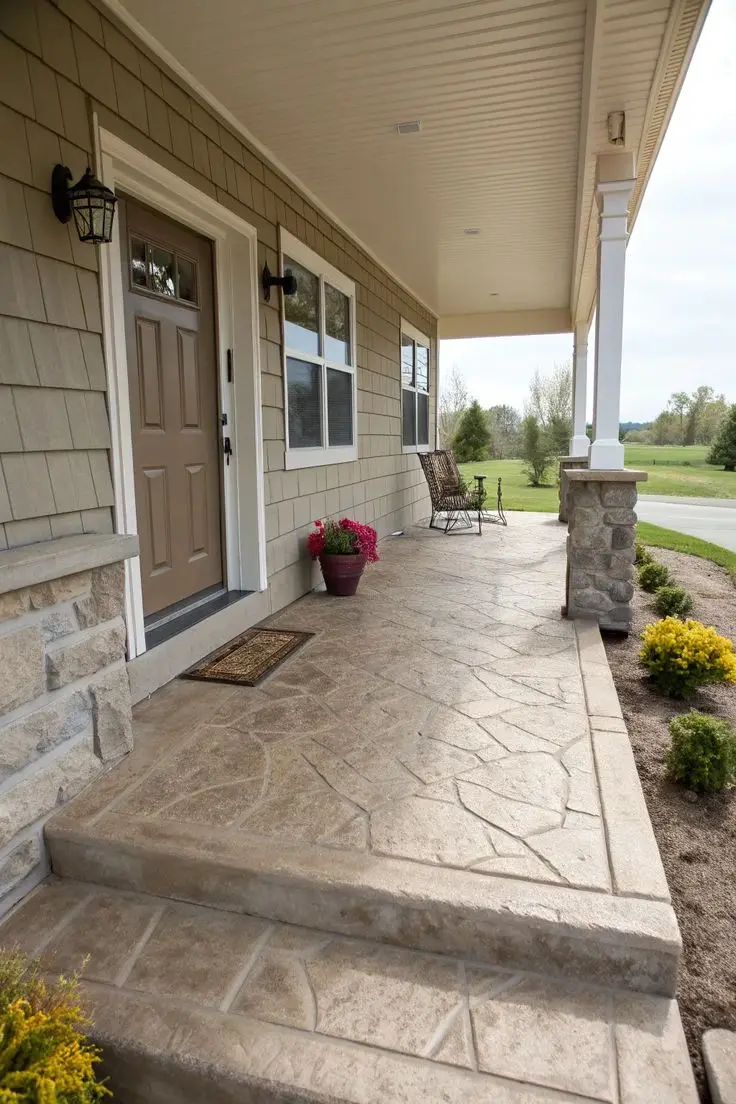
Drainage is the engineering challenge unique to courtyards. An open patio sheds water outward across its edges. A walled courtyard traps water inside the enclosure. The entire surface must pitch toward discrete drain points — typically a central drain or perimeter channel — with enough fall to clear standing water but not so much that furniture sits unevenly. In Saudi Arabia, where sudden heavy rainfall can dump significant volume in minutes, the drainage system must handle peak flow without flooding the enclosed space.
Wall integration is the third distinction. The stamped slab must terminate cleanly at every wall face with an expansion joint that accommodates the different thermal movement rates of the slab and the surrounding structure. This joint is visible at close range, so it must be filled with color-matched flexible sealant that reads as a deliberate architectural detail rather than a construction gap.
Courtyard Specifications at a Glance
360°
Viewing Angle
Walls on all sides mean the surface is seen from every direction and close range
Enclosed
Drainage Engineering
Water must reach internal drains — no open edges to shed runoff
Wall-to-Wall
Edge Precision
Every edge meets architecture with expansion joints and color-matched sealant
SAR 80–110
Per Square Meter
Materials, drainage, stamping, wall integration, and sealing included
Patterns for Architectural Enclosures
Courtyard patterns are viewed from above and at close range simultaneously. The pattern must hold detail under close inspection, scale to the courtyard's geometry, and complement the surrounding architecture rather than compete with it.
Ashlar Slate
Rectangular panels in staggered layout. The clean geometry aligns with architectural walls and columns, absorbs control joints at natural panel breaks, and delivers a formal finish that reads correctly in enclosed spaces. The most specified courtyard pattern.
Random Flagstone
Irregular organic shapes that soften the geometry of a walled enclosure. The natural randomness prevents the enclosed space from feeling too rigid or formal. Deep texture helps move drainage water across the surface toward collection points.
Seamless Slate Texture
Continuous stone texture with no defined joints. Creates an expansive, unbroken floor plane that makes smaller courtyards feel larger. The subtle surface variation maintains visual interest without introducing busy pattern lines.
Old-World Cobblestone
Dense, small-unit pattern with historical character. Suits traditional Saudi architectural courtyards, mashrabiya-enclosed spaces, and properties where the courtyard is a central gathering area with heritage design language.
Large-Format Tile
Clean, regular geometry with wide joint lines. A modern choice for contemporary courtyards, commercial atriums, and entry courts where the architecture demands a refined, minimal surface.
Courtyard Projects Across Saudi Arabia
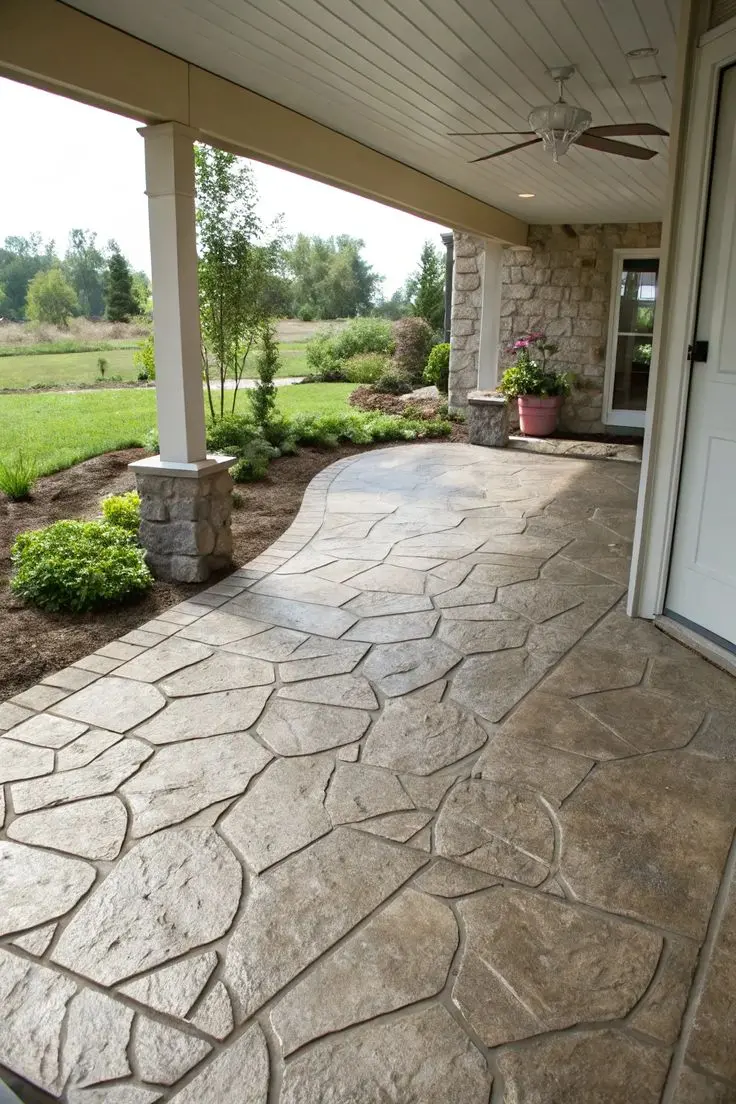
Each courtyard presents unique geometry, drainage requirements, and architectural context. These projects show how stamped concrete adapts to different enclosed outdoor spaces.
Building a Courtyard Surface
Courtyard installation is defined by precision at the edges and drainage engineering within an enclosed space. The walls are already in place, so every measurement and grade must be exact before concrete arrives.
Enclosed Drainage Design
The drainage plan comes first. In an enclosed courtyard, water has no open edge to exit. Drain locations are set, and the entire surface grade is calculated to deliver water to these points. The pitch must be steep enough to clear standing water efficiently but subtle enough that furniture and foot traffic are not affected. Drain positions are planned to align with the stamp pattern's natural joint lines.
1 day design + 1 day drainage install
Sub-Base Within Existing Walls
Working inside a walled space limits equipment access. Sub-base material is brought in through doorways and compacted in lifts. The grade follows the drainage design precisely. Existing wall footings, utility penetrations, and door thresholds are accounted for in the sub-base profile. Isolation joints are planned at every wall-to-slab interface.
1–2 days
Forming, Reinforcement, and Pour
In a courtyard, the walls are the forms. Edge strips are placed against each wall face with compressible expansion material between the concrete and the structure. Reinforcement mesh is positioned at mid-depth. The concrete with integral pigment is placed continuously across the enclosed area, working from the back toward the exit point.
1 day
Stamping and Detail Work
Stamp mats are laid starting from the most prominent viewpoint — typically the main doorway or the window wall. The pattern is aligned to the courtyard's geometry: in rectangular spaces, ashlar patterns run parallel to the longest wall. At wall edges, the pattern is cut cleanly with hand tools. Corners, drain surrounds, and column bases receive detailed hand work.
1 day
Curing, Joints, and Sealing
After curing and release wash, expansion joints at wall faces are filled with flexible, color-matched sealant. Control joints within the field are cut along pattern lines. The sealer is selected for the courtyard's exposure: covered courtyards need stain resistance; open-sky courtyards need UV stability and water resistance. The sealer finish is chosen for the close-range viewing environment.
3–7 days cure
Why Stamped Concrete Works in Courtyards
Wall-to-Wall Coverage
A single monolithic pour fills the entire courtyard from wall to wall. No tile grout lines to crack at the edges, no paver joints to collect debris in corners where walls meet the floor.
Engineered Enclosed Drainage
The drainage pitch is built into the slab during pouring. Water moves to discrete drain points within the enclosed space without visible channels or surface disruptions that interrupt the pattern.
Holds Up to Close Inspection
Courtyard surfaces are seen from windows, doorways, and balconies at short range. Integral color, precision stamping, and a controlled sealer finish create a surface that meets the visual standard of an interior floor.
Manages Enclosed Heat
Walls trap heat in a courtyard. Light integral colors and heat-reflective sealers reduce surface temperature, making the enclosed space usable during Saudi Arabia's hottest months rather than an oven that radiates heat.
Courtyard Surface Materials Compared
Courtyards combine the close-range inspection standards of interior floors with the weather exposure of outdoor surfaces. Not every material handles both demands.
| Feature | ★ Our StandardStamped Concrete | Natural Stone | Porcelain Tile |
|---|---|---|---|
Wall Integration | Pours directly to every wall face with engineered expansion joints. One continuous surface fills the entire enclosure without material transitions. | Individual stones must be cut precisely at every wall edge. Complex wall geometry and columns require skilled masonry. Mortar joints at walls need ongoing maintenance. | Tiles are cut to fit at walls but grout lines at the perimeter are stress points. Corner cuts are prone to chipping, and wall-to-tile junctions collect moisture. |
Drainage in Enclosed Spaces | The drainage pitch is integral to the slab. Water moves across a seamless surface to drain points without being trapped in joints or redirected by grout lines. | Mortar-bedded stone can be pitched correctly, but water collects in joints and the mortar bed underneath can retain moisture, leading to efflorescence and staining over time. | Grout lines collect standing water in low spots. The tile bed underneath retains moisture. Enclosed spaces with poor subsurface drainage develop mold and tile lifting. |
Close-Range Appearance | Integral color, deep texture, and controlled sealer finish create visual consistency across the entire surface. Color does not vary from unit to unit. | Natural material with inherent variation — each stone is unique. This is a benefit for organic aesthetics but can look inconsistent in formal architectural settings. | Factory-consistent color and finish. Excellent visual uniformity but the grout grid creates a busy visual pattern that can make small courtyards feel tighter. |
Long-Term in Enclosed Conditions | Resealing every few years. No grout to crack, no joints to re-sand, no individual units to replace. The monolithic slab is the simplest surface to maintain in a hard-to-access enclosed space. | Mortar joints crack from thermal cycling between sun-exposed and shaded areas of the courtyard. Individual stones may need releveling. Sealed porous stones need periodic resealing. | Grout cracks in thermal cycling conditions, especially where the courtyard has both sun and shade zones. Replacement tiles may not match the original batch. Grout color shifts over time. |
Stamped concrete provides the best combination of wall integration, drainage management, and low maintenance for enclosed courtyard environments. Natural stone delivers material authenticity with higher maintenance in enclosed conditions. Porcelain tile offers visual precision but introduces grout vulnerability and drainage challenges.
Courtyard Pricing
Stamped concrete courtyards in Saudi Arabia typically range from SAR 80–110 per square meter. The pricing reflects the precision work required in enclosed spaces: wall-to-wall edge finishing, enclosed drainage engineering, and the close-range surface quality that courtyards demand.
SAR 80–90/m²
per m²
Standard Courtyard
Single pattern, one integral color, standard reinforcement, drainage to a single point, and UV-stabilized acrylic sealer. For rectangular courtyards with straightforward geometry and good site access.
- ✓One stamp pattern
- ✓Single integral color
- ✓Single-point drainage
- ✓UV-stabilized acrylic sealer
SAR 90–105/m²
per m²
Architectural Courtyard
Pattern with border accent, two-tone color, multi-point drainage system, integration around raised planters or water features, and premium sealer.
- ✓Field + border pattern
- ✓Two-tone color work
- ✓Multi-point drainage
- ✓Feature integration
SAR 105–110/m²
per m²
Premium Courtyard
Complex geometry with columns, alcoves, or multi-level surfaces. Custom pattern alignment to architectural features, concealed drainage throughout, and penetrating sealer for maximum longevity.
- ✓Complex geometry stamping
- ✓Custom pattern alignment
- ✓Concealed drainage system
- ✓Penetrating sealer
All Floroz courtyard quotes are itemized. Every cost element is visible before work begins.
Request a Courtyard AssessmentCourtyard Questions
The slab is poured with a calculated pitch toward internal drain points. In a typical residential courtyard, this is a single central drain or a pair of drains positioned within the stamp pattern's natural joint lines. The pitch is subtle enough that furniture sits level but sufficient to clear standing water. For larger courtyards or areas with heavy rainfall, perimeter slot drains provide additional capacity. All drainage connects to the property's existing stormwater system.
Expansion joints between the slab and the walls accommodate the different thermal movement rates of the concrete and the surrounding structure. These joints are filled with flexible sealant that compresses and expands with temperature changes. The result is a clean, deliberate line at each wall face rather than an uncontrolled crack. The sealant can be color-matched to the stamp pattern so the joint reads as an intentional design element.
Yes. The stamped surface pours around raised planting beds, fountain bases, column footings, and built-in seating. Each feature gets its own isolation joint to accommodate independent movement. The stamp pattern wraps around these elements with hand-finished detail work at the transitions, so the surface reads as one continuous floor with features emerging from it.
Walls trap radiated heat and reduce airflow, so an enclosed courtyard can feel warmer than an open patio. The surface contribution is managed the same way: light integral colors reflect solar radiation, and heat-reflective sealers reduce the temperature the concrete reaches. For fully enclosed courtyards, partial shade structures or strategically placed trees within the courtyard provide the greatest comfort improvement.
Concrete is delivered through existing openings — doorways, gates, or service access points. For courtyards with limited or narrow access, a concrete pump extends reach from the delivery truck to the interior. The pump line can reach through corridors, around corners, and over walls. Material staging and crew access are planned before the pour day to ensure the work proceeds without interruption once concrete begins flowing.
Your Courtyard Is an Outdoor Room. The Floor Matters.
We assess the enclosure geometry, drainage requirements, access constraints, and viewing angles before specifying materials. Every Floroz courtyard quote is itemized so you see each component cost before work begins.