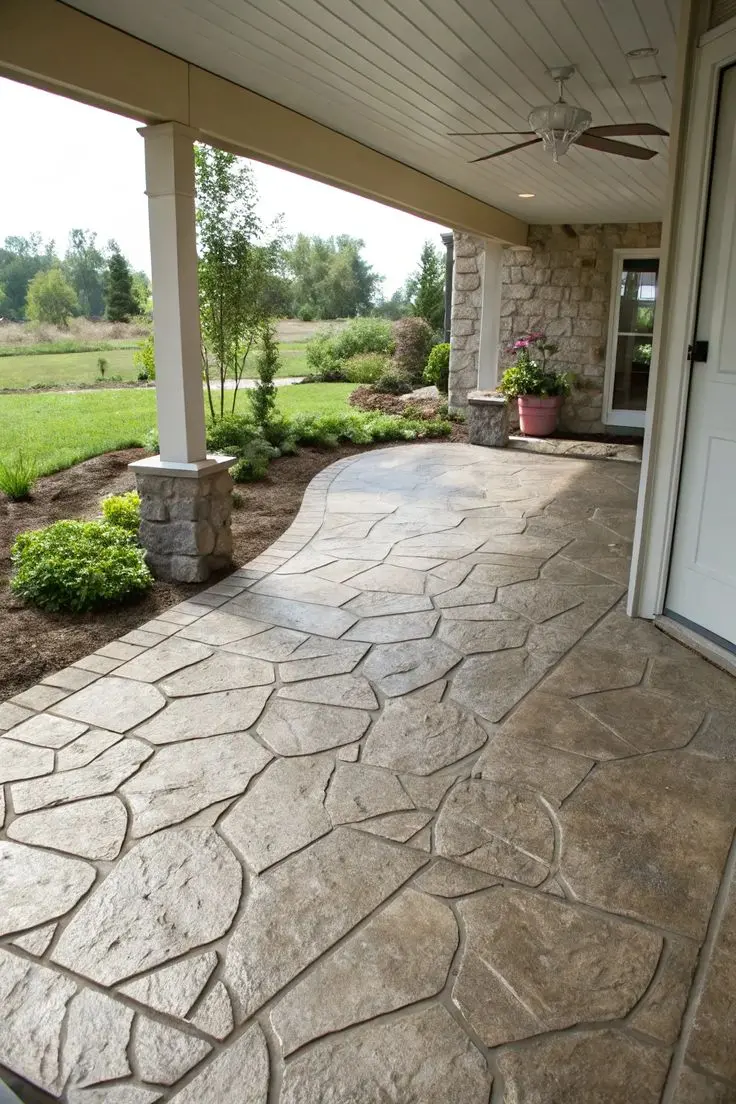
What Pool Surrounds Demand That Other Surfaces Do Not
A pool surround is wet for most of its service life. Splash-out, filter backwash, swimmers stepping out, and rain all keep the surface saturated. Standard outdoor surfaces are designed for occasional wetting — pool surrounds must perform safely under continuous water exposure. The slip resistance cannot depend on a dry surface condition because a dry condition rarely exists.
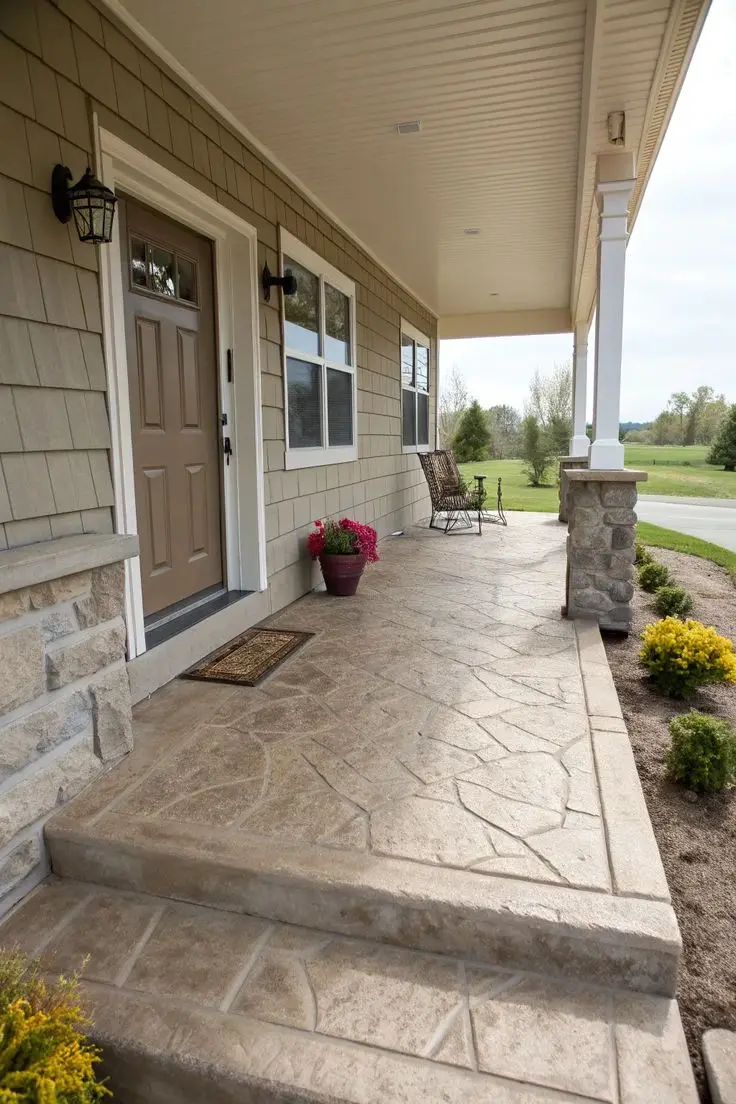
Chemical exposure adds a second layer of complexity. Every pool contains either free chlorine or salt-generated chlorine, plus pH balancers and algaecides. These chemicals deposit on the surrounding surface with every splash and evaporate to leave concentrated residue. Standard concrete sealers break down under this chemical load, losing film integrity within one to two seasons. Pool-specific sealer chemistry is not optional — it is the difference between a surface that holds up and one that fails.
The third requirement is coping integration. The stamped surface must terminate cleanly at the pool edge with an expansion joint that accommodates the different thermal movement rates of the pool shell and the surrounding slab. This joint must be waterproof, flexible, and visually integrated into the stamp pattern so it reads as a natural grout line rather than a construction gap.
Why Stamped Concrete Around Pools
Reliable Wet Grip
Deep stamp textures create physical ridges that channel water away from the contact surface. Anti-slip aggregate mixed into the sealer coat provides consistent traction even when the surface is fully saturated from pool splash.
Resists Pool Chemistry
Chlorine, salt generators, and pH-balancing chemicals attack standard surfaces. Pool-grade sealers — penetrating silane/siloxane or chemical-resistant acrylics — protect against chloride ingress and salt crystallization.
Cooler Than Dark Alternatives
Light integral colors like sandstone and cream reflect solar radiation, keeping the pool deck measurably cooler for bare feet during Saudi Arabia's summer. Heat-reflective sealer formulations add further temperature reduction.
No Joints Around the Pool
Standing water in paver joints around pools breeds algae and mosquitoes. A monolithic stamped slab with proper drainage pitch eliminates the gaps where water collects and organisms grow.
Clean Coping Integration
The stamped surface pours directly up to the pool coping with a flexible expansion joint. This joint handles thermal movement differences between pool shell and surrounding slab without cracking or separating.
Pool Deck Patterns Selected for Wet Conditions
Pool surround patterns must prioritize wet traction above all else. These patterns deliver enough texture depth for reliable grip while maintaining the refined look expected around a swimming pool.
Random Flagstone
Irregular organic shapes with deep texture that channels water effectively. The natural randomness absorbs control joints and the visual style complements pool landscaping. The most specified pool surround pattern.
European Cobblestone
Dense, small-unit pattern with excellent wet traction from its pronounced surface relief. Works well as a full-area pattern or as a border accent that defines the pool edge and transition zones.
Seamless Slate Texture
Continuous stone texture creating a clean contemporary aesthetic. The subtle surface variation provides adequate grip when combined with anti-slip sealer aggregate. Suits modern pool designs.
Wood Plank
Realistic timber grain and knot detail. Delivers the resort-style warmth of wood decking around a pool without the rot, splinter, and chemical deterioration that make real wood impractical near water.
Field Stone
Rounded, smooth-edged shapes with natural size variation. A softer organic look that integrates with naturalistic pool landscaping, rock waterfalls, and garden pool settings across Saudi Arabia.
Building a Pool Surround
Pool surround installation requires coordination between the stamped surface and the pool shell. Drainage, expansion joints, and chemical-resistant sealing are specific to this application.
Pool-Coordinated Grading
The grade around the pool is set to direct splash water and overflow away from the pool edge and toward deck drains or landscape drainage points. The pitch must prevent water from flowing back into the pool. Sub-base is compacted aggregate, typically 75–100mm.
1–2 days
Forming Around the Pool Shell
Forms follow the pool's geometry — curves, steps, spa transitions, and equipment pad locations. Steel mesh reinforcement is positioned at mid-depth. Expansion joints are planned at every point where the stamped slab meets the pool coping to accommodate differential thermal movement.
1 day
Pour, Color, and Stamping
Concrete with integral pigment is placed continuously, working outward from the pool coping. Lighter colors are specified for thermal comfort on bare feet. Release agent and stamp mats are applied in sequence. The crew maintains careful alignment around the pool's curved edges.
1 day
Chemical-Resistant Sealing
After curing and release wash, pool-specific sealer is applied. For salt-chlorinated pools, penetrating silane/siloxane sealers resist chloride ingress at the molecular level. For standard chlorine pools, chemical-resistant acrylic sealers with anti-slip aggregate provide both protection and wet traction. Expansion joints are filled with flexible, pool-compatible sealant.
3–7 days cure
Sealer Chemistry for Pool Environments
Why Standard Sealers Fail Around Pools
Standard acrylic sealers work well on driveways and patios but break down rapidly around pools. The continuous cycle of wetting, chemical exposure, and UV bombardment attacks film-forming coatings from both sides — chlorine degrades the polymer from the surface while moisture vapor pushes from underneath. Within one to two seasons, a standard sealer around a pool develops whitening, peeling, and loss of slip resistance.
Salt Pool Sealers: Penetrating Silane/Siloxane
Pool surrounds in Saudi Arabia require one of two sealer approaches depending on the pool's sanitization system. Salt-chlorinated pools generate higher chloride concentrations that attack surface films aggressively. For these installations, penetrating silane or siloxane sealers are specified. These products absorb into the concrete pore structure rather than forming a surface film, creating a hydrophobic barrier below the surface that resists chloride ingress without providing a film that chlorine can attack.
Chlorine Pool Sealers: Chemical-Resistant Acrylic
Standard chlorine pools allow the use of chemical-resistant acrylic sealers — modified formulations with enhanced cross-linking that tolerate chlorine at normal concentrations. Anti-slip aggregate is mixed into the final coat to maintain wet traction. This approach provides the color enhancement and surface sheen that penetrating sealers do not, with adequate chemical resistance for non-salt systems. Both approaches require periodic renewal, but the recoat cycle is planned into the long-term maintenance schedule.
Pool Surround Materials Compared
Around a swimming pool, every material faces constant water, bare feet, pool chemicals, and intense sun. These conditions expose weaknesses that do not appear in other outdoor applications.
| Feature | ★ Our StandardStamped Concrete | Natural Stone | Porcelain Tile | Composite Decking |
|---|---|---|---|---|
Wet Slip Safety | Deep stamp textures plus anti-slip sealer aggregate provide consistent wet grip across the entire monolithic surface. | Varies widely. Cleft-finish sandstone and limestone grip well. Polished granite and marble become dangerously slippery when wet. | Anti-slip rated porcelain (R11+) performs well. Standard polished tiles are very slippery wet. Grout lines collect standing water. | Textured boards provide decent wet grip initially. Surface texture wears over time and algae growth in shaded areas reduces traction. |
Chemical Resistance | Pool-grade sealers — penetrating or chemical-resistant acrylic — protect against chlorine and salt damage. The sealer is renewable every few years. | Porous stone absorbs pool chemicals over time. Limestone is especially vulnerable to acidic pH balancers. Sealing helps but natural porosity remains. | Porcelain is inherently non-porous and chemically inert. However, grout joints absorb chemicals, stain, and require separate ongoing maintenance. | Composite boards resist chemical damage initially but UV and chemical exposure together cause fading and surface degradation over a few seasons. |
Coping Integration | Pours directly up to pool coping with engineered expansion joints. Clean, continuous connection with no visible transition gaps. | Individual stones must be cut to fit around pool edges. Complex curves require skilled masonry and the joint between stone and coping needs ongoing maintenance. | Tiles are cut to fit but grout lines at the pool edge are the weakest point — cracks allow water infiltration under the tile field. | Cannot integrate with pool coping. Decking sits on a separate frame structure, leaving a visible gap between deck and pool edge. |
Heat Underfoot | Light integral colors and heat-reflective sealers keep the surface measurably cooler for barefoot use during Saudi summers. | Limestone and sandstone stay relatively cool. Dark granite becomes painfully hot barefoot in direct sun. | Porcelain retains heat and can become extremely hot in direct sun regardless of color. Poor choice for barefoot pool areas. | Composite decking absorbs heat and can become very hot barefoot. Lighter colors help but the material stays warmer than concrete or stone. |
Stamped concrete provides the best combination of wet safety, chemical resistance, coping integration, and thermal comfort for pool surrounds in Saudi Arabia. Natural stone offers material authenticity with variable wet safety. Porcelain excels chemically but introduces grout issues and heat problems. Composite decking lacks coping integration and has heat concerns.
Pool Surround Pricing
Stamped concrete pool surrounds in Saudi Arabia typically range from SAR 95–120 per square meter. The higher baseline compared to standard patios reflects chemical-resistant sealer requirements, coping integration detailing, and the precision drainage work around pool shells.
SAR 95–105/m²
per m²
Standard Pool Deck
Single pattern, light integral color, standard reinforcement, chemical-resistant acrylic sealer with anti-slip aggregate. For straightforward rectangular pools with clear site access.
- ✓One stamp pattern
- ✓Light integral color
- ✓Chemical-resistant sealer
- ✓Anti-slip aggregate finish
SAR 105–115/m²
per m²
Integrated Pool Surround
Field pattern with border accent defining the pool edge, two-tone color, expansion joint detailing, and penetrating sealer for salt-chlorinated pools.
- ✓Field + border composition
- ✓Two-tone color work
- ✓Expansion joint integration
- ✓Penetrating silane/siloxane sealer
SAR 115–120/m²
per m²
Complete Pool Environment
Multi-zone design covering pool deck, spa surround, equipment pad, outdoor shower area, and landscape transitions. Custom pattern work around complex pool geometries with penetrating sealer throughout.
- ✓Multi-zone layout
- ✓Complex geometry stamping
- ✓Spa and equipment integration
- ✓Full penetrating sealer system
All Floroz pool surround quotes are itemized. Every component cost is visible before work begins.
Request a Pool Surround AssessmentPool Surround Questions
Yes, when finished with the correct sealer system. The stamped texture provides base-level grip, and anti-slip aggregate mixed into the sealer coat adds reliable wet traction. The key is specifying the right sealer for pool use: standard acrylic sealers can become slippery when wet if applied too heavily. Pool-grade anti-slip sealers are formulated specifically for constant water exposure.
Pool water contains chlorine or salt that attacks concrete surfaces over time. The sealer acts as the barrier. For standard chlorine pools, chemical-resistant acrylic sealers provide adequate protection with recoating every 2–3 years. For salt-chlorinated pools, penetrating silane/siloxane sealers resist chloride ingress at the molecular level rather than relying on a surface film.
The stamped slab is poured up to the pool coping edge with an expansion joint between them. This joint accommodates different thermal movement rates of the pool shell and surrounding slab. The joint is filled with flexible sealant that can be color-matched to the stamp pattern so it reads as a natural grout line rather than a construction detail.
Salt-chlorinated pools produce higher chloride concentrations that attack surface-film sealers aggressively. Penetrating silane/siloxane sealers are specified for salt pools — they absorb into the concrete and create a hydrophobic barrier below the surface. Standard chlorine pools allow chemical-resistant acrylic sealers that provide color enhancement and surface sheen with adequate chemical tolerance.
In Saudi Arabia's high-UV conditions with constant pool chemical exposure, plan for resealing every 2–3 years for acrylic sealers around standard chlorine pools. Penetrating sealers around salt pools typically last 3–5 years between applications. The recoat cycle is planned into your long-term maintenance schedule.
Your Pool Deck Needs to Handle Water, Chemistry, and Heat
We assess your pool type, sanitization system, deck geometry, sun exposure, and drainage before specifying materials. Every Floroz pool surround quote is itemized so you see each component cost before work begins.