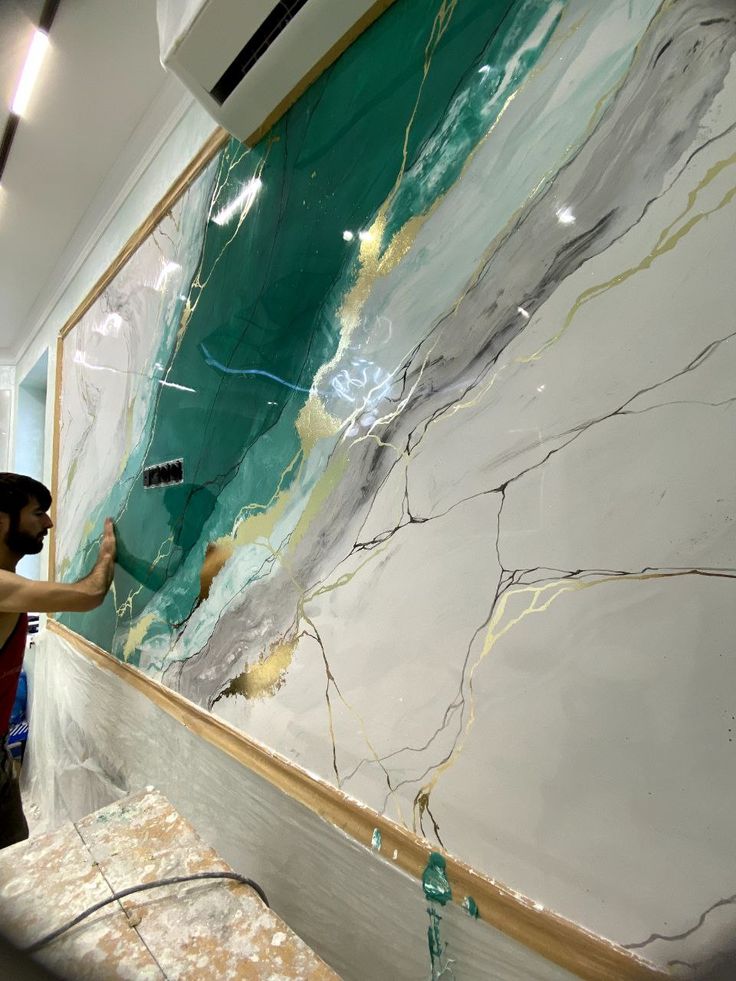
The Physics Problem of Applying Liquid Resin Vertically
Metallic epoxy in its standard floor formulation is a self-leveling liquid. This is precisely what makes it beautiful on floors — it flows under gravity and finds its own level. Apply that same liquid to a vertical wall and gravity immediately pulls it downward. Within seconds of application, the resin begins dripping. Within minutes, it pools at the skirting board.
To apply metallic resin to walls successfully, the viscosity of the mix must be fundamentally altered. We introduce thixotropic agents — additives that change the flow behavior of the resin. A thixotropic fluid behaves as a gel when at rest but becomes fluid when agitated (worked with a trowel or brush). This means our installers can manipulate the resin on the wall surface, working the metallic pigments into their desired position, and when the trowel stops, the resin immediately re-gels in place and holds its position against gravity.
The result is a metallic epoxy wall panel with the same three-dimensional depth and light-reactive quality as a floor system — applied without drips, without sagging, and without structural compromise. The cured wall panel is an irreplaceable combination of visual impact and genuine hardness that no paint, wallpaper, or plaster finish can replicate.
In Saudi Arabia, interior feature walls carry significant cultural and architectural weight. The majlis — the formal reception room of the Saudi villa — is designed around grand visual statements, and the wall surfaces of this space communicate quality to every guest. Metallic epoxy wall panels have become the preferred solution for Saudi residential and hospitality projects because they deliver the visual weight of marble cladding at a fraction of its cost and with none of its structural burden. Marble wall cladding requires significant additional fixings and load calculations. A metallic epoxy panel adds only 3 to 4 kilograms per square metre and applies directly to existing plasterboard or cement render — no structural modification, no specialist stone fixings, no concern about the wall's load capacity.
Three Capabilities Unique to Vertical Metallic Resin Panels
Light Moves Through the Surface — Not Just Off It
Suspended mica particles lock at different depths within the cured resin. Light reflects from multiple internal layers, creating a three-dimensional depth that paint and wallpaper cannot produce.
Shore D 70+ Hardness — Resists Every Impact and Scuff
The cured epoxy wall panel will not dent from impact, will not scuff from contact, and will not peel at edges the way even premium paint systems eventually do.
No Joints Across Unlimited Wall Area
A single unbroken metallic epoxy wall panel can cover an entire wall at any scale — no slab joints, no silicone lines, no veining to match across panel seams.
Thixotropy and Adhesion Science — Making Resin Defy Gravity
The two technical principles that make vertical resin application possible.
How Thixotropic Modification Works
Thixotropy is a reversible gel-to-liquid phase change triggered by mechanical shear. When the installer applies force to the resin with a trowel, the shear stress temporarily breaks the weak molecular bonds formed by the thixotropic additive (typically fumed silica or organoclay), allowing the resin to flow and be manipulated. The moment the trowel is lifted, those bonds reform instantly and the resin returns to a gel state — maintaining its position on the wall while the metallic pigments inside it continue their natural settling and orientation over the next several hours before full cure locks them in place.
Adhesion Pull-Off on Vertical Substrates
A vertical wall coating faces a constant stress that floor coatings do not: gravity-induced shear stress. The weight of the coating itself is always pulling downward, working to separate it from the wall. Adequate adhesion is therefore more critical on walls than on floors. Our vertical system uses a penetrating epoxy primer that must achieve a minimum pull-off adhesion strength of 1.5 N/mm² as measured by the ASTM D4541 dolly pull-off test. Substrates that cannot meet this minimum after priming (typically poorly bonded paint or friable plaster) must be fully removed before the system can be applied.
Vertical Resin Wall Application — The Full Process
Substrate Structural Assessment and Loose Material Removal
Any existing paint or plaster that is not firmly bonded to the structural wall must be removed. We test adhesion by cross-hatching the surface with a blade and applying adhesive tape — lifting tape pulls away any poorly bonded material. Friable plaster is identified by pressing firmly: structurally sound plaster does not powder. Hollow-sounding plaster areas are identified by tapping and marked for removal. The wall must be completely solid and have zero areas of active moisture ingress before proceeding.
Mechanical Abrasion for Chemical Key
Unlike floor preparation which uses diamond grinding, vertical surfaces are mechanically abraded using orbital sanders and 40-grit abrasive discs. The goal is to remove any surface sealants, silicon, or gloss finishes that would prevent the primer from bonding. Smooth plasterboard paper is sanded to break the surface sheen. All sanding dust is vacuumed thoroughly — dust contamination in the primer coat is the leading cause of poor adhesion on vertical surfaces.
Penetrating Epoxy Primer — Deep Wall Consolidation
A low-viscosity penetrating epoxy primer is rolled onto the prepared wall. This primer is significantly thinner than the decorative layers — it is designed to flow into the pores and micro-cracks of the plaster or cement board rather than sitting on top of it. By curing inside the substrate, it acts as a consolidant and stabilizer, significantly increasing the pull-off strength of whatever is applied above it. On porous substrates like bare plaster, a second primer coat may be required to fully saturate the surface.
Thixotropic Base Coat Application
A colored base coat — tinted to closely match the final metallic color — is trowel-applied across the wall. This layer serves two functions: it blocks out the substrate color completely to prevent show-through, and it builds the surface to a smooth, continuous profile before the decorative coat. Application is by Japanese steel trowel in overlapping arcs. The installer maintains a wet edge across the entire wall to prevent visible application lines in the finished surface.
The Thixotropic Metallic Coat — Controlled Pigment Manipulation
The metallic resin, modified to thixotropic viscosity, is applied using a combination of trowels, brushes, and — in some design executions — controlled air movement. The artisan has a working window of approximately 30–40 minutes (shorter than floor applications due to the smaller working area and faster heat loss on vertical surfaces). During this window, they work the pigments into the desired directional flow or cloud pattern. Once satisfied, they step away and allow the resin to gel and cure undisturbed. Resuming manipulation after the gel point creates permanent marks in the surface.
Clear Topcoat for Wall Protection
Once the metallic layer has fully hardened, a clear aliphatic polyurethane topcoat is applied by roller in one or two coats depending on the desired sheen level and abrasion requirement. For walls in high-touch areas (corridors, reception counters), a full two-coat topcoat system is specified. For feature walls behind furniture or art, a single protective coat is typically sufficient.
Vertical System Technical Specifications
| Property | Value |
|---|---|
| Substrate Compatibility | Plasterboard, cement board, render, existing ceramic tile |
| Adhesion Strength to Substrate | > 1.5 N/mm² (mandatory minimum) |
| Viscosity Modifier | Thixotropic agents (fumed silica / organoclay) |
| System Weight per m² | 2.5 – 3.5 kg/m² |
| Finish Options | High Gloss, Satin, or Matt topcoat |
| Application Temperature | 15°C – 35°C (ambient and surface) |
Technical Questions on Vertical Resin Applications
No — if correctly formulated with thixotropic modification. Standard liquid epoxy would immediately run when applied to a wall. Our vertical formulation uses the thixotropic principle: it gels when the trowel stops moving, holding its position against gravity. If an installer quotes vertical epoxy without mentioning thixotropic modification, they are either using an incorrect formulation or an incorrect application method — both of which will result in drips and an uneven finish.
Yes, provided the tiles are firmly bonded to the wall behind them (confirmed by tap-testing and adhesion testing). The tile glaze must be fully sanded off to create a mechanical key, and the grout joints must be filled flush with the tile face. The combined additional weight of the tile plus the epoxy system must be structurally manageable for the wall substrate. For large-format tiles already heavily loaded walls, individual engineering assessment is required.
The colors will be identical. The pattern distribution will be noticeably different. On floors, gravity causes the metallic pigments to pool and create expansive cloud formations. On walls, gravity causes the pigments to trend downward slightly, creating more directional, streaked, or marbled effects. These vertical patterns are often more dramatic and striking than floor patterns. We recommend requesting a vertical test panel on site before committing to full wall installation.
With a full UV-stable aliphatic topcoat and appropriate moisture management, yes. However, exterior walls face additional challenges beyond interior ones: direct sun causes rapid cure that reduces the working window, moisture in the render or blockwork must be fully controlled, and the topcoat specification must match our outdoor system rather than the standard interior topcoat.
The metallic epoxy system is not suitable for surfaces that will reach temperatures above 80°C continuously. For feature walls adjacent to fireplaces or heat sources, the system is acceptable provided the wall surface itself does not exceed this temperature. Walls behind open fireplaces or directly surrounding gas flues should not have epoxy applied — the heat will cause delamination and discoloration.
Plan Your Feature Wall Application
Share your wall dimensions and substrate type with our technical team to confirm adhesion suitability and design options.