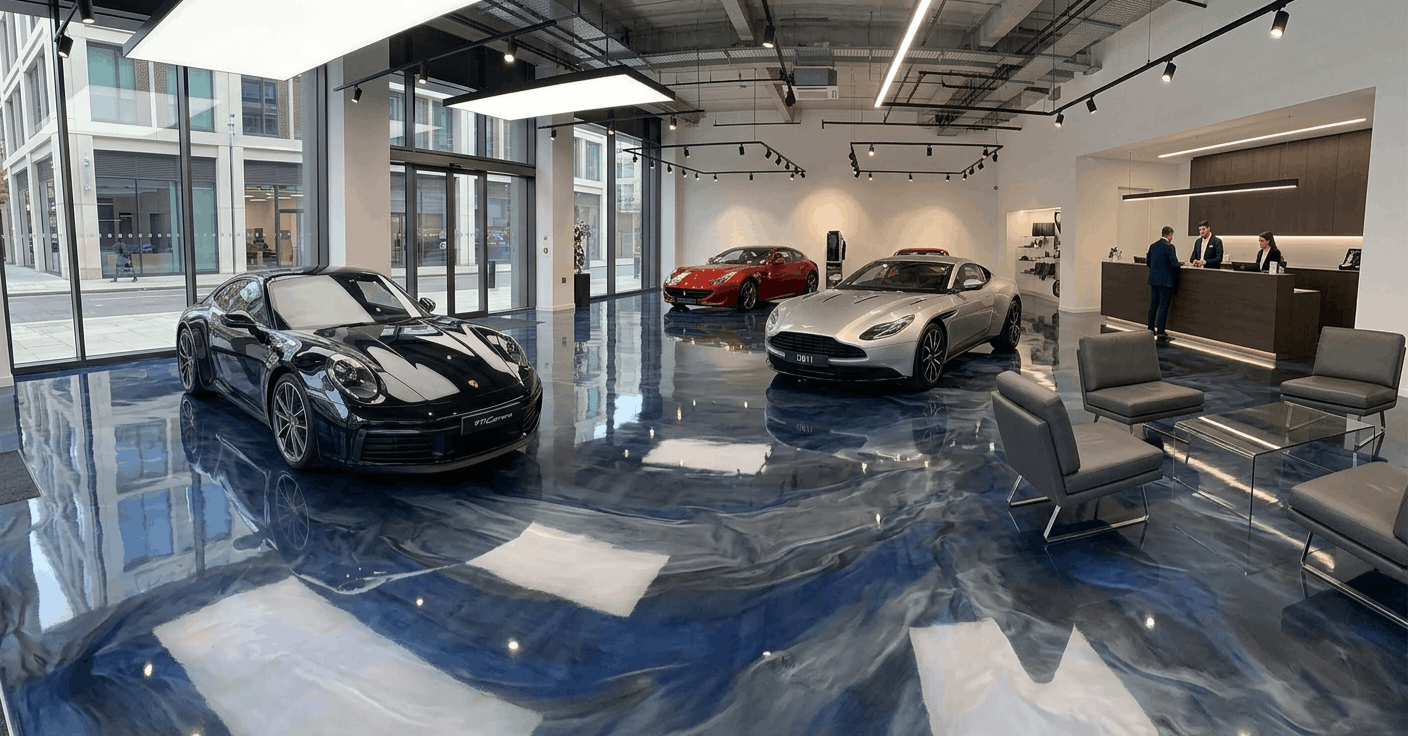
The Floor as a Brand Asset — Why Showrooms Need a Different Specification
A metallic epoxy showroom floor does something that no other flooring system achieves: it becomes part of the product presentation. In a luxury furniture showroom, an automotive dealership, a fashion retail space, or a high-end electronics store, the floor is the single largest visual surface the customer sees. A fractured tile floor with discoloured grout subconsciously signals a lower-quality environment — and a lower-quality environment lowers the perceived value of everything displayed within it. A seamless, high-gloss metallic resin floor does the opposite: it creates a gallery-quality context that elevates every product above it.
The specification requirements for a showroom floor are fundamentally different from a residential floor. Showrooms endure continuous foot traffic from customers — including stiletto heels and leather-soled dress shoes — rolling display racks and furniture pieces, and daily mechanical cleaning with auto-scrubber machines. The floor must maintain its high-gloss finish under this sustained mechanical stress. This rules out standard residential topcoat formulations and demands a commercial-grade aliphatic polyurethane or polyaspartic sealer with verified Taber abrasion resistance.
The second unique requirement of showroom installation is operational timing. A residential floor can be taken out of use for a week without significant cost. A retail showroom that cannot open for five days loses substantial revenue. For showroom applications, we prioritize polyaspartic-based topcoat systems that cure from liquid to full-traffic-ready in 2–4 hours rather than 24–48 hours, allowing installation to be completed overnight and the floor to be open for trading the following morning.
Saudi Arabia's retail environment — with its concentration of luxury automotive dealerships, high-end furniture showrooms, fashion boutiques, and consumer electronics outlets across the Kingdom's major commercial developments — creates a specific demand that metallic epoxy showroom flooring addresses precisely. Saudi retail customers have some of the highest expectations of environmental quality in the region: the condition of the floor communicates brand positioning before a single product is examined. For KSA showroom operators who cannot afford to close during installation, the polyaspartic overnight-cure system means the floor is installed, cured, and ready for showroom opening by the following morning — with zero lost trading days.
Five Reasons the Showroom Floor Is a Revenue-Generating Asset
Products Float Above a Mirror-Like Surface — The Gallery Effect
A high-gloss metallic epoxy showroom floor creates a gallery-quality context. Reflections amplify the lighting design and elevate the perceived value of every product displayed above it.
Brand Color Specification — No Catalogue, Custom Mixed
Metallic pigments are custom-mixed per project to align with corporate brand colors. The floor is as recognizable as the signage — unique, unreplicable, brand-specific.
Commercial Abrasion Rating — Gloss Maintained Under Daily Foot Traffic
Polyaspartic topcoat with verified Taber abrasion resistance (ASTM D4060). The gloss level is maintained under sustained daily retail foot traffic including stiletto heels.
Overnight Installation — Zero Trading Day Lost
Polyaspartic chemistry cures to full commercial hardness in 2–4 hours. Installed at midnight, the floor is ready for trading at 6am. No revenue-impacting extended closure.
Logo and Brand Graphics Embedded Permanently Below the Surface
Corporate logos, direction arrows, and brand graphics are encapsulated 1.5–2mm beneath the clear topcoat. Completely flush, completely permanent — cannot peel, fade, or be damaged by cleaning.
Commercial Floor Performance Testing
Verified durability data for high-traffic retail environments.
| Test | Result |
|---|---|
| Taber Abrasion (CS-17 Wheel, 1000 cycles) | < 35mg weight loss |
| Impact Resistance (Gardner) | > 160 in-lb — No cracking |
| Gloss Retention (60° angle) | > 85 GU initial / > 70 GU after 12 months traffic |
| Slip Resistance (Dry Traffic Areas) | R10 classification — Safe for retail footwear |
| VOC Emissions (Occupied Space Compliance) | LEED v4 Compliant — Safe for occupied installation |
Showroom Floor Installation — Retail-Environment Protocol
Pre-Installation Site Survey and Trade Coordination
Before any preparation begins, we conduct a full site survey in coordination with the fit-out contractor, electrical contractor, and store management. This confirms: the sequence of floor installation relative to other trades (shelving, display fixtures, electrical floor boxes), protection requirements for installed shopfitting during the floor work, the locations of any floor-level service access points that must be marked in the finished floor, and the final handover schedule linked to the store opening date. In retail environments, floor installation is on the critical path — delays cascade directly into lost trading days.
Concrete Preparation — Managing Retail-Grade Subfloor Conditions
Commercial retail slabs are often more complex than residential substrates. They may contain multiple previous flooring adhesives (carpet glue, tile adhesive, levelling compound), cable trenches at irregular intervals, service conduits, and high-traffic surface contamination. We use a combination of diamond planetary grinders for open floor areas and small hand-held edge grinders for working within 150mm of fixed walls and shopfitting bases. All cable trenches and conduits are filled with rapid-setting repair mortar and ground flush. The target profile is CSP 2–3, which provides adequate adhesion without generating the volume of surface debris that CSP 4 grinding produces in an occupied building environment.
Expansion Joint Strategy for Large Trading Floors
Large retail slabs — anything over 200m² — invariably contain structural expansion joints. In showroom applications where the visual aesthetic demands an unbroken floor plane, expansion joints present a design challenge. Our approach: saw-cut the existing expansion joint to a consistent width and depth, fill with a semi-rigid polyurea compound (not fully flexible, not rigid — semi-rigid balances movement accommodation with visual minimization), and grind flush before the epoxy system is applied. A small percentage of movement is still accommodated by the semi-rigid fill, significantly reducing — though not fully eliminating — the risk of a visible hairline at the joint line in the finished floor.
Logo and Brand Detail Embedding
If a corporate logo, direction arrows, or brand graphic is specified for the floor, it is installed at this stage — between the metallic base coat and the clear topcoat. High-resolution vinyl decals with edge-sealed perimeters are positioned precisely on the cured metallic layer. Alternatively, for permanent installations, hand-painted or laser-cut metal inlays can be set into the epoxy. The clear topcoat then floods over the entire floor including the logo detail, encapsulating it permanently at a depth of approximately 1.5–2mm. The finished logo is completely flush with the floor surface and will not peel, fade, or be removed by cleaning.
Metallic Resin Pour — Coordination for Large Commercial Areas
Large showroom floors require coordinated pour teams working in parallel zones, maintaining a continuous wet edge between zones to prevent cold joints (visible lines where two separate pours meet). The pour sequence is planned in detail before work begins: entry points, pour direction, finishing sequence, and team positioning are all mapped. For floors exceeding 500m², a night pour with multiple teams is standard practice. The metallic pigment design is briefed to all team members in advance so the overall aesthetic flows consistently across the zones.
Fast-Cure Polyaspartic Topcoat for Overnight Return to Service
The metallic base coat cures overnight. The following day, the entire floor receives two coats of polyaspartic aliphatic topcoat — a chemistry selected specifically for its 2–4 hour full-cure timeline. The first coat is applied by roller in a continuous, consistent film. The second coat follows 2 hours later, once the first coat has reached its tack-free state. By the time the second coat is applied and cures, the floor has achieved full commercial traffic resistance — typically within 4–6 hours of first coat application. The store is ready to receive its merchandise and open for trading the following morning.
Technical and Operational Questions for Retail Showrooms
The initial gloss level (typically >85 GU at 60°) will experience gradual reduction under sustained foot traffic as the topcoat surface is microscopically abraded by shoe soles and grit. The rate of reduction depends heavily on daily foot traffic volume and housekeeping practices. Showrooms with a rigorous daily cleaning routine — dust mopping and auto-scrubber — and an entrance matting system to capture incoming grit will maintain gloss significantly longer. A topcoat refresh application (a thin re-coat of the polyaspartic sealer) every 2–3 years, depending on wear, restores the original gloss without touching the metallic design layer.
All rolling display fixtures should have soft polyurethane or rubber wheels. Steel casters and plastic wheels on hard flooring will scratch any surface, including natural stone, over time. We recommend conducting a floor protection assessment of all planned display furniture before installation, and fitting appropriate caster replacements where necessary. Dragged furniture without wheels will cause visible scratches in the topcoat regardless of the topcoat specification.
Yes, with the correct topcoat specification. Standard passenger vehicle weights are well within the compressive tolerance of the epoxy system. The critical issue in auto showrooms is hot tire contact — as with garage floors, the vehicle must not be driven in until the system has cured for the full 7 days. For auto showroom applications, we specify the same hot-tire-resistant aliphatic topcoat used in our garage floor systems, ensuring the floor remains pristine even when vehicles are regularly moved in and out.
Yes. Floor box locations are identified and masked during the resin pour. The resin is applied up to the edge of the floor box frame, creating a clean, seamless transition. If the box frame is recessed below the finished floor level, a small pour around the perimeter fills the gap cleanly. All floor box covers are protected during the pour and topcoat application to prevent contamination.
The recommended cleaning protocol is a two-stage daily routine: dry dust mopping first to remove loose particulates (the main cause of surface micro-scratching), followed by a wet auto-scrubber pass with a soft, non-abrasive pad and a pH-neutral floor cleaner. Avoid steam cleaners — the steam can temporarily soften the topcoat surface if held stationary. There is no requirement for waxing, buffing, or diamond polishing — unlike marble and polished concrete, the polyaspartic topcoat does not need periodic re-polishing to maintain its gloss.
Design the Floor That Sells Your Space
Contact our commercial team to discuss brand color matching, trading floor dimensions, and installation scheduling.