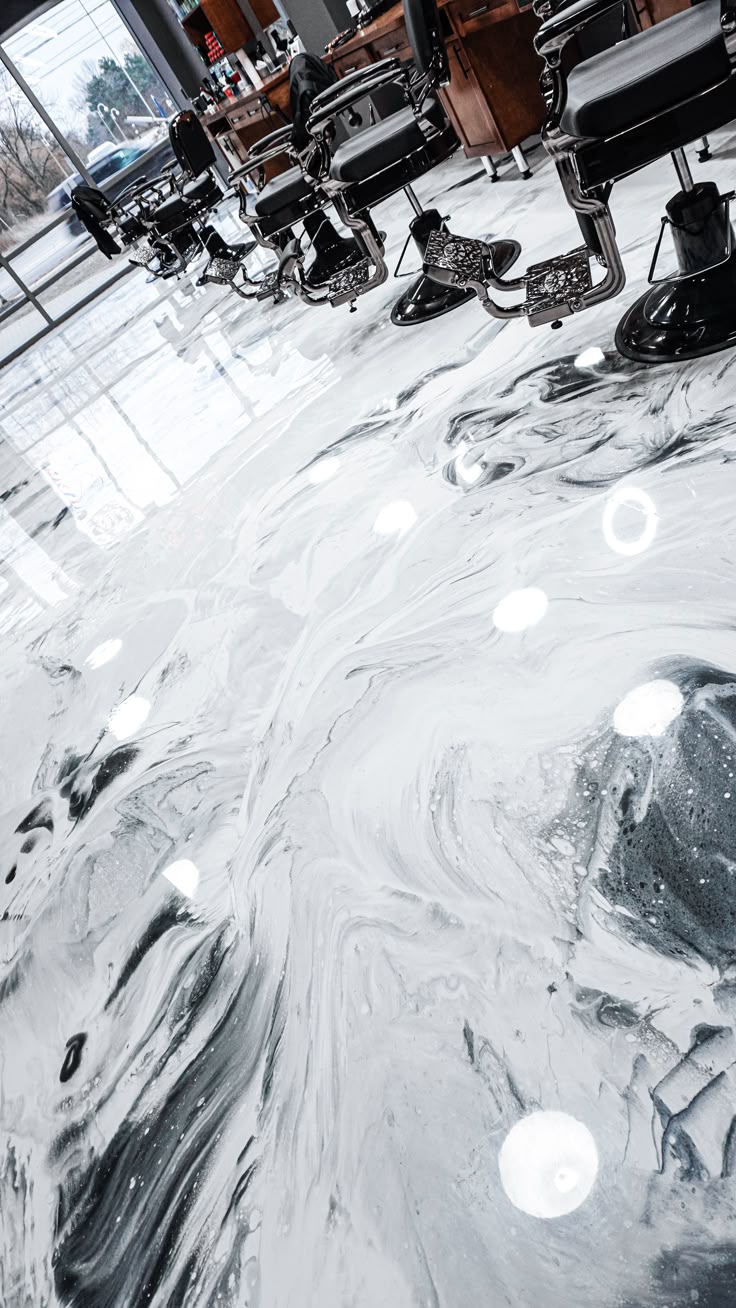
When the Floor Is Operational Infrastructure — Not Interior Design
In a residential context, a floor is chosen for how it looks and feels. In a commercial context, a metallic epoxy commercial floor must satisfy a completely different set of requirements before aesthetics are even considered. It must comply with fire safety regulations (many commercial tenancies in Saudi Arabia require a Class 1 or Class 2 fire rating on floor finishes). It must meet the slip resistance standards mandated by occupational health and safety regulations for the specific occupancy type — a restaurant kitchen requires a different classification than a hotel corridor. It must resist the specific chemicals present in the environment — a dental clinic with disinfectants, a restaurant kitchen with food acids and cleaning chemicals, or a retail space with cleaning agents.
Beyond compliance, a commercial floor must survive operational conditions that would destroy residential systems within months. Commercial spaces experience foot traffic volumes that are orders of magnitude higher than residential floors. They encounter rolling loads from trolleys, pallet jacks, and catering equipment. They are cleaned aggressively with chemical detergents on daily cycles. In food service environments, the floor must meet HACCP (Hazard Analysis Critical Control Point) hygiene standards — which effectively requires a seamless, non-porous surface with no joints where food debris or bacteria can accumulate. Grouted tile floors categorically fail this requirement; seamless resin systems meet it by design.
The third critical dimension for commercial clients is time. Business downtime is not an abstract inconvenience — it is a direct financial cost. A restaurant that cannot open for five days loses five days of revenue on top of paying for the floor. We address this with two strategies: polyaspartic fast-cure systems that reach full commercial hardness in hours rather than days, and night-shift and weekend installation scheduling that confines all work to non-trading hours.
Regulatory Compliance and Certification Data
Independent test results for commercial specification.
| Test | Result |
|---|---|
| Fire Resistance Classification | Class 1 (Self-Extinguishing) — Passes BS 476 Part 7 |
| Slip Resistance — Dry Pedestrian Traffic | R10 – Compliant for corridors, retail, reception |
| Slip Resistance — Wet Commercial Kitchens | R11–R12 with anti-slip aggregate broadcast |
| Chemical Resistance — Food Industry Detergents | Pass — No surface degradation after 7-day exposure |
| Abrasion Resistance (Heavy Commercial) | < 30mg loss (CS-17 Wheel, 1000 cycles) |
| VOC Emissions — Occupied Space Safety | Pass — LEED v4 Compliant Low-Emission Product |
Six Operational Requirements Metallic Epoxy Commercial Flooring Meets by Design
HACCP-Compliant — No Joints for Food Debris to Accumulate
Zero grout lines and zero surface porosity. The seamless resin surface meets the HACCP requirement for food preparation area floors by eliminating every harbouring point.
Lowest Whole-Life Cost of Any Commercial Floor Finish
No quarterly polishing, no re-grouting, no strip-and-wax cycles. Daily auto-scrubber maintenance only — significantly lower ongoing cost than stone, tile, or polished concrete alternatives.
Night-Shift Installation — Open for Trading Next Morning
All preparation, pouring, and topcoating is scheduled in non-trading hours. With polyaspartic fast-cure systems, the floor is ready for foot traffic before morning operations begin.
Rolling Load Rated — Pallet Jacks, Trolleys, Hospital Beds
Compressive strength exceeds 70 N/mm². The multi-layer build handles pallet jacks, catering trolleys, hospital bed wheels, and the point loads of heavy display fixtures without cracking.
Chemical Resistance Matched to Your Specific Cleaning Protocol
The topcoat specification is selected against the actual disinfectants and cleaning chemicals used in your facility — not a generic specification. pH 2–12 resistance as standard.
Fire Rated Class 1 — Commercial Tenancy Compliant
Tested to ASTM E648 / BS 476 Part 7: Class 1 (Self-Extinguishing). Test certificates provided for submission to the building authority or landlord as part of the fit-out documentation.
Commercial System Technical Architecture
| Property | Value |
|---|---|
| System Build Thickness | 3.0 – 5.0mm |
| Compressive Strength | > 70 N/mm² |
| Topcoat Options | Polyaspartic (fast-cure) or High-Solids Polyurethane |
| Chemical Resistance | pH 2–12 (acids, alkalis, food-industry detergents) |
| Slip Resistance Range | R10 (dry) to R12 (wet anti-slip broadcast) |
| Fire Rating | Class 1 (Self-Extinguishing) |
| Daily Maintenance Method | Auto-scrubber, soft pad, neutral pH cleaner |
Commercial Floor Installation — The Night-Shift Protocol
Compliance Pre-Assessment and Specification Selection
Before any preparation is planned, we conduct a compliance assessment specific to the occupancy type. For restaurant kitchens, we assess the HACCP hygiene requirements and specify anti-slip aggregate grades aligned with commercial kitchen safety standards. For healthcare facilities, we assess the chemical resistance requirements against the disinfectant products used by the facility's infection control team. For retail spaces, we confirm the fire rating requirements of the tenancy agreement and building regulations applicable to the fit-out. This compliance pre-assessment determines the final system specification — including primer, metallic layer, topcoat chemistry, and anti-slip grade — before a single machine enters the building.
Night-Shift Scheduling and Stakeholder Coordination
We produce a detailed installation schedule referenced against the client's trading hours, specifying exactly which activities occur during which shifts. Day-shift work (if any) is limited to non-production areas or activities that do not generate airborne contamination. All grinding, pouring, and topcoating is scheduled for periods when the space is unoccupied. For multi-tenant buildings, we coordinate with the building management team to ensure no other overnight trades conflict with the floor installation program. We confirm temporary power supply requirements, service elevator access for equipment, and security access arrangements 72 hours before the first shift.
Heavy-Duty Surface Preparation — Commercial-Grade Machines
Commercial slabs have typically been subjected to years of loading, chemical exposure, and surface contamination. We use large three-phase planetary grinders and, where necessary, captive shot-blast machines to prepare the surface to CSP 3–4. Shot blasting — propelling steel shot at the concrete surface under controlled pressure — is particularly effective on commercial slabs with deep oil, grease, or chemical contamination. All preparation equipment operates with directly-attached industrial HEPA extraction to comply with occupied-building air quality requirements for any adjacent operational areas.
Substrate Repair — Crack Injection and Joint Treatment
Commercial slabs frequently contain dormant cracks from previous point-loading events, failed repair attempts, and aging. Each crack is classified as dormant or active, then treated accordingly: dormant cracks are injected with low-viscosity epoxy resin and ground flush; active cracks receive a saw-cut, flexible polyurea injection, and a surface feather-fill. All expansion joints are saw-cut to a consistent profile and filled with semi-rigid polyurea. Cable trenches and conduit runs are filled with rapid-setting repair mortar. The entire surface is then inspected under raking LED light to identify any remaining surface imperfections before priming.
Moisture-Tolerant Priming and the Metallic Design Pour
Commercial spaces — particularly ground-floor retail units and basement restaurant kitchens — frequently show elevated moisture vapor emission. We use moisture-tolerant primers that can handle slabs up to 97% RH without the blistering risk of standard epoxy primers. On the primer specification confirmed, the metallic design coat is poured during the night shift. In large commercial spaces, coordinated pour teams maintain wet edges across zone boundaries, eliminating visible cold joints. The poured floor is protected with signage and barrier tape for the overnight cure period.
Fast-Cure Polyaspartic Topcoat — Same-Night Return to Service
For operations that require same-shift return to service, we apply polyaspartic topcoat over the overnight-cured metallic layer. Polyaspartic chemistry cures to full commercial hardness within 2–4 hours at ambient temperature. Applied at 11pm, it reaches foot traffic readiness by 3am — well before the start of morning prep at 6am in a restaurant environment. Anti-slip aggregate is broadcast into the first coat where the specification requires it. The second coat encapsulates the aggregate. A final quality inspection under raking light, and the floor is signed off for business operations.
Questions from Commercial Operators and Facility Managers
Yes. The metallic epoxy system, when tested to ASTM E648 or BS 476 Part 7, achieves a Class 1 (Self-Extinguishing) fire rating — meeting the floor finish requirements of most commercial tenancy agreements and Saudi building code requirements for occupied commercial spaces. We provide the relevant test certificates as part of the project handover documentation for submission to the building authority or landlord where required.
Yes — it is the most technically appropriate flooring system for commercial kitchens. The seamless, non-porous surface meets HACCP hygiene requirements by eliminating all joints where food debris can accumulate. The chemical resistance of the topcoat handles the acids, fats, and commercial kitchen cleaning chemicals at normal use concentrations. Anti-slip grade R11 or R12 with rounded quartz aggregate is specified for kitchen floor areas, meeting the slip resistance requirements of health and safety regulations for wet-process food production environments.
In many cases, yes. If the space can be zoned — with one section of the floor accessible while another is being installed — we can install the floor in phases around the business's operations. Night-shift and weekend scheduling handles the bulk of the work in non-trading hours. With polyaspartic topcoat systems, each phase is ready for morning trading before staff arrive. However, the entire floor cannot be operational during preparation — grinding in an occupied space with active customers is not feasible regardless of dust management provisions.
We provide a handover training session covering the approved cleaning products, machine specifications, and cleaning sequence. The essentials are: dry dust mop first to remove loose particulates (prevents micro-scratching), auto-scrubber with soft non-abrasive pads and neutral pH cleaner second. Avoid rotating abrasive pads, steam cleaners held stationary, and high-concentration acid or bleach cleaners for regular use. Avoid dragging furniture or fixtures across the floor. These simple protocols maintain the floor's performance and appearance for the long term without specialist contractor involvement.
Healthcare environments have the most demanding flooring specifications of any commercial occupancy. Key requirements to discuss with our team: the disinfectant chemistry used by your infection control protocol (quaternary ammonium compounds, hydrogen peroxide, peracetic acid — each has different polymer compatibility profiles), the requirement for anti-static properties in areas with sensitive electronic equipment (ESD-compliant topcoats are available), the minimum slip resistance classification required by your facility's health and safety assessment, and whether the floor needs to meet specific antimicrobial certification standards. We handle healthcare flooring specifications regularly and will request your facility's requirements document at the project initiation stage.
We provide a structural warranty covering adhesion failure and delamination for commercial installations. The duration depends on the specified system thickness, the confirmed traffic classification, and whether the substrate preparation met the required profile. Thicker systems on well-prepared substrates receive longer warranty terms. We do not provide warranties where preparation access was limited by the client's operational constraints — if we cannot prepare the substrate correctly, we cannot warrant the outcome. Full warranty terms are provided in writing as part of the commercial proposal.
Specify the Right System for Your Commercial Space
Contact our commercial division with your occupancy type, floor area, and operational constraints. We will produce a compliant specification with an installation schedule around your business hours.