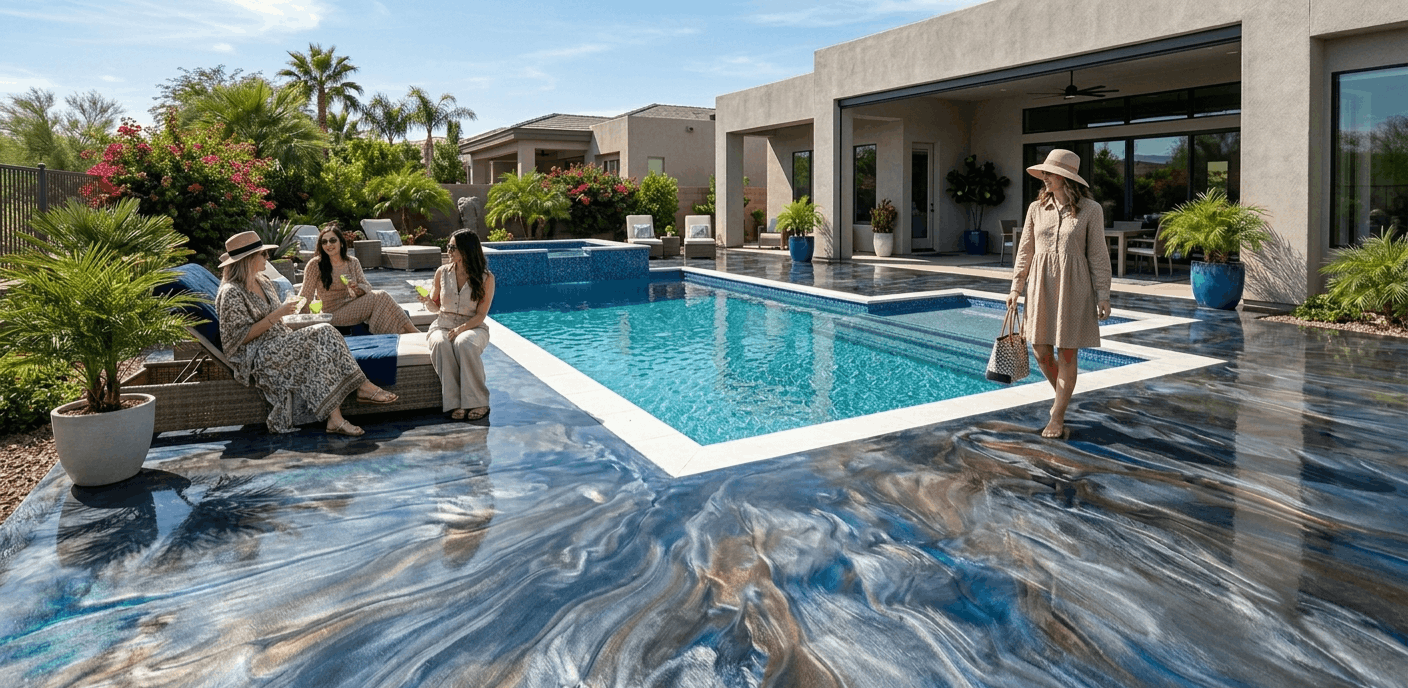
Why Pool Surrounds Are the Most Technically Demanding Outdoor Surface
A metallic epoxy pool surround faces a combination of chemical, thermal, and mechanical stresses that no other outdoor surface encounters simultaneously. The pool deck is continuously exposed to chlorinated splash water — a fluid that degrades most polymer coatings over time by attacking their plasticizers and causing embrittlement. It faces direct Saudi Arabian sunlight at intensities that destroy standard aromatic epoxy within months. And every minute the pool is in use, wet, barefoot children and adults are running across the surface — making anti-slip classification not an upgrade, but a legal and moral requirement.
Traditional pool surrounds handle this with ceramic tiles. The tiles themselves are durable, but the grout joints between them are not. Chlorinated water saturates the cement grout continuously, eroding it chemically. Algae spores — present in all outdoor water environments — colonize the porous grout surface within the first few seasons. What begins as green staining between tiles gradually becomes a black algae mat that cannot be permanently removed with surface cleaning alone. Power washing removes the visible algae but does not kill the root system embedded in the grout. The only permanent solution is to eliminate the joint.
A correctly specified metallic epoxy pool surround removes every grout line from the equation. The seamless resin surface has no pores for algae to root in and no joints for chlorine to erode. The system is sealed with a 100% aliphatic polyurethane topcoat that is specifically chlorine-resistant and UV-stable, and a high-density anti-slip aggregate ensures the surface provides classified R12 grip even when completely flooded with water.
R12
Anti-Slip Rating
Class C (DIN 51097) — highest barefoot wet zone classification
0%
Algae Joint Penetration
No grout lines — nowhere for algae to root
Pass
Chlorine Resistance
Tested at sustained pool-level chemical concentrations
2000+
UV Test Hours
QUV weathering — no color change (ASTM G154)
How a Metallic Epoxy Pool Surround Defeats UV, Chemicals, and Algae Simultaneously
Class C Barefoot Safety — Rounded Quartz, Not Sharp Grit
Rounded quartz aggregate provides R12-classified grip without angular edges uncomfortable for children's bare feet. Grip is embedded into the sealer, not loose on the surface.
Chlorine and Salt Pool Chemistry Cannot Degrade It
Aliphatic topcoat formulated for continuous chlorinated and salt-chlorinated water exposure without discoloration, embrittlement, or surface degradation.
Aliphatic UV Barrier — No Yellowing in Saudi Sun
The aliphatic polyurethane topcoat contains no aromatic rings to yellow under UV. Metallic colors remain accurate in year 5 as in year 1, even under daily direct Saudi sunlight.
No Algae Because There Are No Joints to Root In
Algae spores require a porous surface to colonize. A seamless, non-porous metallic epoxy pool deck provides no harbouring point. No root structure means no regrowth after cleaning.
Lighter Colors Stay Cooler Underfoot in Summer
Light metallic palettes — pearl, silver, champagne — reflect solar radiation and stay 15–20°C cooler underfoot than dark stone or composite decking at peak Saudi summer temperatures.
Pool Surround System Technical Data
| Property | Value |
|---|---|
| Barefoot Slip Resistance | Class C / R12 |
| Chlorine Resistance | No degradation at pool-level concentrations |
| Saltwater Resistance | Full resistance |
| UV Stability | 2000+ hours QUV (no color change) |
| Water Absorption | 0.0% (fully impermeable) |
| Thermal Shock Tolerance | No cracking: 65°C surface to cold water |
| Topcoat Chemistry | 100% Aliphatic Polyurethane |
Pool Deck Surface Options: An Honest Evaluation
| Feature | ★ Our StandardMetallic Epoxy Surround | Porcelain Pool Tiles | Timber / Composite Decking |
|---|---|---|---|
Algae and Mold Risk | Zero — seamless, non-porous | High — grout lines colonized by algae | High — porous surface and gaps between boards |
Barefoot Slip Safety | R12 aggregate — Class C rated | Low on standard glazed tile | Variable — algae growth makes it very slippery |
Chlorine Resistance | Excellent — aliphatic topcoat | Good — grout erodes over 3–5 years | Poor — chlorine bleaches and degrades wood fiber |
Joint / Gap Maintenance | None — zero joints | Ongoing grout scrubbing and replacement | Annual re-oiling, gap cleaning, board replacement |
Heat Underfoot | Lighter colors stay cooler than stone | Dark tiles become extremely hot | Generally cooler than stone, but splinters when dry |
Metallic Epoxy Pool Surround Installation — Full Technical Sequence
Pool Deck Condition Survey and Drainage Assessment
Pool surrounds present unique substrate challenges. The concrete deck is typically exposed to continuous wetting and drying cycles that cause carbonation of the surface layer — creating a weak, powdery surface that must be identified and fully removed before any coating is applied. We survey the entire deck perimeter using a Schmidt hammer to measure surface hardness and identify any carbonated zones. Simultaneously, the drainage gradient of the entire pool deck is assessed: a minimum fall of 1:80 toward perimeter drains is required to prevent standing water pooling on a non-absorbent surface. Any areas with flat or reverse gradient must be corrected with a levelling compound before the epoxy system is applied.
Expansion Joint Mapping and Flexible Filling
Outdoor concrete slabs have a higher density of expansion joints than indoor floors due to the greater thermal movement from Saudi temperature extremes. Every expansion joint in the pool deck is mapped. Unlike indoor floors where rigid joint fillers are sometimes acceptable, outdoor pool surrounds require all expansion joints to be filled with a flexible polyurea joint compound that can compress and extend with the concrete movement. Bridging expansion joints with rigid epoxy will result in cracking at the joint line within one or two thermal cycles. Each joint is routed to a consistent width and depth before the flexible compound is injected and tooled flush.
Mechanical Profiling: Removing Carbonation and Contamination
The pool deck surface typically has three layers of contamination: carbonated laitance on the outermost surface, biological contamination (algae, sunscreen residue, pool chemical deposits) in the pores, and potentially old sealer or paint from previous maintenance attempts. We diamond grind the entire surface using outdoor-rated machines with scarifying attachments to cut through all three layers simultaneously, reaching clean, hard aggregate. The grind profile must reach CSP 3–4 — significantly more aggressive than standard indoor floor preparation — because the outdoor environment demands maximum adhesion to compensate for continuous environmental stress.
Moisture-Tolerant Primer Application
Pool surrounds are almost always damp in their substrate, even when the surface appears dry. Rising ground moisture from the subgrade, lateral seepage from the pool shell, and residual moisture from recent rainfall all mean that a standard moisture-sensitive epoxy primer is highly likely to fail in this environment. We use moisture-tolerant, penetrating epoxy primers that can cure in the presence of elevated substrate moisture. The primer is applied generously by roller, allowed to penetrate, and the excess back-rolled to prevent surface pooling. On pool decks with confirmed high moisture vapor emission, a two-coat moisture-mitigation primer system is used.
Metallic Resin Pour — Lighter Colors Specified
For pool surrounds specifically, the metallic color palette selection is technically informed rather than purely aesthetic. Dark metallic pigments — charcoals, deep bronzes, dark blues — absorb solar radiation and create surface temperatures that can cause thermal discomfort for bare feet and accelerate topcoat wear. We strongly advise lighter palettes — silvers, light blues, pearl whites, champagnes — that reflect a higher proportion of solar radiation. The resin is poured and distributed following the drainage gradients identified in Step 01, ensuring the self-leveling resin enhances rather than counteracts the designed water run-off direction.
R12 Anti-Slip Aliphatic Sealing — The Safety-Critical Final Step
Two full coats of aliphatic polyurethane are applied. While the first coat is still at its critical wet-film stage, a calibrated broadcast of rounded quartz aggregate is applied evenly across the entire surface using a hand-cranked spreader to ensure consistent coverage density. The aggregate particle size and shape is selected specifically for barefoot comfort: rounded grains of 0.4–0.8mm diameter provide Class C / R12 grip without the sharp, abrasive surface of angular aluminum oxide which would be unacceptable on a pool deck used by children. Once the first coat cures, the second aliphatic coat is applied, encapsulating the aggregate permanently and providing the full-thickness UV protection layer.
Pool Surround System — Technical and Practical Questions
Yes — specifically because we use rounded quartz aggregate rather than angular aluminum oxide for pool surrounds. Rounded particles provide equivalent grip to angular ones but feel smooth against soft skin. If you touch the finished surface, it feels like fine sandpaper rather than sharp grit. Children and adults can run on it comfortably. We avoid all sharp-aggregate specifications on any surface where barefoot contact is the primary use case.
No. The aliphatic polyurethane topcoat we specify for pool surrounds is formulated specifically for resistance to chlorinated water at the concentrations maintained in residential and commercial pools (1–3ppm free chlorine for residential, up to 5ppm for commercial). Continuous exposure to pool splash at these concentrations will not cause color change, embrittlement, or surface degradation. We test the topcoat specification with sustained chemical exposure before recommending it for pool environments.
Cracks must be categorized before treatment. Dormant cracks — those that have not grown or moved in years — can be treated by routing them to a consistent profile, injecting a rigid epoxy filler, and grinding flush. Active cracks — those that are still moving due to ground settlement, thermal cycling, or structural loading — must be filled with flexible polyurea. Rigid epoxy over an active crack will re-crack at the same location. Our site survey identifies all cracks, classifies them as dormant or active, and specifies the correct treatment for each.
Yes. Standard pool area cleaning products — pH-neutral detergents, diluted algaecide spray for perimeter walls, and water-jet cleaning — are all compatible with the aliphatic topcoat. Avoid highly concentrated bleach applied directly to the floor for extended periods. The recommended cleaning routine is a weekly hose-down, removing sunscreen and organic debris, which prevents accumulation. Because there are no grout joints, this takes minutes rather than the hours required to scrub a traditional tiled pool deck.
Any solid surface in direct Saudi sun will gain heat. The key variable is color. Dark-colored pool surrounds — anthracite, deep blue, dark bronze — can reach surface temperatures above 55°C in peak summer sun. We strongly advise against dark color specifications for pool surround applications. Light metallic colors — pearl, champagne, silver, light aqua — reflect a significantly higher proportion of solar radiation and maintain surface temperatures 15–20°C lower than their dark equivalents, making them comfortable for bare feet in summer conditions.
The pool deck can receive light foot traffic — socks only — after 48 hours from the final topcoat application. Bare feet should wait 72 hours. The pool itself can be filled and used after 7 days from the final topcoat. Do not allow pool water to flood the deck surface within the first 7 days — the aliphatic topcoat continues cross-linking during this period and sustained water exposure before full cure can affect the final surface finish.
Specify the Right Pool Deck System
Contact our team with your pool perimeter dimensions and current deck substrate for a full technical specification.