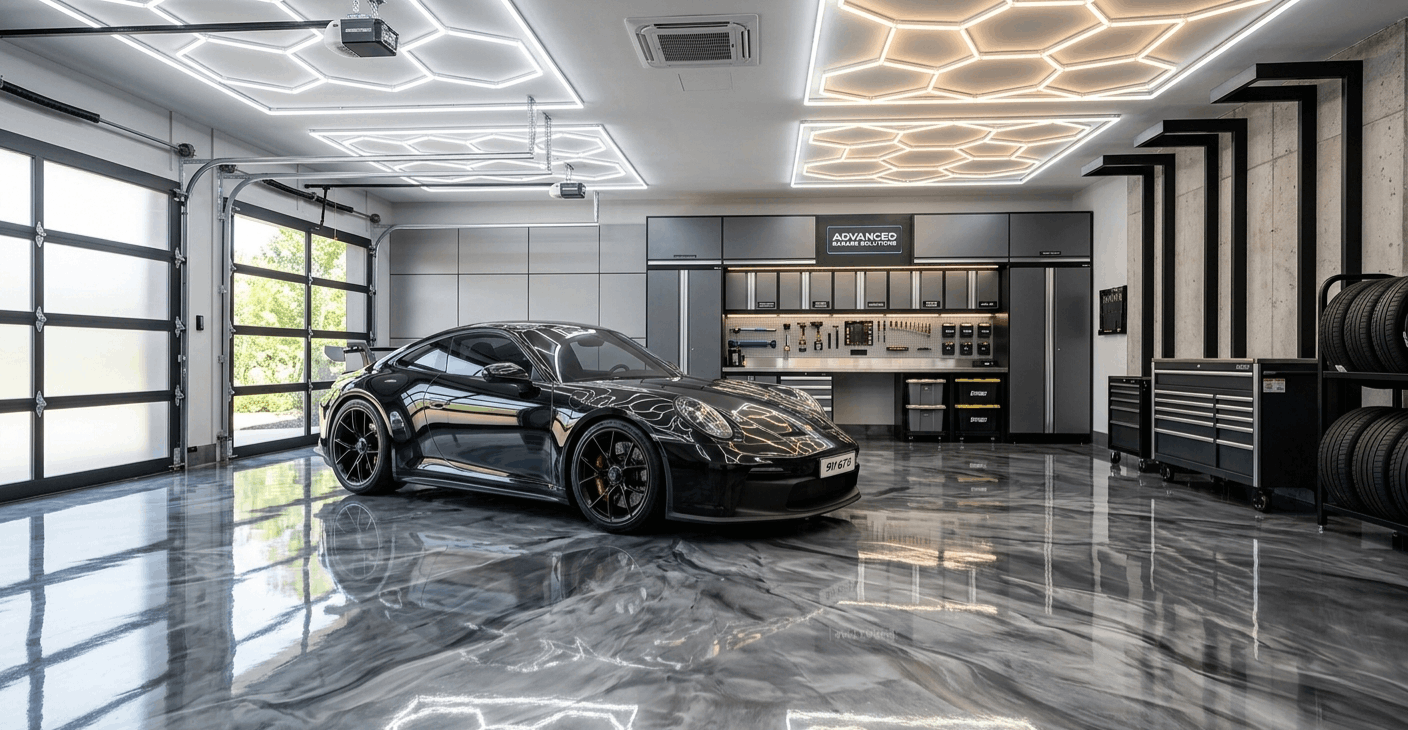
What Actually Destroys a Garage Floor Coating — And How to Prevent It
A metallic epoxy garage floor is subjected to a combination of stresses that exists almost nowhere else in a building. The first is thermal: a vehicle driven on a Saudi Arabian highway arrives with tire temperatures of 60–70°C. The moment the hot tire contacts the floor, it transfers heat into the coating. Standard floor paints and thin epoxy coatings — those sold as DIY garage floor kits — soften at these temperatures. As the car is later reversed out, the partially softened coating adheres to the hot rubber and peels away with it. This is called hot tire pickup, and it is the single most common failure mode for inadequate garage coatings.
The second stress is chemical. Engine oil, brake fluid, transmission fluid, and battery acid are all present in a working garage. Bare concrete is highly porous and absorbs these fluids permanently, leaving stains that cannot be cleaned out. Standard floor paints lack the chemical cross-link density to resist penetration from these fluids. True 100% solids epoxy, by contrast, forms such a dense polymer network that oil sits on the surface indefinitely without penetrating.
The third stress is mechanical: floor jacks, axle stands, rolling toolboxes, and the weight distribution of heavy SUVs. Standard concrete handles compressive loads well in spread-out distributions, but concentrated point loads — such as a steel floor jack wheel — are transmitted into any coating on top of it. A thin coating will crack or dent under these loads. A true build-up system, applied in multiple layers to a minimum of 3mm total thickness, distributes these loads through the depth of the coating before they reach the concrete.
How a Metallic Epoxy Garage Floor Defeats the Three Threats
Hot Tire Pickup Immunity — Aliphatic Topcoat Chemistry
The aliphatic polyurethane topcoat does not soften at tire contact temperatures (60–70°C) and does not chemically bond to rubber plasticizers. Move the vehicle without peeling the floor.
Motor Oil Pools on the Surface — Cannot Penetrate
100% solids non-porous resin. Engine oil, brake fluid, and transmission fluid sit on the surface. Wipe clean with a rag — zero residual staining in the substrate beneath.
Hose-Out Clean — No Grout to Scrub
A completely seamless surface from wall to drain. Power wash the entire garage floor and leave it spotless in minutes. No joint brushing, no chemical soak required.
Garage System Technical Data
| Property | Value |
|---|---|
| Compressive Strength | > 70 N/mm² |
| Hot Tire Resistance | Tested at 70°C tire contact |
| Chemical Resistance | Motor oil, brake fluid, antifreeze, battery acid |
| System Thickness | 2.5mm – 3.5mm (heavy prep substrates up to 5mm) |
| Slip Resistance | R10 (standard) / R12 (broadcast aggregate) |
| Topcoat Chemistry | Aliphatic polyurethane (anti-yellowing) |
| Full Cure for Vehicle Traffic | 7 days minimum |
Evaluating Garage Flooring Options Honestly
| Feature | ★ Our StandardMetallic Epoxy System | DIY Epoxy Paint Kit | Interlocking Rubber Tiles |
|---|---|---|---|
Hot Tire Resistance | Excellent — aliphatic topcoat | Poor — fails within months | Good — rubber does not bond to rubber |
Oil Penetration | Zero — 100% non-porous | High — thin coat stains | Liquid seeps beneath tiles |
Total Thickness | 3mm+ multi-layer system | 0.1–0.3mm (single coat) | 10mm+ but modular, not seamless |
Power Washable | Yes — seamless perimeter | Partially — peeling edges | No — water traps beneath tiles |
Installation Requirement | Diamond grinding + specialist | Acid etch + DIY | No prep — peel and stick |
The Garage Floor System Installation Process — In Full Technical Detail
Oil Contamination Removal and Surface Degreasing
The most common reason garage floor coatings fail is invisible oil contamination in the concrete. Even a garage that 'looks clean' can have years of oil deeply absorbed into the pores of the slab. Standard diamond grinding alone does not remove oil — it merely exposes and redistributes it. Our process begins with a proprietary alkaline degreaser applied across the entire floor and worked into the surface. After 30 minutes of dwell time, it is thoroughly rinsed. This process may be repeated 2–3 times on heavily contaminated slabs. Only once the surface is confirmed oil-free does grinding begin.
Diamond Grinding to CSP 3–4 Profile
Garage floors are some of the hardest and most contaminated substrates in any building. We use heavy three-phase planetary grinders — not lightweight handheld units — to cut through the hardened surface laitance and create a CSP (Concrete Surface Profile) of 3 to 4. At this profile, the surface texture is visibly rough with defined peaks and valleys. This aggressive profile is necessary to provide sufficient mechanical anchor for the primer in a high-stress environment like a garage. All grinding waste is captured by industrial HEPA vacuums to prevent recontamination of the prepared surface.
Moisture Mitigation Priming
Garages are frequently at or below grade, making them susceptible to vapor drive — the movement of water vapor upward from the ground through the slab. Standard epoxy primers fail when vapor pressure builds beneath them, causing osmotic blistering. We address this by testing the moisture vapor emission rate (MVER) of the slab using calcium chloride test kits. If the MVER exceeds the threshold for standard primers, a specialized moisture-mitigating epoxy primer is applied. This formulation chemically reacts with residual moisture in the slab, turning it into part of the adhesion mechanism rather than a failure point.
100% Solids Metallic Build Coat
The two-part metallic epoxy is combined and mixed in precise weight ratios — not volume — to ensure the hardener activates correctly across the entire batch. In garage environments, we typically apply a non-decorative grey intermediate build coat first to maximize thickness and fill surface voids, then apply the metallic design layer on top. This two-coat base approach increases the total system build and significantly improves long-term durability under vehicle loads.
Aliphatic Polyurethane Topcoat with Anti-Slip Aggregate
The final coat is the most critical for long-term performance. An aliphatic polyurethane is used — not a standard epoxy topcoat — because aliphatic chemistry resists both UV yellowing and the plasticizer attack from hot rubber. The topcoat is applied in two coats. Fine aluminum oxide anti-slip aggregate is broadcast into the first coat while wet, then sealed in by the second coat. The garage must remain empty for a minimum of 7 full days after the final topcoat. Vehicles driven at any point before this creates a permanent risk of hot tire pickup, which voids the warranty.
Garage Floor System — Technical Questions
The answer is 7 days minimum from the date the final topcoat is applied — with zero exceptions. The resin continues cross-linking chemically for the full week after application. Before 7 days, the polymer network has not fully hardened, and the hot rubber of a car tire will chemically bond to the partially-cured topcoat and peel it off when the car reverses out. This is the most common cause of garage floor failures and it is entirely preventable by waiting the full cure time.
Yes, after full cure (7 days). The compressive strength of the cured epoxy system exceeds that of the concrete beneath it. The floor jack itself will not crack or dent the surface. However, the narrow steel wheels of a floor jack can scratch the topcoat under heavy loads. We recommend placing a thin piece of plywood or rubber mat under the jack wheels to protect the surface finish. Axle stands can be placed directly on the floor.
No. The cured system is completely resistant to pressure washing at normal residential PSI ratings. Do not use high-pressure nozzles directly against the perimeter edges where the floor meets the wall — prolonged direct water jet impact at edges can eventually lift the very edge of the coating. A standard fan nozzle at 30cm distance is ideal for complete floor washing.
Diluted battery acid (sulfuric acid at the concentrations found in vehicle lead-acid batteries) will not immediately damage the floor. It should be rinsed with water immediately as a precaution. Extended pooling of battery acid at high concentration is the only scenario where the polyurethane topcoat may be affected over time.
Structural cracks in concrete — those that move, flex, or are actively widening — cannot be permanently covered by a rigid epoxy coating. The crack will reflect through the coating over time. The correct approach is to cut the crack wider (chase it), fill it with a flexible polyurea crack filler, allow it to cure, and then apply the epoxy system over the filled crack. The flexible fill accommodates any residual movement without transferring stress to the rigid epoxy above it.
A standard high-gloss finish is slippery when wet. For garages — which regularly see wet tyres, rain tracked in, and hosing — we always include an anti-slip broadcast aggregate in the topcoat. The aggregate provides meaningful grip without changing the visual impact of the metallic design, as the aggregate particles are below the threshold of normal viewing distance.
Protect Your Garage Floor Permanently
Contact us to arrange a substrate assessment. We will determine your slab's moisture level, oil contamination, and crack profile before specifying the correct system.